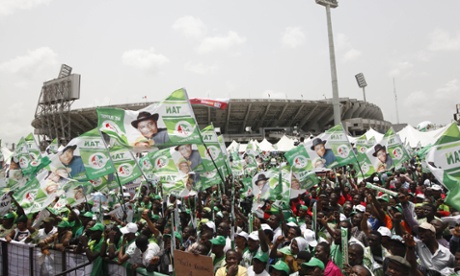
Nigeria is holding elections on Saturday after a six-week delay. Originally scheduled for 14 February, they were postponed at the last minute after the national security adviser warned the military needed more time to drive out Boko Haram, the radical Islamist insurgents, from the north-eastern states.
But some commentators, such as the author Chimamanda Ngozi Adichie, suspected that the ruling People’s Democratic party (PDP) was afraid of losing a close race and needed more time to improve its chances. The PDP had been losing ground in the ratings amid falling global oil prices, corruption scandals and an insurgency which left some 10,000 dead last year alone.
The background
This election in Africa’s most populous nation – of 179 million – is seen as its biggest political test since the end of military rule in 1999. Apart from tough economic conditions, the government has been battling Boko Haram, who gained international notoriety last year when they captured hundreds of schoolgirls from the town of Chibok – many of whom remain missing.
The government was criticised for its feeble response to the mass abduction and – until recently – for its toothless approach to Boko Haram, which has declared its allegiance to Islamic State. However, recent tangible battlefield gains by the Nigerian army and troops from Niger, Chad and Cameroon have allowed the president, Goodluck Jonathan, to claim victory.
Military successes
Besides the intervention of neighbouring countries, which had also suffered attacks and massacres by Boko Haram, analysts saw an improvement in Nigerian military performance with the use of senior officers to lead combat operations and special forces, and cooperation with local militias.
The involvement of foreign military contractors, many of them South African, may also have made a difference. However, analysts have cautioned that it is premature to declare Boko Haram a spent force as the fuel of its strength in the north-east – neglect and poverty – persist.
Fears remain about the safety of voters on polling day. There have been several suicide attacks in the north in recent weeks and Boko Haram’s leader, Abubakar Shekau, has threatened to disrupt voting.
The prospects
The PDP will be hoping that recent military gains will boost its electoral prospects, but these could be double-edged as questions remain as to why it took so long to turn the tide against Boko Haram.
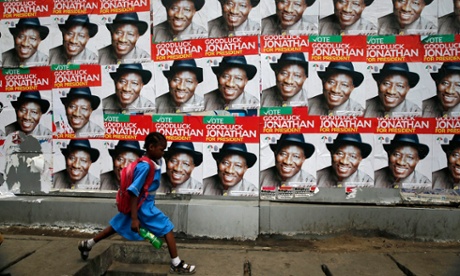
Observers in the capital Abuja say the race remains tight and recent polls show Jonathan losing ground. The opposition, however, has run out of money. Posters of the president are on every billboard and every lamppost while Muhammadu Buhari, his chief rival, is almost invisible.
Meanwhile, considerable unease surrounds the vote. Nigerian elections have been plagued by violence in the past – the 2007 vote was condemned as the most violent, with more than 800 deaths .
If the vote is close, marred or followed by widespread violence, analysts fear it would deepen Nigeria’s ethnic, religious and regional divides. Since gaining independence from Britain in 1960, Nigeria has never had a change of government via the ballot box, so victory for the opposition would be a seminal moment for African politics.
The candidates
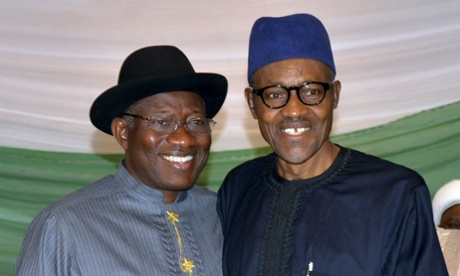
The race pits Jonathan, sometimes described as the accidental president, and Buhari, the ex-military dictator who heads the All Progressives Congress (APC), who is standing as the “candidate of change” in his fourth run for the presidency.
Goodluck Jonathan
The 57-year-old former zoology professor is seeking a second four-year term after succeeding Umaru Musa Yar’Adua, a Muslim northerner who died in 2009, midway through his term.
He is presented by his party as a well-educated, Christian man from modest beginnings, a perception which contributed immensely to his popularity in Nigeria’s 2011 general elections, during which he garnered a staggering 22 million votes.
In his own words: “They [Boko Haram] are getting weaker and weaker by the day and I am very hopeful that it will not take us more than a month to recover all the territories that have been in their hands.”
Muhammadu Buhari
The 73-year-old retired military ruler heads the APC, a mish-mash of opposition parties that came together in 2013 sensing an opportunity to defeat a vulnerable PDP.
The founding parties were largely regional groups, but the APC has drawn defectors from the powerful ruling party too. Its core support is in the Muslim-majority north and in Lagos, the engine of Africa’s biggest economy.
In his own words: “Nigeria in my experience has never been so divided, so polarised by an unthinking government hell-bent on ruling and stealing forever whatever befalls the country. We in APC are resolved to bring change to Nigeria. We plan to do things differently.”
The mechanics
In the first round, a candidate must win more than 50% of the vote, as well as more than 25% of the vote in two-thirds of the 36 states.
If no candidate wins by those margins, a runoff takes place two weeks later. If those margins still are not achieved, a third round is held a week later, winnable by a simple majority.
All states will hold presidential, federal parliament and houses of assembly (state parliaments) elections. Gubernatorial polls will be held in 29 states. If there is a close vote and if voting is disrupted in the north-east, the APC is likely to challenge the results in the courts.
Nigeria’s police chief has banned all vehicles from the roads during elections on Saturday to “ensure adequate security”. Cars will not be allowed on the road from 8am – when polling stations open – until 5pm.