WASHINGTON — President Joe Biden’s meeting with Israel’s new prime minister would be a milestone event under almost any other circumstances, with the future of a key alliance and policies toward Iran’s nuclear program hanging in the balance.
But on Friday, the Oval Office encounter was overshadowed by Thursday’s terrorist attack in Kabul, which killed dozens of Afghan civilians and 13 U.S. service members who were providing security for the evacuation effort there.
“The mission there being performed is dangerous and has now come with significant loss of American personnel, but it’s a worthy mission because they continue to evacuate folks out of that region, out of the airport,” Biden told reporters.
More than 12,000 people were flown out in the last 24 hours, he said. That’s a slower pace than before the strike, which the Pentagon said involved one bomb and gunmen at an airport gate. The Pentagon said its earlier report of a second bomb at a nearby hotel was incorrect.
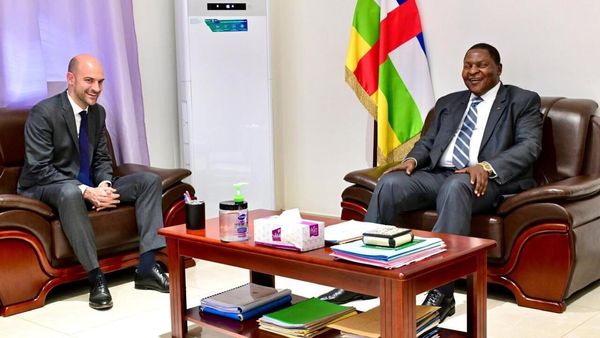
The attack by Islamic State terrorists prompted Biden to delay his meeting with Naftali Bennett, who recently replaced Benjamin Netanyahu as Israel’s prime minister, by a day.
Bennett is the right-wing leader of a highly fragmented coalition government that banded together to oust Netanyahu, Israel’s longest serving prime minister.
Bennett and Biden have never met — a sign of Bennett’s status as a relative political novice, given that Biden has spent decades crisscrossing between world capitals.
The two leaders seem to share no political positions and will likely remain at odds over whether to rejuvenate the nuclear agreement with Iran. Biden wants it back, while Bennett cheered former President Donald Trump’s decision to withdraw.
“The main issue we’re going to be talking about today here is Iran’s race to a nuclear weapon,” Bennett told reporters during a break in his private meeting with Biden.
“We talked about it inside the room,” he said. “I was happy to hear your clear words, that Iran will never be able to have a nuclear weapon, and you emphasized that we will try the diplomatic way but that there’s other options that will work out.“
Biden said he would try first to revive the 2015 pact between Iran and other nations. “We’re putting diplomacy first and seeing where that takes us,” he said. “But if diplomacy fails, we’re ready to turn to other options.”
Bennett and Biden are both looking for an opportunity to normalize U.S.-Israeli relations after several years in which Israel has increasingly become a partisan issue in American politics. Republicans have tied themselves to Israel’s ruling right wing, a shift accelerated by Trump and Netanyahu, while Democrats have grown disenchanted with Israel’s indifference to the Palestinians, who remain under occupation.
“One thing that both of them care the most about is getting over this rancor in the relationship in the past few years and the polarization beyond that,” said Ilan Goldenberg, a Middle East expert at the Center for a New American Security, a Washington think tank, who has also advised the Biden team.
Michael Doran, a senior fellow at the Hudson Institute, a conservative think tank in Washington, said that “they have a shared interest at the moment in the appearance of very productive and cordial relations.”
Both sides are already taking steps in that direction. Biden called Bennett to congratulate him hours after he became prime minister in June, and a senior administration official gushed over the “truly remarkable” government that Bennett represents, describing it as a “big tent” that shows “people of divergent views can come together to solve big problems.”
Bennett had sounded hopeful before taking off from Israel, saying “there’s a new government in the U.S. and a new government in Israel, and I bring with me from Jerusalem a new spirit of cooperation, and this rests on the special and long relationship between the two countries.”
U.S.-Israeli ties have always been strong, but the relations among leaders have ebbed and flowed.
President Barack Obama and Netanyahu — who served as prime minister from 2009 to June of this year, and from 1996 to 1999 before that — did not like each other. Netanyahu dealt the ultimate diss when he traveled to Washington to speak before the U.S. Congress, with no formal notification to the White House, and then used the occasion to attack the Iran nuclear deal Obama was negotiating.
Under Trump, Israel without question found its staunchest U.S. ally ever. But critics said that relationship was built more on personal ties among Trump, and his family, and Netanyahu — not on the legal principles that had long governed U.S. dealings with Israel and the Palestinian territories, which the former president did his best to sideline and punish.
Ideologically, Bennett is probably closer to Trump. He embraces some of the Israeli right’s most radical positions, rejecting the creation of a Palestinian state and annexing much of the West Bank claimed by Palestinians to become part of Israel.
But he also recognizes the way the excessiveness of the Trump years damaged the bipartisan support for Israel that the nation has enjoyed for decades. And given his politically precarious status as the leader of a fragile parliamentary coalition, Bennett wants to demonstrate that he can deliver a strong relationship with his country’s most important ally.
Even though the Biden administration has sought to revive the Palestinian role in the conflict and peace talks to resolve it, these issues were not likely to be a priority for Biden and Bennett in their meeting. The Israeli was reported to be carrying a new series of recommendations for dealing with Iran.
While the two leaders differ sharply on Iran, Biden may be content to have an Israeli prime minister who appears easier to deal with.
Susie Gelman, executive board chair of the Israel Policy Forum, a U.S.-based advocacy group, said what Bennett brings to the Oval Office is “a new face.” She said Bennett, the son of a Berkeley, California, couple who immigrated to Israel, is unlikely to bring dramatic proposals for the Palestinian conflict, nor a willingness to budge on Iran, but he will try to build a “personal, more positive relationship."
“He can be very charming,” she said.