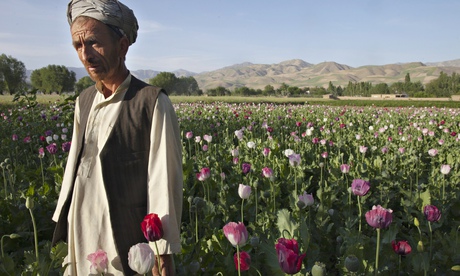
The opium crop in Afghanistan will hit a new high this year, the United Nations has said, presenting a challenge to the country in tackling the trade that fuels the Taliban-led insurgency.
Opium cultivation has risen 7% year-on-year to 224,000 hectares, and production in 2014 may reach 6,400 tons – a 17% increase – according to a report by the UN Office on Drugs and Crime (UNODC).
Afghanistan’s southern provinces, which have been disproportionately affected by the recent surge in violence, continued to drive overall production, with a 27% increase in yields.
In Helmand province, where the British forces operated and the UK government spearheaded eradication efforts, opium cultivation appeared to have stabilised. Nevertheless, it still remained the country’s top opium-cultivating province. .
The money from opium production finances Taliban operations, and also serves as a major source of systemic corruption in the Afghan government.
Across the country, governor-led eradication decreased 63%, while the number of fatalities during the campaign fell from 143 in 2013 to 13 in 2014.
The figures showed counter-narcotics efforts had failed, Jean-Luc Lemahieu, director for policy analysis and public affairs at the UNODC, said, but there was hope for success under the new government.
“[Changing] the economic incentives away from the illicit economy to the licit economy, now that’s a hell of a task, but that’s exactly what indeed this new government seems to stand for,” he said.
President Ashraf Ghani was inaugurated in late September, following months of tension following the disputed election. The political wrangling accelerated a sharp economic downturn caused by the withdrawal of foreign troops.
“For him the criminalisation of the economics and politics of Afghanistan is one of the main problems, it penetrates everything and anything he wants to achieve,” Lemahieu said.
A recent report by the US watchdog found that the opium economy directly employees 411,000 Afghans with real jobs – more than the fledgling Afghan national security forces. The poppy industry still makes up 4% of Afghanistan’s estimated GDP.
Ghani has a comprehensive plan to tackle the drug problem, Lemahieu said, including creating incentives for farmers to plant alternative crops and prosecuting smugglers.
The president, who wrote a book on how to fix failed states, has said the key to opium eradication is jobs. He has also suggested cotton could replace opium if the west scrapped tariffs on Afghan textiles.
The failure of the eradication campaigns has inspired Afghanistan experts, such as the former UK ambassador to Afghanistan Sir William Patey, to come out endorsing legalisation of the drug.
“If we cannot deal effectively with supply, then the only alternative would seem to be to try to limit the demand for illicit drugs by making a supply of them available from a legally regulated market,” he said earlier this year.
The US has spent $7.6bn (£4.8bn) on counter-narcotics efforts in Afghanistan since ousting the Taliban in 2001, according to the US government watchdog for reconstruction, and ending Afghanistan’s illicit drug trade was listed as one of the reasons for deploying British troops to Afghanistan.