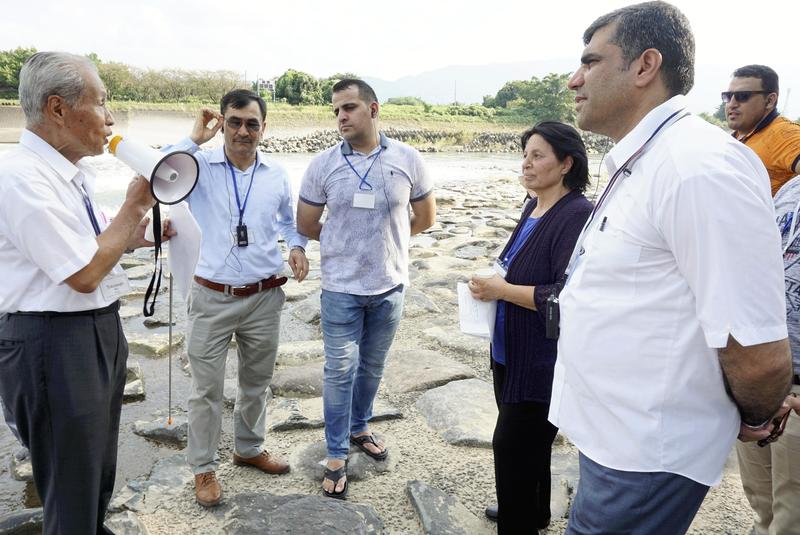
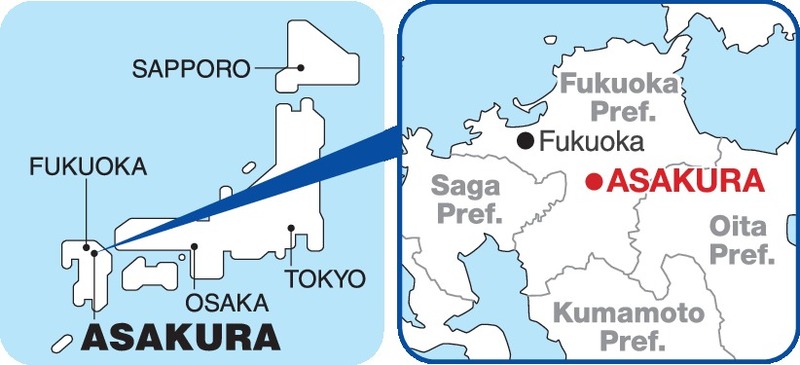
ASAKURA, Fukuoka -- A group of Afghan government officials visited the Yamadazeki weir in Asakura, Fukuoka Prefecture, earlier this month as part of a project to build an intake dam modeled on the weir. They studied the history and structure of the weir, which has been in use since the Edo period (1603-1867).
The Japan International Cooperation Agency organized the inspection tour as part of its efforts to promote the wider use of irrigation technologies.
Senior Afghan ministry and agency officials in agriculture and other fields visited Japan together with members of the Peace Japan Medical Services (PMS), an Afghanistan-based nongovernmental organization backed by the Fukuoka-based nonprofit organization Peshawar-kai.
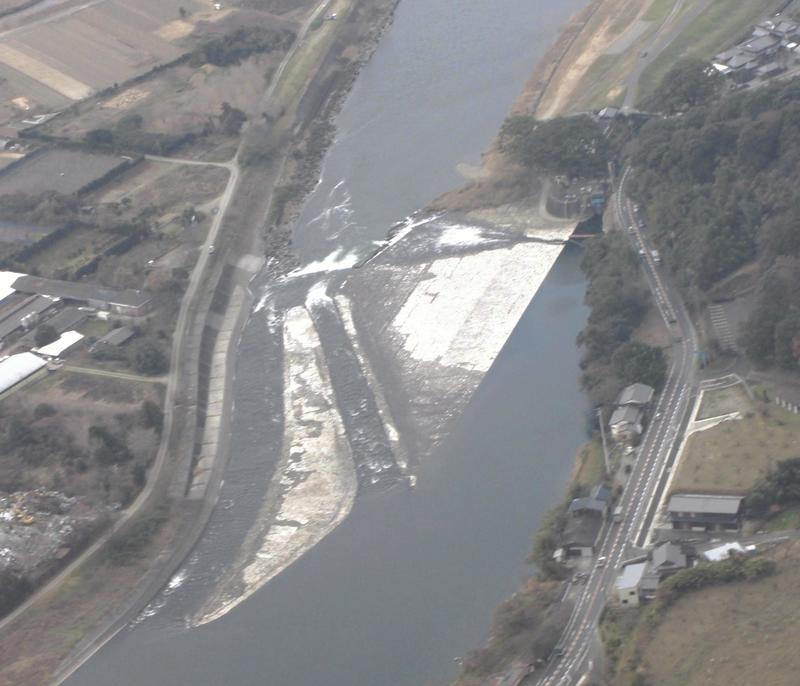
According to a local group working to improve and maintain the weir, the system dates to the Edo period and still delivers water from the Chikugogawa river to farmland in the area through the Horikawa Yosui canal and a triple waterwheel -- both nationally designated historic sites.
"Our ancestors undertook the difficult construction work for their children and grandchildren," said Tetsuya Tokunaga, the head of the group, during the tour.
He also showed the participants how to use a foot-operated threshing machine that was used in the region during the Showa era (1926-1989).
The Yamadazeki weir method was first introduced to Afghanistan by PMS.
The original weir, completed in 1790, consists of stones piled diagonally across the 85-meter-wide river, so that water is gradually diverted into the irrigation canal as the current eases.
The system functions both in summer, when the water level decreases, and winter when it is high. It is being adopted in Afghanistan because it is well-suited to the country's fast-moving rivers and climate.
PMS is also introducing gabions, or wire cages filled with stones, to reinforce the banks of the canal. The gabions are filled with willows, making them stronger as the plant's roots become entangled with the stones.
The Afghanistan canal was begun in the east of the country in 2003 and is now 27 kilometers long. It has revived farmland and brought 150,000 people back to the region.
In 2016, the U.N. Food and Agriculture Organization began a project to expand the Yamadazeki weir system across Afghanistan in cooperation with Tetsu Nakamura, who heads PMS and led the recent tour.
"I think the participants got a sense that they could actually ensure productivity if they can devise certain methods and make steady efforts," he said.
Read more from The Japan News at https://japannews.yomiuri.co.jp/