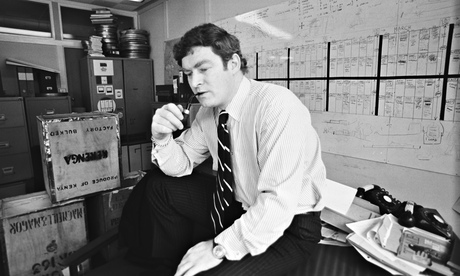
The producer Adrian Malone, who has died aged 78, wanted to make a history of science for television with the best talent he could find. The spur to do so came from seeing what Michael Gill’s series Civilisation (1969), presented by Kenneth Clark, had done for the story of art.
Adrian suggested that we work on it together, but we could not then interest our BBC2 masters in the idea. Our proposals lacked cohesion, so Adrian turned to Jacob Bronowski, a polymath already familiar to broadcasting audiences, to write and present the 13-part series. It took all Adrian’s persuasiveness to overcome the reservations of various BBC and scientific establishment figures and get the idea accepted.
For The Ascent of Man, Adrian recruited a production team he could trust. The story was to be told ambitiously, inventing new techniques as necessary. As if to prove that nothing was impossible, he persuaded his team to ride on horseback across the mountains of Iran with the nomadic Bakhtiari tribes for the second programme. We visited the Arctic, the jungles of Amazonia, Easter Island and Afghanistan in pursuit of Bronowski’s story. Pursuing authenticity, Bronowski and the team were admitted to the secret archives of the Vatican, and to the extermination camp of Auschwitz.
In April 1973, the series was successfully previewed at the Royal Society’s headquarters. Today, DVDs are still on sale, Bronowski’s companion book is still in print, and Adrian’s vision has proved to have enduring value.
We wanted to repeat that success with the dismal science, economics. Employing his usual chutzpah, Adrian rang up a possible author/presenter, John Kenneth Galbraith. The BBC hierarchy were (rightly) furious that an offer had been made without the proper authority, but grudgingly agreed to another huge series, and much the same production team reassembled. The technical skill was still evident in The Age of Uncertainty, and Galbraith’s writing was both witty and profound, but when the series was shown in 1977 it was not a success. The Conservative party attacked Galbraith’s opinions, demanding equal television time to put their view, and later the mandarins of the BBC ordered that the Galbraith series was never to be repeated.
Times had changed at the BBC. Sir Huw Wheldon, the managing director of BBC television and one of Adrian’s supporters, was unexpectedly passed over for the post of director general.
Adrian left the BBC and went to Philadelphia, to teach the history of science at the University of Pennsylvania, but after a few months the US co-producers of the Galbraith series, KCET Los Angeles, enlisted him to produce a series on astronomy and space, to be hosted by the charismatic Carl Sagan. Although Sagan frequently clashed with Adrian on creative issues, Cosmos became a huge broadcasting success in 1980.
Adrian was born in Liverpool to Philip and Mary. They were immigrants from Ireland, and ran a fish and chip shop in Bootle. Always a rebel, Adrian quit his Jesuit school and did not go to university. But his reading was deep and wide and his knowledge of history, philosophy, music and art became prodigious. Later he would add an intimate knowledge of science, which fascinated him throughout his life. In 1961 he met Thomasina (Ina) Henry at a party on Tyneside and they married. Adrian was now at Border Television, learning the skills he would use more ambitiously at the BBC and afterwards.
Perhaps Adrian’s defining characteristic was courage: no challenge daunted him, and in 1968 he decided to confront the British defence establishment by making his exposé of chemical warfare, A Plague on Your Children. It earned him applause from the peace movement, but the undying suspicion of conventional authority.
Although he had been recruited by BBV TV’s science department, Adrian widened his scope. He read Bronowski’s book on William Blake, and he and Bronowski then made a vivid film together on the poet and artist, followed by another, even more ambitious, on Leonardo da Vinci. This paved the way for the big BBC series, and then for Cosmos.
The series with Sagan took Adrian to California. However, the next opportunity came back on the east coast, managing a series of films for the Smithsonian Institution in Washington. This was followed by a series on tribal life, Millennium: Tribal Wisdom and the Modern World (1992).
Diabetes and heart problems compelled Adrian to cut back on work commitments. He and Ina moved back to Tyneside. During retirement, from the mid-1990s, Adrian devoted his leisure to meticulous woodwork, making racks for his wine, and toy villages and doll’s houses for his grandchildren.
Ina died in 2010, and Adrian is survived by his children, David, James and Adrienne.
• Adrian Hugh Malone, television producer, born 3 February 1937; died 13 March 2015