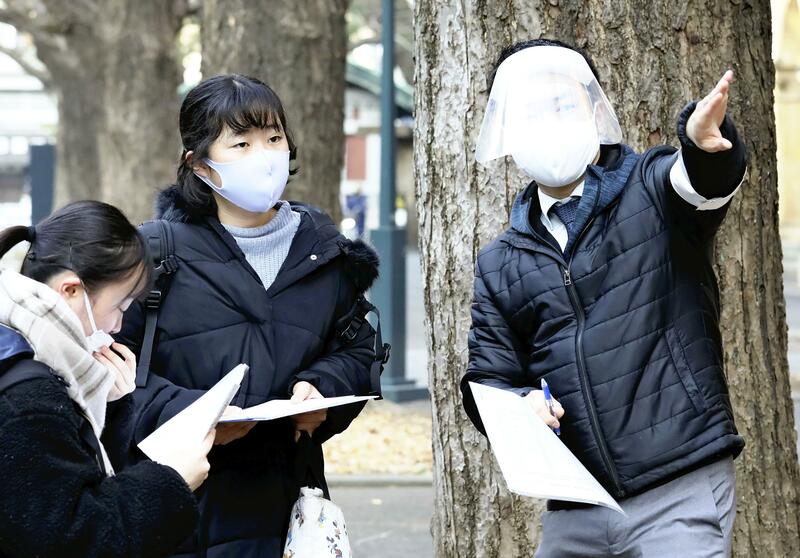
As the nation's largest university entrance exam started on Saturday, taken by about half a million students nationwide, administrators have faced the major challenge of striving to prevent infections and ensure strict fairness.
An official overseeing the Common Test for University Admissions at a private university in Kanagawa Prefecture said Saturday, "There was an unprecedented number of students who asked to take a makeup exam, but we're relieved that we were able to get through it."
Usually only about one student requests to take a later makeup exam on the day of the test, according to the official. However, on Saturday, about 10 students requested to do so, due to fever or other reasons.
In consideration of students whose health deteriorated during the exams, the National Center for University Entrance Examinations, which operates the test, changed its guidelines to allow students to take makeup exams on a subject-by-subject basis. Previously, all the subjects on a particular day test day had to be taken at once.
The center also called on students to take advantage of the makeup exams, urging applicants, "Don't force yourself to come in."
Changes were made until the last minute regarding infection control in the exam's administration. On Jan. 8, students were newly allowed to apply for a makeup exam even without a medical certificate if they had been asked to stay at home.
An official of a private university in Tokyo said: "We received a series of new infection control measures from the center. I'm not sure if we'll be able to hold the exams without any problems."
-- Individual cancellations
A senior official of the Education, Culture, Sports, Science and Technology Ministry insisted that the common test "will be held as scheduled unless there is a nationwide curfew or similar situation."
The common test can be taken at a venue close to the applicant's residence. The risk of infection is therefore lower than with the entrance exams specific to individual universities, which attract many students from all over Japan. Even if the infection situation worsens and university-specific entrance exams cannot be held, students can be screened based on the results of the common test, which acts as a safety net.
It was also significant that an expert from a government panel said last October that "unlike other events, there is no conversation involved in entrance exams, and the risk of infection is low."
Some universities have already decided to forgo their own entrance exams. On Jan. 8, the Sanyo-Onoda City University in Yamaguchi Prefecture announced that it would screen students based on their scores on the common test.
Yokohama National University has also decided not to give an academic test in the second round of entrance exams. It will screen students based on their scores on the common test and other factors.
-- Relying on self-reports
In implementing the common test, the education ministry took great care to avoid close contact between people and to ensure fairness by conducting the test under the same conditions nationwide.
For example, the ministry decided that no temperature check would be conducted at entrances, even at universities that have thermography or non-contact thermometers to measure body temperature. Since hundreds to thousands of students gather at each venue, the ministry took into consideration concerns about creating dense lines during temperature checks, and the fact that the results may vary depending on air temperature during the cold season.
As a result, temperature checks had to rely on self-reporting by the exam takers. Several private universities that had removed the thermography equipment normally installed on their campuses voiced their concerns about this. "It would be safer to check their temperature," a university official said.
At a press conference on Jan. 12, education minister Koichi Hagiuda said, "We want to trust the students who take the exams."
A measure has been established to allow students who have been recognized as being in close contact with an infected person to take the common test if they meet certain requirements, such as being asymptomatic. One requirement is a negative result on a PCR test, but a certificate is not required, and the ministry also trusts the self-reports of exam takers in this regard.
Read more from The Japan News at https://japannews.yomiuri.co.jp/