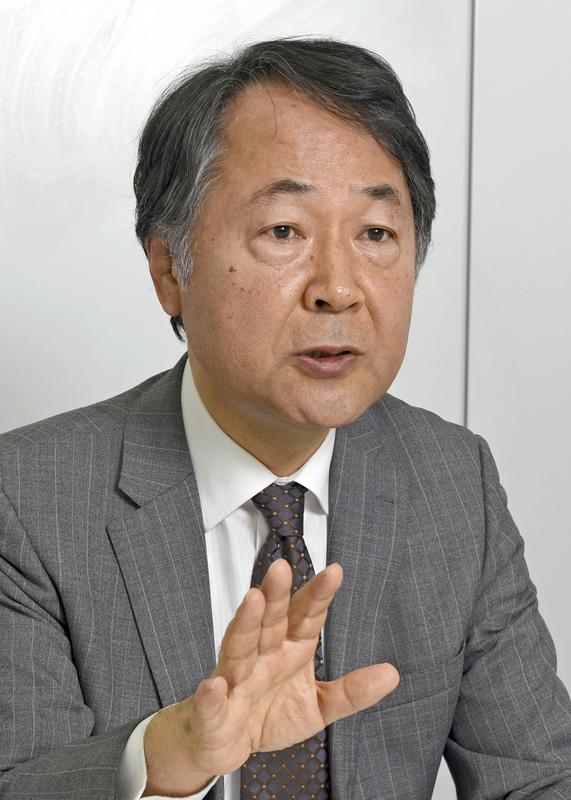
Teachers at public elementary and junior high schools who sustain world-class academic abilities at the compulsory education level are facing the threat of karoshi, or death from overwork due to prolonged hours. The Yomiuri Shimbun asked Masahito Ogawa, chair of a subdivision of the Education, Culture, Sports, Science and Technology Ministry's Central Council for Education -- which has discussed teachers' work style reforms and proposed capping their work hours -- about where the reforms are headed, including a review of legal systems. The following are excerpts from the interview.
==
The Yomiuri Shimbun: The subdivision's interim report released at the end of last year described teachers' actual working hours as "unlimited and unfixed."
Ogawa: The survey in the 2016 academic year on teachers' actual work situations revealed abnormal conditions whereby even the average monthly overtime work of teachers is surpassing the karoshi line (see below). The situation at that rate was serious and shocking, beyond what we expected.
As if parallel to these results, for the past 10 years the number of teachers taking sick leave due to psychological problems has remained high, at around 5,000 each year. In almost the same period that the number of patients with mental illnesses nationwide has increased 1.58 times, the number of teachers taking sick leave due to psychological problems has increased 2.84 times. The impact of prolonged work is undeniable.
Q: Some say the rise in clerical and other noneducational work is a cause of prolonged work.
A: There is a great amount of peripheral work, but teachers' time spent on "primary duties" is going up. For in-school work on weekdays, compared to the last survey in the 2006 academic year, time spent on jobs such as classes and classroom management came to about 21 hours longer per month at elementary schools, and about 26 hours longer at junior high schools. Sixty or 70 percent of that increase is teachers' primary work, such as classes, class preparation and study guidance.
This is said to be the result of the increase in class time caused by the 2008 revised teaching guidelines, an enhancing of small-group teaching to meet individual students' needs, classes on Saturdays, integrated elementary and junior high education, supplementary lessons, and other factors.
Q: From the 2020 academic year, new teaching guidelines that emphasize deep learning, which is both independent and interactive, will start being gradually implemented, and English will become a subject at elementary schools, meaning teaching hours will further increase.
A: These are necessary reforms, but it means more thorough teaching will be required, along with the research and training to do it. So there is a fear that prolonged work will become even more severe.
Japanese-style education aims not only to give educational guidance, but also shape students' characters in every aspect of their lives. This should be preserved, but teachers in Japan are spending more than 60 percent of their legally designated work hours on jobs outside the classroom. The fact that the range of jobs that teachers take on is unlimited and ambiguous is the primary factor behind their prolonged work. Unless we quickly rethink the current situation, not only will the objectives of the teaching guidelines be unattainable, but the future of school education will be in jeopardy.
Q: In the interim report, aside from a proposal to cap working hours, jobs that should be handled by the school and teachers are classified separately from the jobs that should not.
A: We sought their separation from the perspective of "What work should teachers prioritize?" to reduce overtime work among a limited number of staff, and sought to bring in staff from outside. Unless we reduce the huge amount of work, "unpaid overtime" will linger -- despite undertaking overhauls on working hour caps and legal systems -- and the actual situation won't change.
Q: Meanwhile, the interim report does not give the impression of strongly seeking an increase in the number of teachers.
A: Looking at the situation in schools, there are not enough teachers, and they are overloaded, burdened by their primary jobs alone. I believe we should increase the quota of teachers and create an environment in which they can give careful attention to children. But considering the severe fiscal circumstances, the education authorities are having a hard time placing such sound logic at the core.
Ideal time management
Q: Until now, there have been many schools that were not even aware of their teachers' actual working hours. There are some that say due to the special measures law on salaries of teachers at compulsory education schools (see below) -- in which an allowance is uniformly paid while overtime money is not -- awareness of work hours has become loose.
A: The law was established because teachers' jobs extend to educational activities inside and outside school, and their time management is difficult compared to ordinary civil servants. Normally, the principal is supposed to assign work appropriately and does not, in principle, order them to do overtime work. There are only four items for which they can order [overtime].
However, schools nowadays are so busy that simply assigning work like before cannot cover everything. For example, there is a lot of work besides the four items, such as home and community support -- which, because it is not considered formal overtime work, is interpreted as "teachers' voluntary acts." This is quite different from reality.
The allowance paid in lieu of compensation for overtime work is about 150 billion yen, national and local governments combined. Supposing compensation was paid in line with the total current overtime work hours, there is a trial calculation that puts the total at about 3 trillion yen. It can be said that modern school education rests on an enormous foundation of "work with no pay."
Q: What do you think is a good course of action for revising the law?
A: The main question is, how do we catch the amount of overtime work for jobs considered "voluntary acts," and how can it be restrained? On top of that, we should consider whether to compensate the amount of overtime work with money, or through the acquisition of paid holidays. First, I think the law should be revised to give the responsibility of managing teachers' work hours to the principals and have them manage the hours adequately, including capping overtime work.
Regarding overtime work, a fixed proportion should be handled through teaching adjustments, including increasing the allowance. For any further portions, it is worth considering providing paid holidays to protect teachers from any impact to their health due to overwork. I certainly hope to deepen the discussion in future meetings of the ministry's Central Council for Education.
(This interview was conducted by Yomiuri Shimbun Senior Writer Natsuki Komatsu.)
(From The Yomiuri Shimbun, Jan. 16, 2018)
--Masahito Ogawa / The chair of a subdivision of the Education, Culture, Sports, Science and Technology Ministry's Central Council for Education
Ogawa is a professor at the Open University of Japan and an emeritus professor at the University of Tokyo, specializing in educational administration studies. He serves as vice chair of the Central Council for Education, and the chair of its elementary and secondary education subdivision. He has written books including "Nihon no Kyoiku Kaikaku" (Japan's educational reform).
--Karoshi line
A critical point for determining death from overwork set by the Health, Labor and Welfare Ministry. It serves as a standard for acknowledging cerebral and cardiac work-related diseases. There have been cases recognized in which overtime was "100 hours in a month prior to symptoms appearing" and "over 80 hours per month in the two to six months prior to symptoms appearing."
--The special measures law on salaries of teachers at compulsory education schools
A law enforced in 1972 stipulating that teachers, in principle, cannot be ordered to do overtime work. If they are ordered to do overtime work, it is limited to four work items: laboratory teaching for students; school events; teacher meetings; and work at times of emergencies and disasters. Overtime allowance is not paid to teachers; instead}, money worth 4 percent of their base pay is included} in salaries as "teaching adjustments."
Read more from The Japan News at https://japannews.yomiuri.co.jp/