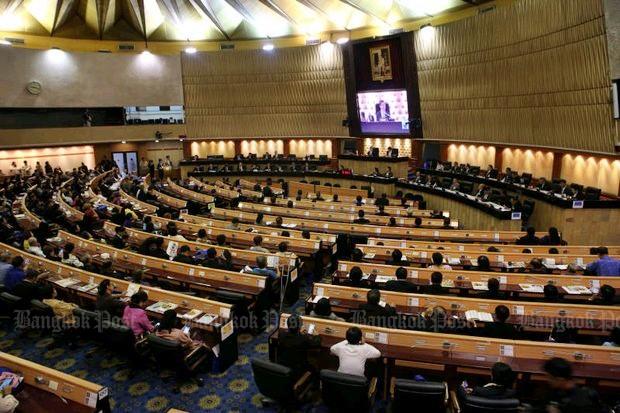
The draft amendment to the Anti-Dumping and Countervailing (ADC) Act that adds new chapters regarding anti-circumvention penalties has received National Legislative Assembly (NLA) vetting, with enforcement expected by the end of this year.
Adul Chotinisakorn, director-general of Foreign Trade Department, said the NLA passed the second and third reading of the draft amendment to the ADC Act, adding 22 chapters regarding anti-circumvention practices.
Circumvention is any activity designed to avoid the payment of anti-dumping or countervailing duties imposed on a particular product made in and/or exported from other countries.
Circumvention of anti-dumping and countervailing duties has long harmed domestic industries, as there are no penalties under the current act.
The amendment would empower the ADC Board to carry out investigations into suspected circumvention and impose anti-circumvention duties in response.
If circumvention is found to be taking place, the anti-dumping or countervailing duties imposed in the original investigation will be extended to the product from the circumventing third country, to the parts/components of the product, or to the slightly modified product, depending on the individual case.
The Commerce Ministry has received complaints from domestic industries that many foreign manufacturers and exporters to Thailand have been circumventing anti-dumping or countervailing duties by various means.
Thailand has imposed anti-dumping and countervailing duties in 13 cases, mostly concerning steel products and citric acid.
Kriangkrai Tiannukul, vice-chairman of the Federation of Thai Industries (FTI), said business operators agree with the NLA's moves on anti-circumvention because the measures can protect local steel producers and shield against the impact of the US-China trade row.
"With the trade war happening, local steel operators are concerned about Chinese steel products being dumped in Thailand and Southeast Asia as [China] seeks other markets to offset declining steel exports to the US after tariffs were imposed," Mr Kriangkrai said.
He said electronics and steel are the two main industries suffering from the trade war because China is a large competitor in those sectors.