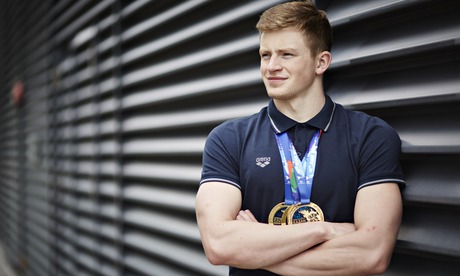
“It’s a false ideology, really,” Adam Peaty says coolly, his three world championship gold medals clinking around his neck, as he considers one of the most cliched and overheated words in sport: pressure. Peaty, who has just returned from Russia, where he was the dominant male swimmer while winning the 50m and 100m breaststroke world titles and then helping power GB to gold in the mixed medley, appears not to understand the concept of pressure.
“People make the mistake of thinking they’ve got to perform just because someone has said something about their potential,” the 20 year-old says. “They might feel there is pressure for them, financially, to be successful. But I feel no pressure. I enjoy racing because I want to do it. No one’s forcing me. What’s the worst that could happen? You’re going to come second or lose? It’s not like someone has got a gun to your head.”
Peaty smiles nonchalantly. “Just because someone says I could become Olympic champion next year doesn’t mean I’m going to get ahead of myself. I am only this successful because I’m so good at grounding myself. Once I’m back in the training regime it’s brutal and I am going to get better every day – so that no one can get near me.”
It sounds like the blissful innocence of a young champion, the untainted purity of a swimmer yet to be battered by real life and the harsh vagaries of elite sport. Peaty holds two world records alongside the three gold medals which still give him such pleasure that he keeps them dangling from his neck throughout our interview. He can be free, for now, from the “pressure” that might otherwise trail him as a clear favourite for the 100m breaststroke Olympic title.
Yet Peaty is also more complex, and interesting, than this initially uncomplicated assurance suggests. Just as he is so open in dismissing external distractions, he is also candid in expressing his inner doubts. He makes an intriguing distinction between ‘pressure’ and ‘doubt’ – and becomes quietly animated when I introduce the subject.
“This is the first time after the worlds that someone has asked me about doubt and it’s a really important question. It’s played a massive part in my rise. At the training camp before the worlds there was so much doubt in my head. Even the night before my first heat I was saying to myself: ‘I can’t do this.’ I wouldn’t say I was a complete mess but I was down on myself a lot. It’s going to be like that for the Olympics. I will get down on myself. But my coach Mel Marshall helps me. She reassured me before the worlds and it all came together.”
Was his doubt at its most acute the night before racing began? “It went on much longer. Weeks before, months even. It lasts a long time. But you can’t be a victim of it. When you become a victim of it the mind goes. So once I start making excuses or I hear myself asking: ‘What am I doing here?’ I stop myself. I realise it’s one of the great opportunities of my life. Slowly the doubt goes and I start to become who I am.
“Mel knows what I’m like. When I go through taper, and my body starts resting, I become quiet. I don’t like talking and I can’t listen well. My brain doesn’t concentrate very well and she knows I’m ready to race. It’s just your body preparing yourself. As soon as that first race starts it all changes. You enjoy it and believe again.”
Peaty is precise about the moment that belief finally surged inside him. Fifteen months ago he was just another swimmer hoping to qualify for the Commonwealth Games. He achieved his goal and, in the 100m breaststroke final in Glasgow, he finally swam against Cameron van der Burgh, the 2012 Olympic champion from South Africa.
“I’d never even swum once before against Cameron,” Peaty says, sounding amazed all over again. “It would definitely be right to call him my idol then. He was Olympic champion and the world record holder. So it was an honour to race him, to be near him really. It was a little intimidating but I had nothing to lose. I just swam my heart out and came away with gold.
“Beating Cameron in the Commonwealth final was a turning point – as was the time I posted, 58.9. It gave me so much more confidence, knowing I could take down the Olympic champion and post one of the leading times in the world. I carried that into the European championships and capitalised with four golds.”
Peaty smashed the world record for the 100m at the British trials earlier this year. He not only obliterated Van der Burgh’s record by half a second but he became the first man to dip under 58 seconds for the event. “When I touched the wall, I thought: ‘That was pretty fast.’ I thought it might be a world record at 58.3. I never thought it was a 57.9. I just looked at the board and thought it was wrong. No one in history had ever gone under 58 seconds for the 100m breaststroke. But last week I wanted to win the gold medals to match the time. It would sound a bit odd if you’ve got the world record but you’re not world champion.”
Van der Burgh is an imposing champion, however, and the South African was ready for Peaty in Kazan at the outset of the 100m qualifying races. “I was in a heat after Cameron,” Peaty recalls. “He went 58.58. It would have been the fastest heat ever. I thought: ‘Oh God, what’s going on now?’ But something came over me. I thought: ‘I can go faster than that this morning.’ I went out in 58.52 – and it was so smooth. Later that night he went 58.49 and I went 58.18. And then we got to the final. I just did what I do.”
That simple statement belies the compelling nature of the race. Van der Burgh led the final for 99.5 metres – only losing to Peaty at the death when the young swimmer from Uttoxeter finally edged ahead. “With 25m to go I didn’t think I was going to get him,” Peaty admits, “but then I turned it on. I said: ‘Fight every inch, don’t be a victim of this environment. Just keep going. You’ll catch him.’ I did. I got my hand on the wall first.”
Peaty grimaces as he relives the agony of racing. “The pain train is a very hard place to be. That 100m final is probably the most painful I’ve done because it was the worlds, and there were all these emotions and everything comes down to that final moment. The pain began after 50m – and it got worse every metre after that. Afterwards you can’t feel your arms for a long time.”
The hurt is sharp but much shorter over a 50m sprint, and Peaty excelled again – winning gold and setting another new world record in the semi-finals. “26.42,” Peaty says with a huge grin. “In the call room I said to Cameron: ‘Well done on your world record this morning,’ because he had equalled mine. He said: ‘I am sure one of us going to break it tonight.’ I agreed because I felt I would go a lot faster. That first heat was just so bloody easy.”
Peaty again trailed his rival for most of the 50m final before he found yet another killer finish to secure gold. He then followed it up with an imperious display in the mixed medley. Where GB set a new world record.

Three gold medals should have assured Peaty of Fina’s “Swimmer of the World Championships” – but the governing body caused outrage by awarding the title to China’s controversial Sun Yang. Sun won two golds and one silver compared to Peaty’s trio of victories and two world records, but Fina apparently does not consider relays to be real races. France’s Florent Manaudou and Mitch Larkin of Australia were also superior to Sun in Kazan and it seems strange that the governing body should award its prestigious prize to a swimmer who had failed a doping test. The cloud over Sun darkened still further after he withdrew from the 1500m final with chest pains. He had tested positive for using a heart stimulant last year – but Sun stated that he did not know it was a banned substance and had taken it as prescribed medication for heart palpitations.
Was Peaty shocked to hear Sun’s name being called ahead of his own? “There was a moment of disappointment, really, to see Sun Yang get it. Larkin and Manaudou deserved it as much as me. Three golds? Sun got two. Why don’t relays count for points? It’s a bit silly.
“Larkin and Manaudou were quiet. They played the sensible card. But I don’t take anything like that. I retweeted Michael Jamieson’s tweet and I got a lot of abuse from Chinese people. But I don’t worry about that.” Jamieson, the Scottish swimmer who won silver in the 200m breaststroke at London 2012, tweeted: “Top swimmer of World Champs awarded to an athlete found guilty of doping – what kind of message does that send out?”
Peaty frowns in disapproval of Sun and Fina. “There have been so many things said about him in the press that it makes you wonder how he got it. It’s Fina’s decision, but there is uproar in the British press and I’ve been getting stick from the Chinese media. Really nasty messages. I have not said anything until now. But clearly the Chinese media has said something. Anyway, I’ve got these.”
He looks down at his three gold medals. But does he believe there is widespread doping in swimming? “It’s not as much of a concern as in athletics. But I think there are people who are doping in swimming and getting away with it. But improved technology means they will be caught. Their blood and urine is stored and in a few years’ time they will be caught.”
Has Peaty been tested more since he started breaking world records? “Much more,” he stresses. “Most weekends I’m tested. It must be more than 35 tests for me so far this year. I had eight blood and urine tests in Kazan. I know that all we can do as British athletes – in one of the cleanest nations on earth – is work hard. Even if they’re doping we’ll work even harder. They’re not going to beat us.”
There might be romantic defiance to Peaty’s assertion in the face of cynical doping but it still sounds like a winning ideology for a successful young swimmer. It’s also easy to be swept away by Peaty when he talks about listening to Dr Dre and his favourite grime artist, Jaykae, from Birmingham, before racing. “I love Dre but I also listen to house. Some days it’s classical. But, mostly, I listen to grime. I like Jaykae a lot. I like the dark undertow of grime and it gets me aggressive. You need that aggression.
“Grime reminds me that swimming is very gladiatorial. The roar of the crowd when you come out for a final is like nothing else. When 15,000 people are cheering you, a lot of adrenaline goes right through you. It’s goose-bumpy. I believe in that gladiatorial mind-set. I love it.”