It was many years after the publication of his first book, Lantern Lecture, that Adam Mars-Jones realised it was “almost entirely made up of insults to father figures”. And not just father figures. Alongside novella-length stories about the Queen contracting rabies and the last squire of a north Wales estate was a version of the 1976 Black Panther murder trial. Mars-Jones had wanted to show how the court and the judge “had missed the point”. The judge in this case being his actual father, Sir William Mars-Jones.
Nearly 35 years later Mars-Jones is, apparently, more straightforwardly writing about his father again, this time in a memoir, Kid Gloves, published next week. “He was a big believer in respectful piety and not digging too deep,” he explains. “He liked surfaces and the formal mask and so probably wouldn’t have liked it that this book is not formal or distant. But while he’d be mortified by some things, I also think he’d have been pleased by others.”
Adam Mars-Jones is best known as a novelist, most recently of two enormous books, Pilcrow and Cedilla, the start of a series narrated by the almost completely immobile John Cromer. He is also a film, theatre and book critic whose stringent analyses won him the inaugural Hatchet Job of the Year award for his demolition of Michael Cunningham’s 2012 novel By Nightfall.
But despite his apparent productivity, he says “I don’t do motivation. I started the memoir because I joined in with a creative writing student exercise. I thought the best way to limit the material was to write about the time I was looking after my father towards the end of his life. I hoped that might stop the material from tendrilling everywhere, but as I went on, the material indeed tendrilled everywhere.”
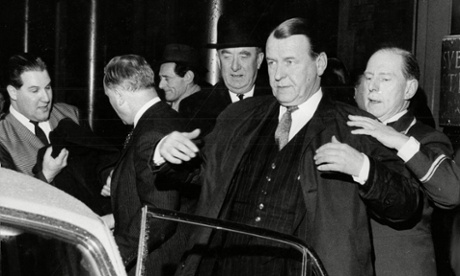
It was in early 1998 that his mother, “with self-effacing briskness in little more than a month”, died of lung cancer. Mars-Jones thought “it made sense for me to stay in place to look after the survivor”. His father was by now suffering from mild dementia, but he had once been a junior counsel at the Moors murderers trial, presided over the ABC official secrets trial, and Ken Dodd’s tax evasion as well as many other high-profile cases that included imposing the longest single sentence ever handed down in the UK, for a plot to blow up an Israeli plane. Sir William was also highly conscious of his position in the world, and it would have been easy for Mars-Jones to sum him up with the anecdote of his father arguing on the phone with American Express about “how many of his honorifics – MBE, LLB – could be crammed onto his Gold Card”. (He compromised by calling himself “Sir Wm”).
But while this is, mostly, a memoir of Sir William, it is also about Adam. Despite his father being a keen guitar player and fan of the Beatles, “when you’re a teenager and your father is a judge it was unthinkable that he could be in any way liberal”. In fact Sir William, towards the end of his career, was applauded as a maverick who stood up for individual rights, which Mars-Jones was slow to appreciate.
One landmark case involved a family being racially persecuted by the police, during which Sir William found it amusing that the black family’s name was White. “I was so offended by his failure to observe metropolitan conventions and not regard a black person called White as any stranger than a white person called Black,” says Mars-Jones, “that I managed not to notice that he had not only awarded damages to the family, but exemplary damages, conveying that the police behaviour was intolerable.”
But while his father was liberal on issues such as police malpractice, and indeed the death penalty, he was decidedly less so about homosexuality. Then again, so was Adam when younger, as evidenced by the self-headlined essay for the New Statesman “I was a Teenage Homophobe”. Even when he was sure of his own sexuality, Mars-Jones says he took to gay life less like a “duck to water than a stone to treacle. You might think your attitudes today are what you always thought, but they are not. I had no expectations. No one had given it any sort of good press. There was a doomed existential honesty about putting your hand up and saying ‘I am Spartacus’, but it was not expected to be fun.”
Kid Gloves contains a semi-comic set piece of him coming out to his father, but he says much worse was his “mawkish self-pity when I came out to my mother. I accepted it as a blot and wound. The idea that I might have some sort of whole or fulfilling life was not really contemplated.” In fact Mars-Jones has gone on to have not only a successful career but also two successful family lives. He and his long-term partner Keith King entered into a civil partnership in 2008. Perhaps more unexpectedly, in this memoir of his father he also writes about being a father, too, to a daughter born in 1991.
“When she was young it seemed better to have some privacy. Her mother and I assumed that at some stage we would all sit down and tell her that you may have noticed there is something slightly different about our family … but that moment was never required. When Keith and I eventually had our civil ceremony I thought she might have reservations, but she wanted to be bridesmaid and for the dog to be there and so on.” Mars-Jones says there was always a “minimum assumption” of his involvement in her life “but it has turned out a great deal more than that. My parents maybe saw more of her than of their other grandchildren and it did provide the elements of family life that my father would have wanted.”
While he says he is not necessarily comfortable writing about his own life, in this instance it seemed required. “Not because I’m an exhibitionist, but when you’re talking about the dead they have no dignity. You have the last word, and so I thought the only way of rectifying that balance was to remove a little of my own dignity. Also, if you try to rise above it then the tone becomes phoney.”
Mars-Jones was born in 1954 and brought up in the Gray’s Inn lodgings where he would eventually nurse both his parents. He went to Westminster school in 1967 and says the word that then best summed him up was “timid”. “The school was actually very liberal and London was felt to be part of what it had to offer. But I was so down on myself and so self-limiting that I somehow didn’t feel I was entitled to go and see Peter Brook’s transformational production of A Midsummer Night’s Dream, which many of the other boys went to. Instead I saw Laurence Olivier in Strindberg’s Dance of Death, also a wonderful production, but somehow typical of what I would allow myself.”
While his father “certainly expressed the wish” that Adam and his two brothers would follow him into the law, none of them did. Adam went to Cambridge to study classics but soon changed courses to English. He then started a PhD on Faulkner at the University of Virginia.
Although he had had gay relationships, Virginia was the first place where he was “able to present myself as gay from the outset”. His first stories were for a class in Virginia, and the idea for the Black Panther trial story came from seeing a course on law in literature. “I didn’t even attend it, but until then had thought of the two things as absolutely opposed in the way they dealt with experience: the law made things black-and-white, literature dealt with grey areas.” He chose the Black Panther trial because he had acted as his father’s Marshall, his personal assistant, and had himself sat on the bench.
Mars-Jones acknowledges some relationship between legal judgment and his reviewing. “There is certainly an element of the forensic in it. I try to quote a great deal and provide evidence. I don’t say I hated something, I say, ‘On page 300 the missing toe was on the other foot’. This tells you more about inattentiveness than just asserting the whole thing is slapdash. Perhaps there is some similarity between Dad hammering bent coppers and me getting medieval on things that hadn’t been thought through.”
Such is his reputation as a stern critic that he says people are surprised when he teaches – currently at Goldsmiths – to find him “nurturing and mother-hennish. They imagine I get pleasure from seeing blood on the walls, but there seems to me all the difference in the world between a manuscript, which is a work in progress and is still living and breathing and drawing these nutrients from the soil around it, and something that is announced to the world as finished, yet is still defective.”
Lantern Lecture was published to acclaim in 1981, but Mars-Jones still wasn’t sure that this was the start of a career, or even that he was a writer. In 1983 he edited an anthology of lesbian and gay fiction, Mae West Is Dead. In the introduction he made a passing reference to Aids. By 1987, with the scale of the epidemic now evident, he co-authored with Edmund White The Darker Proof: Stories from a Crisis featuring men living, and dying, with HIV and Aids.
“It was through Aids that my generation learned about hands-on death, so when my mother was diagnosed with cancer I pretty confidently said that she could die on me. It was different, but not that new. As Dylan Thomas said ‘After the first death, there is no other’.” Looking back, Mars‑Jones is proud that a “community that seemed to be best at identifying pleasure also turned out to be loyal and dutiful and organised” – as he put in a short story, “the disco bunnies were Stoic philosophers”.
Although he had been named on Granta’s 20 best young British novelists list in both 1983 and 1993, it wasn’t until after the second list that he produced a novel, The Waters of Thirst, featuring a voice-over actor waiting for a kidney transplant. That his next novel, Pilcrow, emerged 15 years later was assumed to be because of writer’s block. “Perhaps by other writers’ standards, for whom writing is their salvation and interior monologue, it was. But that wasn’t the case with me. I’m not the sort of person who writes every day. I write when there’s something to write, and if I can’t think of a way to write something, I just don’t.”
This approach has paid dividends. “Maybe if I’d had a stronger sense of what I did as a writer, it would have been inconceivable to go from a short, crystalline comic novel about suffering, Waters of Thirst, to Pilcrow, to this enormous, near-modernist, not quite stream of consciousness about somebody with an incredibly restricted minority status.” He says volume three of the series will likely be shorter, but he is certain it will extend beyond three books. “I know how it ends and what material it covers, but the great thing is that it is potentially indefinite, and it is a very good feeling to be writing something that has a future built into it.”
He says the sense of continuity and longevity in his personal life has also come as a nice surprise. Kid Gloves is dedicated to his daughter and her cousins, his parents’ grandchildren. When he came out, “the idea was that gay people were trapped inside a family. Then, fostered by things such as Clause 28, gay people were supposed to be inherently anti-family and their arrangements were parody families and potentially corrupting. Looking at my own experience, I am actually rather family minded. I like my kin and take the trouble to keep in touch. That idea that when a writer is born in the family, the family is finished – usually attributed to Philip Roth because he is easier to pronounce than Czesław Milosz who actually said it – is also not right. First, I don’t think writers are born, and second, I don’t think there’s anything anti-family about writing. Writing this memoir has been interesting for all sorts of reasons, not least for locating relatively conventional sentiments within myself, such as not wanting Dad to be looked after by other people. Not as a virtue or an act of self-sacrifice, just something that didn’t sit well with me.”