When Money Dies was first published 40 years ago, when inflation was running at up to 20% in the UK. An examination of the social effects of hyperinflation on the German people, it was written the better to understand the popular anxieties and behaviour that this phenomenon was then causing.
The book had a very favourable reception at the time, but the publisher of that small edition, Peter Kimber, died before any paperback could follow, although it appeared in both Italian and Spanish. So why should this historic study have had such a remarkable new efflorescence now, at a time of historically low inflation? Over the past five years it has been published in 11 languages, including Russian, Korean, Portuguese and classical and modern Chinese, and has just been reissued in the UK.
One quick answer must be the advent of quantitative easing, that weaselly modern euphemism for printing money, coined perhaps because most money is no longer printed. When the US Federal Reserve seemed bent on unlimited easing of the US dollar for domestic economic purposes, the prospect of the inflation of the only reliable international currency, to whose price all others and most commodities are tightly linked, worried the whole world. Similar ventures by the Bank of England and the European Central Bank have hardly calmed those fears, since the efficacy of quantitative easing is so unsure and consequences still so unknown.
Recent sales of the book were certainly helped by press reports in 2010 that a businessman from Holland had sent a copy to every member of the Dutch parliament: Warren Buffett, he said, had commended it to him. But then the Times had already suggested back in 1975 that the prime minister put a copy by every bed at Chequers.
Nothing makes ordinary people question the nature of money so much as high inflation. And little so distresses and disrupts a society as loss of trust in its national currency or of confidence in those who issue or corrupt it. For these quasi-Leninist propositions, Germany of the early 1920s provided a preposterous object lesson.
The Weimar hyperinflation owed as much to ignorance of the quantitative theory of money as to Germany’s being a defeated country ruined by war and subject to unpayable reparations and expropriations. Hitler was still in the wings; but the combination of revolutionary threat, industrial unrest, unemployment, starvation, deprivation and occasional assassination made monetary discipline almost impossible, even had the fragile new republican government had the courage to impose it. Meanwhile, as corruption spread where previously it had been unthinkable, as mutual jealousies and suspicions mounted between citizens, classes, regions and families, as crime and black markets multiplied, tax collection became meaningless and coherent government futile.
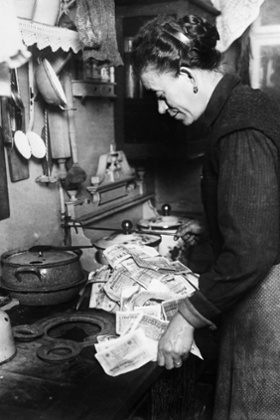
Germany’s inflationary experience took a characteristic course. Price rises led to strikes and wage demands from the huge public sector. As the purchasing power of the mark plummeted, people would rid themselves of money as fast as possible, seeking safer goods or currencies for survival. Mounting velocity of circulation effectively increased the money in use, stoking the fires of inflation ever higher. The rising demand for banknotes was met by the Reichsbank under the unsackable Dr Rudolf Havenstein to the very limit of his capabilities, and the mark exploded exponentially. While rows of noughts were added to the denomination of its notes, the pace of printing accelerated in harmony, with 2,000 printing presses eventually on permanent duty.
Even so, that inflationary process was aided by the widespread issue of unofficial emergency money – by the states, by cities, by industries, by the railways and public services – to meet the wages and needs of their workers in the absence of enough paper from the bank. The sole benefactors from this disaster were any who chose to pay their debts with the price of a postage stamp – and the profiteering industrialists, borrowing long and acquiring immense wealth at the nation’s expense.
What is money? The economist JK Galbraith reckoned it was pretty much what people think it was – remarking that metal discs and written IOUs can be more conveniently handled than cattle as a means of exchange. Money remains for most the measure of wealth, power, security and even social position. Now, so long after the Reichsbank’s presses ceased to fill railway trucks with progressively more worthless banknotes to meet an insatiable demand, times have changed.
Blizzards of broken paper promises are history. Only a short time ago Ben Bernanke of the US Fed was able to order trillions of dollars of new money at the touch of a button. Extraordinarily, although Havenstein regularly sent the mark/dollar rate to new unplumbed depths, latter-day QE, though hardly less alarming, has so far failed seriously to breach those dams of public trust in money that keep inflation at bay.
Has the nature of money changed? Probably not; but public perception of it, in the era of plastic cards, seems to have misted over. And central bankers, whose primary duty must be to maintain the trustworthiness of their currency, seem to forget they are playing with a fire that can run dangerously out of control. That is a precept which Germany, fighting for the integrity of an ailing euro, has never forgotten. And it is the challenge that would face Athens after a Grexit from the eurozone.
Inflation remains the only way a government can rid itself of irredeemable debt. That is what this book is about, and that is why it continues to be relevant today.
Extract
Over most of Germany the lead was beginning to disappear overnight from roofs. Petrol was siphoned from the tanks of motorcars, barter was already a usual form of exchange; but now commodities such as brass and fuel were becoming the currency of ordinary purchase and payment. A cinema seat cost a lump of coal. With a bottle of paraffin one might buy a shirt; with that shirt, the potatoes needed by one’s family. Herr von der Osten kept a girlfriend in the provincial capital, for whose room in 1922 he had paid half a pound of butter a month: by the summer of 1923 it was costing him a whole pound.
More on When Money Dies
“When Money Dies cannot be used to prove that the combination of rising deficits and the modern money manufacture euphemised as ‘Quantitative Easing’ can only end up in near-apocalyptic disaster … Nevertheless, the book is a ‘sobering’ warning of what could go wrong.” - Wall Street Journal.
Read full review here
Buy the book
When Money Dies has been reissued by Old Street publishing at £8.99 and is available at the Guardian Bookshop for £7.99.