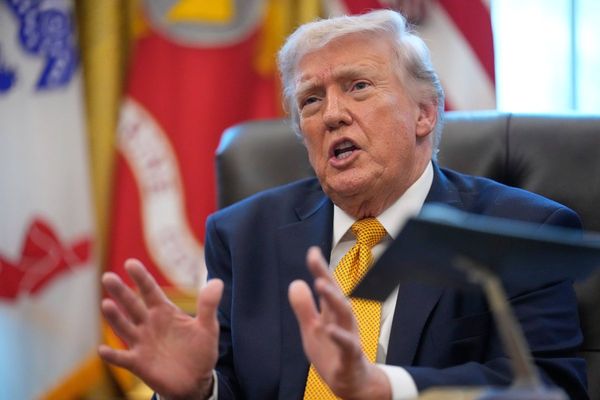

President Donald Trump took plenty of heat when he referred to Spain’s premier Mariano Rajoy as “President Rajoy” at a joint press conference at the White House last week.
Twitter, as it is wont to do when Trump errs or it thinks Trump has erred, dove in.
President Rajoy? Or was it King Mariano? (Rajoy is Spain’s Prime Minister, but never mind) https://t.co/csuagKXdNF
— Mathieu von Rohr (@mathieuvonrohr) September 26, 2017
//platform.twitter.com/widgets.js
Except Trump didn’t err, not entirely.
In Spanish political nomenclature, Rajoy isn’t the “prime minister,” as he’s almost universally known for international audiences, but rather the “president of the government.” No less than the Spanish Embassy in Washington had asked the Trump team to refer to the visiting leader as “president,” and Trump obliged. (He obliged in more ways than one: He also offered Rajoy U.S. support for a “unified” Spain just as Madrid was dealing with a separatist challenge in the wealthy northeastern region of Catalonia.)
“As with every official visit, the White House consulted us on the correct way to address Mr. Rajoy in English, and we indicated to them that Mr. Rajoy is the President of the Government of Spain, and should be addressed as Mr. President. Actually it is not incorrect to say Prime Minister, because functionally he is, but the right title is President of the Government of Spain,” a spokesperson for the Spanish Embassy told Foreign Policy.
The problem is that Spain isn’t a republic — it’s a constitutional, parliamentary monarchy. Rajoy didn’t get elected as “president” to lead the country; he headed a party slate that (eventually) mustered a workable majority in the legislature. So while he’s formally known as “presidente del gobierno,” his job actually is that of a prime minister. And he’s also subject to periodic “no confidence” votes, just like other prime ministers.
Rajoy survived one “no confidence” vote this year already. It remains to be seen if he’ll face another after plenty of headlines for his government’s response to the Catalan independence referendum Oct. 1. After breaking it up with a heavy-handed display of government authority, including police charges on would-be voters, Rajoy came under a hailstorm of international (and domestic) criticism.
Meanwhile, with the Catalan regional government threatening a decision as soon as Monday on whether it will stay in Spain or try to break away, Catalan businesses are getting leery. Big banks have begun leaving Catalonia and relocating to elsewhere in Spain. And there could be an even more spirited departure in store: Cava-maker Freixenet might be heading for the exits, too.
Alex Wong/Getty Images