Actor Teruyuki Kagawa shows off his extreme passion for insects on his NHK-E TV show "Kagawa Teruyuki no Konchu Sugoize" (Teruyuki Kagawa presents the greatness of insects).
Kagawa also serves as an official ambassador for the special exhibition "Insect," which began on July 13 at the National Museum of Nature and Science in Tokyo's Ueno Park.
The promotional poster for the exhibition features the actor geared up for insect-hunting on a hot summer day. In an interview with the passionate insect-loving actor, countless entertaining anecdotes about his experiences with insects were revealed.
"I used to keep mantises in my garden," he said. "They were free-range."
Kagawa said when he was a junior high and high school student he lived in Setagaya Ward, Tokyo, a district with a large number of natural green spaces in those days.
Kagawa used to catch mantises in a grass field in his neighborhood and take them home. He released them in his garden and fed them insects, such as locusts, and the mantises ended up settling in his garden, he said.
"I didn't want to impact their well-being by confining them in cages. I wanted to accurately observe everything in their lives -- from how they live to how they die."
Males fly around searching for females, whereas females rarely move as long as they continue to be fed.
Kagawa kept the males and females apart to prevent the creatures from engaging in cannibalism, so there were always about five to 10 mantises in his garden.
"Once I closely watched a mantis eating one of its kind. It was an impressive spectacle," Kagawa said. "It devoured the other from the head on down. It was amazing to witness a thing that existed only five minutes before disappearing from the world."
The various scenes Kagawa has observed are small but impressive aspects of nature. He has seen a giant Asian mantis trying to eat a Japanese giant mantis. He has seen mantises engaged in mating all night long.
While talking about insects, Kagawa also mentioned his sense of crisis about the Earth.
"The other day, I looked across Tokyo from a deck at Tokyo Skytree during a video shoot, and the whole view was dominated by buildings. I felt the Earth's anger and pain. And yet the Earth continues to revolve around the sun. Thanks to that, life exists. It is a miracle that we are on the Earth, which is floating around in dark space. Thinking such things, I appreciate how wonderful nature is," he said.
"It would be great if this exhibition can be an opportunity to show people what existed when the Earth was not affected by humankind."
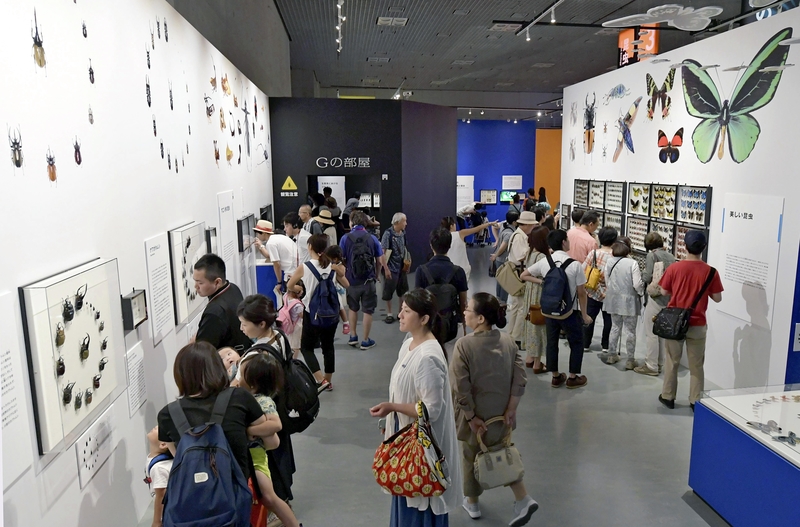
The special exhibition, which runs through Oct. 8, features about 50,000 samples, including the original specimen of a Yanbaru long-armed scarab beetle, and the fossilized insect body of an extinct species that has been preserved in amber, as well as models and displays from which visitors can learn more about the biology of insects.
Read more from The Japan News at https://japannews.yomiuri.co.jp/