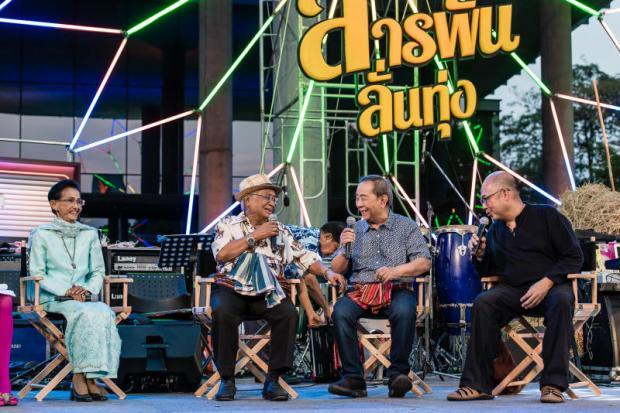
Thai PBS held a fun event to celebrate Teacher's Day "Saraphan Lan Thung" or The Sonic Luk Thung Variety Show at the TV station's main compound last Wednesday. World Beat was there to enjoy the mini-festival.
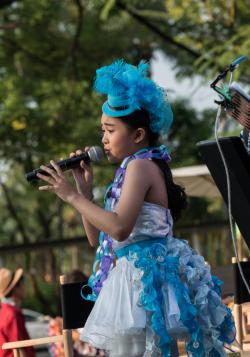
Ten-year-old Bai Bua. John Clewley
National Artists Pongsri Woranut and Chaichana Boonachote were joined by legendary songwriter and producer Surin Paksiri and a whole host of singers that included Subin Tippawat, Thep Toonjai, Tidep Phetban-na and 10-year-old wonder Bai Bua. Veteran pleng luk thung musicians staffed the stage band, among them a terrific accordion player.
The grounds of the TV station were transformed into a temple fair, with straw bales, food and drink stalls and a huge microphone for selfies and portraits. To play their part, which everyone did with real gusto, members of the audience donned their best flower-patterned shirts and dresses -- typical of central Thai folk gatherings.
Individual singers took to the stage. I was very impressed with the rich timbre of Tidep Phetban-na's voice which included the best yodel I've ever heard from a Thai luk thung singer. (This precipitated an erudite conversation with Surin Paksiri as he explained to me the importance of Hank Williams to certain luk thung subgenres and the film biopic of his life that was shown in cinemas in Thailand around 1968). Also impressive was the tiny Bai Bua whose small frame belied a powerful voice. She told me she's been singing since she was five, so I suppose she is already a veteran. Her version of Sao Transistor was wonderful; she has that clear tone reminiscent of Pumpuang Duangjan, and I wasn't surprised when she told me that she had already performed at the annual Pumpuang festival at Wat Thap Kradan in Suphan Buri.
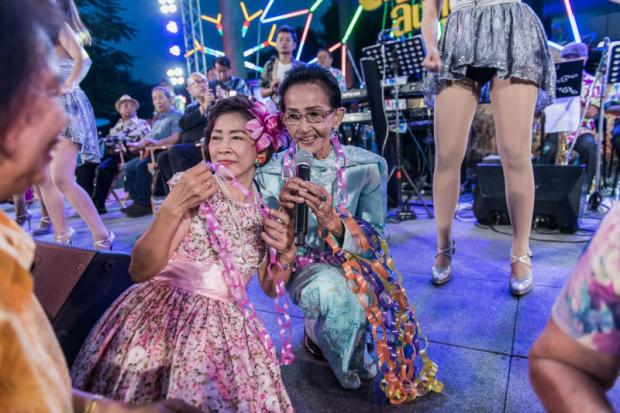
Singers had to deal with constant requests for selfies and group portraits -- not easy when you're in the middle of a song. But one of the things that is so endearing about pleng luk thung is the relationship between singer and audience. Even the evergreen Pongsri would get down with her fans, crooning all the while. Multitasking, luk thung style!
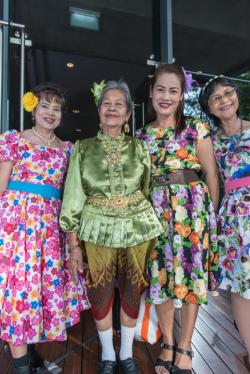
Luk thung fans in their finery. John Clewley
There were plenty of breaks and time to mingle and chat with fans and some of the stars -- it was nice to meet southern luk thung singer Sampan Phattalung again. Then after a rest, the stage was changed and a panel of experts led by Pongrsri, Chaichana and Surin discussed some of the history and background to the term luk thung and the genre's origins.
There was also a digression on the subject of accents in luk thung music -- the ner, as it's called. The early Suphan sound (from Suphan Buri), it was pointed out, has the famous lilting accent sa-ner, and the panel noted that regional accents do affect the singer's sound because a kind of musicality is carried in the tone of the accent, which can be exploited by the singer in the form of embellishments and ornamentation.
I was particularly interested in the panel's discussion on central folk music and the roles of pleng lae, harvest songs, ramwong and likay, all elements that made up the early luk thung sound. Ajarn Chaichana was on hand with his encyclopaedic knowledge of all central styles and he was able to illustrate his explanations by singing examples off the cuff. Questions were taken and the audience was clearly very knowledgeable too.
Gifts to the panel members and singers were given by the director of PBS. Then the stage was opened for all singers to take to the stage, along with a chorus line of dancers, many of whom were the same dancers I'd seen at recent Luk Thung Square shows. They told me they were freelancers, hired for events by singers.
Gone are the days when so many huge luk thung troupes toured the country and a dancer would earn 50 baht a day; these freelancers have college degrees. To find those kinds of big bands now, you have to go and see the last molam mu troupes from the Northeast, such as Nok Noi Uraiporn or Prathom Ban Tungsin.
And so the band played on, the dancers twirled and the singers joined together on stage for a long finale. In front of the stage, everyone was swaying to the rhythm of the music, hands gracefully shaping the air, smiles beaming. Interested readers can find more information on the show and Q&A at thaipbs.or.th/home.
John Clewley can be contacted at clewley.john@gmail.com.