Achieve Diet reform within the Heisei era
Momentum is growing for Diet reform with the suprapartisan "council to achieve House of Representatives reform within the Heisei era," chaired by former Defense Minister Yasukazu Hamada, compiling proposals in July. The establishment of the council was called for by LDP Chief Deputy Secretary General Shinjiro Koizumi and others. The Yomiuri Shimbun spoke with members of the council, who see Diet affairs management as outdated and thus consider Diet reform a remaining task of political reform for the Heisei era. The following material is excerpted from interviews conducted by Yomiuri Shimbun Senior Writer Koichi Mochizuki.
(From The Yomiuri Shimbun, Aug. 22, 2018)
Move from resistance to discussion
The role of opposition parties in the Diet is very important, as is their oversight function. As other parties have become involved in the Liberal Democratic Party's efforts to reform the Diet, their opinions must also be carefully incorporated. I believe we, the opposition parties, must act as a check on this reform, to prevent it from becoming something led only by the ruling camp. This is why I participated [in the suprapartisan council].
Some lawmakers in the ruling bloc say that because the prime minister and Cabinet members are required to be in attendance at the Diet for more days than their counterparts in foreign countries, the number of days should be reduced. However, from the standpoint of the legislature supervising the administration, I find it strange that they are discussing Diet reform based on an argument that it is not good for the prime minister and Cabinet members to have too many days in attendance.
We believe that respect for our laws and budget is ensured because the Diet -- the representative of the people and the highest organ of state power -- carefully checks how the prime minister and Cabinet members steer the government. We also believe that because the Diet carefully deliberates over government measures, the laws enforced by government officials have more significance. Therefore, the [ruling bloc's] stance of taking all of this lightly conflicts with our own perspective.
Diet reform should not be undertaken just by Diet members; it also has much to do with the public. Traditionally, opposition parties, based on the results of a general election, are expected to prevent some bills from passing the Diet, no matter how few lawmakers they have. Some people hope they will cause damage to the administration.
However, it is only natural that ruling parties, having gained a majority in a general election, would get bills passed. The public should judge in the next general election whether that legislation has served them.
Until now, the public has expected opposition parties to stand in the way of any legislation put forward by the ruling bloc. However, I believe that the public needs to change its mind-set. It should judge the overall achievements of the ruling camp in the period since the last election, evaluate the legislation they have passed, and reflect that evaluation in the results of the next election, even if the opposition parties have not been able to stop the passage of bills through delaying tactics that take advantage of Diet schedules.
Otherwise, it will always be assumed that minority opposition parties will try to stop the ruling bloc's legislation even through physical resistance. Through Diet reform, we hope to put an end to the physical resistance of the past and create an argument-centered Diet.
Lawmakers from opposition parties aim to make it to the ruling side and take over the reins of government. Naturally, we would like to discuss important national matters, such as the economy, social security, diplomacy and security. We did not become Diet members just to debate scandals. Scandals occur suddenly, yet we are always ready to debate such important topics as those I just listed.
What people expect from the budget committee -- in which lawmakers are meant to discuss budget bills -- is robust policy debate. That is the original purpose. We hope that, if many of those on the committee demand that scandals not be overlooked, a special investigative committee will be created separately so that both the budget committee and the special committee can function on parallel tracks.
Yuichiro Tamaki, coleader of our party, took up the issues of the northern territories and Japan-U.S. trade negotiations in one-on-one party leaders' debates during an ordinary Diet session. We were sometimes criticized for not discussing the problems surrounding private school operator Moritomo Gakuen and the Kake Educational Institution in the Diet, with critics saying there are few other opportunities to discuss them. On the other hand, Yukio Edano, leader of the Constitutional Democratic Party of Japan, was criticized for bringing up the Moritomo and Kake problems too many times. I think that if we were to ensure that there are places where we can discuss both issues, we would not be faced with just two options -- to bring up scandals or not mention them at all -- as we currently are.
Since one-on-one debates between party leaders were held too few times in this ordinary Diet session, each party leader ended up spending the time for self-aggrandizement instead, and failed to develop policy debates. I would definitely like to create a routine for party leaders' debates. I believe we can transform the current Diet so that we can carry out policy debates in a natural way. Our recommendations also include holding sessions in the evening, which would allow more people to watch them live on TV. If party leaders were to display disrespectful conduct, people's disillusion with politics would only grow deeper. I think that the quality of party leaders' debate itself would become more important.
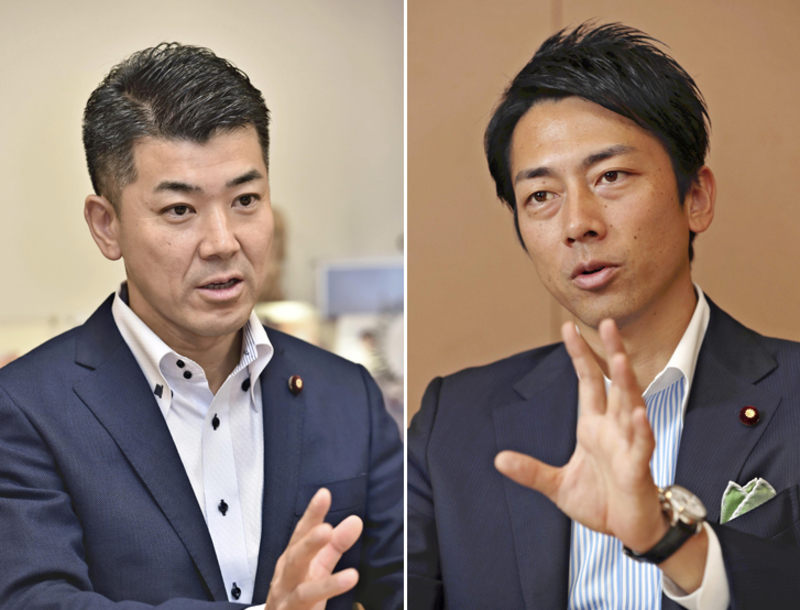
--Kenta Izumi / Diet Affairs Chief of the Democratic Party for the People
Izumi, 44, has been elected to the House of Representatives seven times. Before taking up his current position, he worked as a parliamentary vice minister of the Cabinet Office. He proposed suprapartisan Diet reforms in 2010.
Regular party leaders' debate vital
When about 30 LDP lawmakers who make up the council to discuss the post-2020 economy and society began trying to thoroughly sum up the Heisei era -- essentially asking, "What was it?" -- Diet reform emerged as a theme. What became clear was that political reform can be divided into three categories: electoral system reform, administrative reform and Diet reform. While there is debate as to whether the existing electoral system is really appropriate, the single-seat constituency system was introduced, and ministries and agencies were reorganized under former Prime Minister Ryutaro Hashimoto's administrative reform initiative. Diet reform, therefore, is the remaining reform issue.
One reason I became aware of the need for the Diet reform was the state of the Diet following last year's lower house election. The first thing that needs to be done in the Diet following an election is to hold votes to choose the prime minister, the lower house speaker and vice speaker. A lengthy total of 110 minutes is spent to write the three names and cast the votes, with lawmakers walking around the lower house chamber three times in the process. Since there may be some last-minute drama, I understand the need to spend that much time to elect the prime minister. However, the lower house speaker and vice speaker are customarily decided in advance, so there is no need to write their names and vote [in such a time-consuming way]. Because the authority of the Diet is very important, I very much understand the necessity and importance of etiquette in doing these things and holding ceremonial events, but I believe these can be done in a more rational manner through other methods.
Russian President Vladimir Putin, Chinese President Xi Jinping, Workers' Party of Korea Chairman Kim Jong Un, U.S. President Donald Trump and other leaders are fiercely engaged in power games in the diplomatic sphere. What would those world leaders do if they were given 110 minutes? When I thought about it, I realized that it would be wrong, from the viewpoint of how politicians should use time, to leave the Diet as it is. I strongly feel a sense of crisis over what we are doing especially at a time when the relative power of the United States is declining and we are in a period of adjustment toward a new world order with the rise of China and other factors.
If we suggest that the prime minister and other Cabinet ministers should reduce their attendance at the Diet session, the opposition parties say that is simply intended to serve our own benefit. However, I do not think they would say the same thing if they think they may become the ruling party. Regrettably, this is one of the things that the LDP should have done when we were an opposition party.
When I think about what we can do while taking this all into consideration, what is important is to hold one-on-one party leaders' debates on a routine basis, including holding them at night. This may increase the burden on the prime minister. Along with thorough party leaders' debates, after-the-fact reports should thoroughly be made if ministers are abroad when the Diet is handling important issues. I believe this approach will fully ensure that the Diet properly functions to monitor administrative affairs.
It is significant that a suprapartisan "council to achieve the House of Representatives reform within the Heisei era" was launched and moves are growing to promote one-one-one party leaders' debates as a consensus between the ruling and opposition parties, to introduce information technology in the lower house and to allow proxy voting by female lawmakers who are absent due to childbearing.
Another significant thing is that the Diet reform proposal was put forth by the Constitutional Democratic Party of Japan. They did not attend the council's meetings, but if the council had not been launched, the CDPJ would not have put forth the proposal. Diet reform is now firmly on the agenda. We have much in common at many points in terms of the direction we are heading for. Ultimately, I think we will be able to find common ground on the matter at the lower house's Rules and Administration Committee.
We are working on Diet reform, knowing, in the first place, that it is a tough challenge. In 2014, Diet reform did not make progress even though there was an agreement among seven Diet affairs committee chiefs of the ruling and opposition parties. That is precisely why members of the opposition and ruling parties in our council have basically agreed to make a breakthrough in Diet reform during the Heisei era, even if it starts with only a single reform. Every council member shares this, so Chairman Hamada said the next extraordinary Diet session is very important and so the members should gather again once the session begins. We have our eyes on the next step.
I believe that words used in politics are very important and they can actually change society. Just like the phrase "an era of 100-year lifespans," the phrase "within the Heisei era" is now used in a variety of contexts. When I was attending festivals in Yokosuka on weekends, local residents encouraged me to work hard on Diet reform. I was surprised that the words "Diet reform" are spoken by the people so naturally. Although they do not know about Diet reform in concrete terms, many people seem to realize the Diet as it is no good.
--Shinjiro Koizumi / Chief Deputy Secretary General of the LDP
Koizumi, 37, has been elected four times to the House of Representatives. Before taking on his current position he was a researcher at the Center for Strategic and International Studies in the United States, chief of the LDP Youth Division, a parliamentary vice minister of the Cabinet Office and Reconstruction Agency, and director of the LDP's Agriculture and Forestry Division.
Read more from The Japan News at https://japannews.yomiuri.co.jp/