FORT LAUDERDALE, Fla. _ Esteban Santiago, handcuffed, shackled and wearing a red maximum-security jumpsuit, spoke in a monotone Monday as he answered questions from a judge during a court hearing that lasted about 30 minutes.
Santiago, 26, is accused of killing five people and wounding six others at Fort Lauderdale's airport last Friday. He was flanked by eight to nine deputy U.S. marshals as he answered questions from U.S. Magistrate Alicia Valle.
"The maximum penalty, if you were to be convicted, is death _ it is a capital offense," Valle told him.
Santiago, who stared down at the defense table for much of the hearing, said he understood the seriousness of the charges he is facing.
In court, Santiago did not say anything about his alleged motive or why he came to South Florida.
He also said nothing about his mental health or psychiatric diagnosis.
But Santiago told authorities, after his arrest, that doctors told him he may have schizophrenia, sources told the Sun Sentinel.
He said he was told that in November during a mental health evaluation he underwent after he sought help from the FBI office in Anchorage, Alaska, the sources said.
People with schizophrenia may "lose touch" with some aspects of reality, according to the National Institute of Mental Health. Other possible symptoms include hallucinations, delusions and unusual or dysfunctional ways of thinking.
Agents said he reported that he was having terroristic thoughts, believed the government was controlling his mind and pushing him to watch Islamic State group propaganda videos.
In answering a series of questions from the judge in court, Santiago, with visible tattoos on both arms and wearing flip-flops with no socks, said he has no assets and only about five or 10 dollars in his bank account.
Santiago told the judge that he has not worked since November when he left his job as a security guard in Anchorage, Alaska, a position that earned him about $2,100 dollars monthly during the last three years.
Prior to that, Santiago said he was in the Army "around 10 years," earning about $15,000 per year by the end of his stint.
During the hearing, Assistant U.S. Attorney Ricardo Del Toro said prosecutors wanted Santiago detained without bond while the case is pending. A bond hearing was scheduled for Jan. 17 and an arraignment, during which Santiago will formally plead to the charges against him, is set for Jan. 23.
Assistant Federal Public Defender Robert Berube was appointed to represent Santiago. The two spoke briefly during the hearing, whispering as they huddled next to each other.
Berube said he had just met his client in court for the first time.
"There is a time and place to make a comment; this is not it," he told the Sun Sentinel.
Enhanced security was apparent at the courthouse as Santiago was brought there Monday morning from Broward's main jail: There were metal barricades at the entrances, armed federal agents and explosives-detecting dogs.
Santiago, 26, is facing federal charges involving murder, firearms and airport violence.
Formal charges have not yet been filed against Santiago.
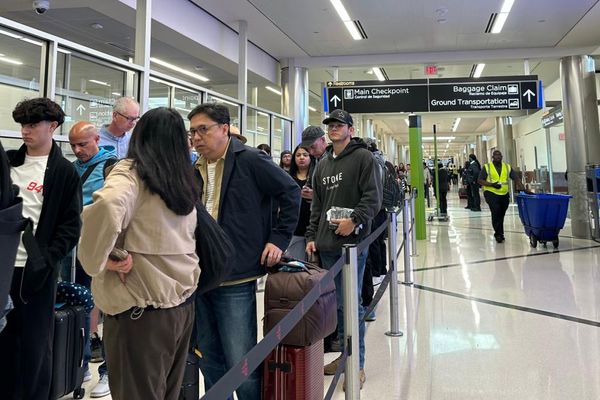
Airport security video shows Santiago pulling a semi-automatic handgun from his waistband and shooting at people in the baggage carousel area in Terminal 2.
Santiago confessed shortly after the Friday afternoon shooting, according to the FBI and Broward Sheriff's Office.
He told investigators that he planned the attack and bought a one-way ticket to Fort Lauderdale to carry it out, according to court records. His motive and reason for traveling 5,000 miles from Anchorage, Alaska, to Fort Lauderdale before opening fire remain unclear, said George Piro, the agent in charge of the FBI in South Florida.
After the hearing, Santiago was quickly returned to the Broward Main Jail, where he is being held on federal allegations he fatally shot people, as well as firearm and airport violence charges.
The charges "represent the gravity of the situation and reflect the commitment of federal, state and local law enforcement personnel to continually protect the community and prosecute those who target our residents and visitors," U.S Attorney Wifredo Ferrer said.
Santiago, a former National Guard soldier who was born in New Jersey, grew up in Puerto Rico and most recently lived in Anchorage, has a history of mental health problems since he returned from serving in Iraq, his family and federal officials said.
Agents said he legally checked a 9 mm Walther semi-automatic and two magazines of ammunition in his baggage on a Delta flight from Alaska via Minnesota.
After picking up his bag from the baggage carousel, he told investigators he unpacked the gun, loaded it inside a stall in the men's restroom, and shot the first people he saw after he walked out of the restroom.
Santiago was briefly hospitalized in November after he walked into the FBI office in Anchorage and asked for help, authorities said. He told agents the U.S. government was controlling his mind and forcing him to watch Islamic State propaganda videos, investigators said.
Authorities initially said he had left his 2-month-old baby son and a gun in his vehicle outside the office and brought in a magazine that contained ammunition. They later clarified that the infant was safely in the care of the FBI. The infant's mother was called to take custody of the baby and local police seized his gun and took him to a local psychiatric hospital for treatment, they said.
Santiago's gun was returned to him on Dec. 8, less than one month before the bloodshed in Fort Lauderdale, investigators said.
Santiago was discharged from the National Guard last year after being demoted for unsatisfactory performance.
Family members said he was hearing voices and was severely affected by seeing a bomb explode near two of his friends when he served in Iraq.