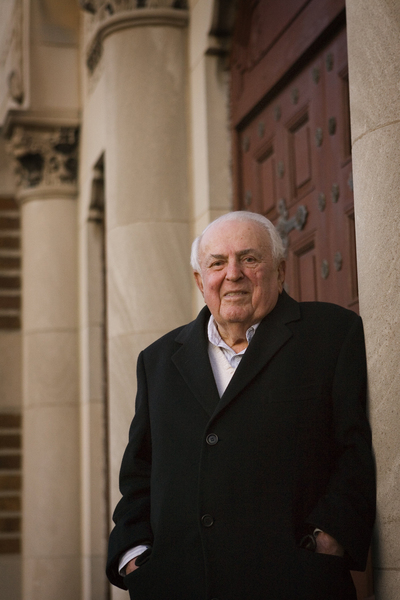
CHICAGO _ Abner Mikva was turned down in his first attempt at civic duty with a line that became embedded in Chicago's political lore, "We don't want nobody nobody sent."
Undeterred, the young, liberal outsider from Hyde Park forged ahead for a sterling career as a state legislator, congressman, federal appellate judge and presidential adviser, maintaining through more than a half-century of public service a vaunted reputation for honesty.
Mikva, 90, died Monday in a hospice at Rush University Medical Center in Chicago, according to Brian Brady, national director of the Mikva Challenge. The cause of death was bladder cancer, Brady said.
In November 2014, Mikva was given the Presidential Medal of Freedom, the nation's highest civilian honor, by President Barack Obama. He called it the "greatest thing that ever happened to me."
Obama in a statement Tuesday said he'd lost a mentor and friend and credited Mikva with offering valuable guidance as he embarked on his career.
"No matter how far we go in life, we owe a profound debt of gratitude to those who gave us those first, firm pushes at the start," the president said. "For me, one of those people was Ab Mikva. When I was graduating law school, Ab encouraged me to pursue public service. He saw something in me that I didn't yet see in myself, but I know why he did it _ Ab represented the best of public service himself and he believed in empowering the next generation of young people to shape our country."
Noting how the Chicago political machine initially gave Mikva the brush-off, Obama added: "Ab didn't take no for an answer because he knew that in America, in our democracy, everybody can be somebody _ everybody matters. ... We're all better off because we were sent Ab Mikva, and because Ab in turn sent us forward to do big things."
The son of Ukrainian immigrants and a native of Milwaukee, Mikva came to Chicago for law school at the University of Chicago and was elected to the state House when he was 30.
He served five terms, then five more in the U.S. House before President Jimmy Carter appointed him to a seat on the U.S. Court of Appeals for the District of Columbia.
He served on the influential court for 15 years and was its chief judge for four years before resigning to serve as White House counsel under President Bill Clinton.
In 2009, Mikva headed a state commission that examined the influence of clout in the admissions process at the University of Illinois following a Chicago Tribune investigation. The panel recommended that then-Gov. Pat Quinn replace the trustees and that the University of Illinois change some of its admissions policies, including making all outside interference public. Nearly all the trustees and the university's president and chancellor resigned after the commission's report.
Mikva attended the University of Wisconsin, transferred to Washington University in St. Louis to be closer to his future wife, then served as a navigator with the Army Air Forces during World War II.
He graduated from the University of Chicago's law school in 1951 and worked as a clerk for U.S. Supreme Court Justice Sherman Minton.
Inspired by liberal Illinois political leaders such as Paul Douglas and Adlai Stevenson, Mikva went to his local Democratic ward committeeman to see how he could help during the elections of 1948.
The entire exchange, as recounted by Mikva to Milton Rakove in his book "We Don't Want Nobody Nobody Sent," is classic.
"I came in and said I wanted to help. Dead silence. 'Who sent you?' the committeeman said. I said, 'Nobody.' He said, 'We don't want nobody nobody sent.' Then he said, 'We ain't got no jobs.' I said, 'I don't want a job.' He said, 'We don't want nobody that don't want a job. Where are you from, anyway?' I said, 'University of Chicago.' He said, 'We don't want nobody from the University of Chicago.' "
Despite the inauspicious start, Mikva in 1956 was elected to the first of five terms as a state legislator representing Chicago's Hyde Park. In 1969, he began five terms as a U.S. representative. In Congress, he was a member of the Judiciary and Ways and Means committees, and he was a reliably liberal vote.
Carter appointed him to the U.S. Court of Appeals in 1979, a year after he had won re-election over Republican John Porter.
In 2014, when he was awarded the Presidential Medal of Freedom at a White House ceremony, Mikva was dealing with macular degeneration and was walking with a cane. He said in an interview afterward that he could no longer read books, so he listened to them on his iPod.
He chuckled at a White House miscue since his name card read, "Mivka," the written version of a mispronunciation employed by the late Mayor Richard J. Daley. "My medal is spelled right _ that's all I care about," he said.
He also remembered that Obama was not much of an orator during his unsuccessful bid for Congress in 2000, but said when Obama ran for the U.S. Senate in 2004, he "could have taught Martin Luther King elocution."
U.S. Rep. Jan Schakowsky, D-Ill., who represents Mikva's old district, said "he was such a special friend to me."
"So this is really painful. He was the greatest public official, public servant that I know. The most ethical, strategic, kind man dedicated to creating government that was the most helpful it could be to the most people," she said.
Schakowsky said Mikva was rare for having served all three branches of government _ the Congress, the judiciary and as counsel to Clinton in the executive branch.
She said a celebration for Mikva held in Washington when he won the Medal of Freedom drew Supreme Court Justice Elena Kagan, a former law clerk of his.
"Abner also was the creator of the grass-roots politics," Schakowsky said. "Not patronage politics but engaging volunteers in elections."
She said he continued that work through the nonpartisan Mikva Challenge, a nonprofit started in 1997 by Mikva and his wife, Zoe. The program drew high school students into public policy and political campaigns.
Kagan clerked for Mikva from 1986 to 1987 on the U.S. Court of Appeals for the D.C. Circuit, often called the second most important court in the country.
"Ab Mikva gave me my first job _ and my first chance _ in the law," she said in a statement. "For more than 60 years, Ab devoted his extraordinary gifts of intellect, wisdom, energy and spirit to advancing the public good and strengthening the country he loved. He was a person of complete integrity and unwavering principle."
Jack Marco, of Evanston, who met Mikva 45 years ago and managed his later congressional campaigns, said he visited him for about 15 minutes Saturday just after Mikva was moved into the hospice.
"He was sharp. He still had his wits about him, but I know from his family he was struggling in and out a bit," Marco said.
Chicago Mayor Rahm Emanuel said in a statement that the first political campaign he worked on was a Mikva campaign for Congress. The two later worked together in the Clinton White House.
"With Abner Mikva's passing, we have lost one of the greatest public servants of our time," the mayor said. "Throughout his career, Abner fought for unpopular decisions and for those whose voices needed to _ but could not _ be heard. He championed for minority voting rights, civil liberties, free speech and equality. ... Abner was not only a great Chicagoan, but a great American."
Illinois' Republican Gov. Bruce Rauner called Mikva a "dedicated public servant and principled leader" whose focus encouraging youth to become active and engaged in the democratic process "will be felt for generations."
In addition to his wife, Mikva is survived by three daughters, Mary Mikva, Laurie Mikva and Rachel Mikva Rosenberg; and seven grandchildren.
Services will be private, but a public memorial is set for early August.