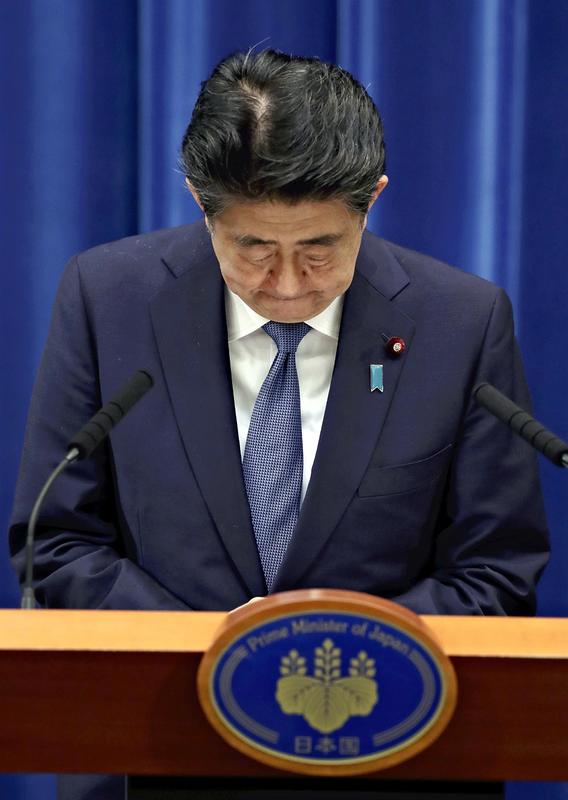
With the spread of the novel coronavirus now on a downward trend, Prime Minister Shinzo Abe said he decided to resign from his post as the situation over the virus has reached a turning point. Abe apparently considered the timing of his resignation announcement carefully to avoid being criticized for "abandoning" his duty. He had received such criticism when he stepped down as prime minister during his first administration.
"A situation that will cause obstacles to responding to the new coronavirus must be avoided as much as possible. Over the past month or so, I was thinking hard," said Abe, whose voice was shaking at times during a press conference on Friday.
"I was agonizing about it over and over, but I concluded this is the only time," he stressed.
A government subcommittee of experts on measures against the pandemic said Monday that a gradual decline can be seen in the number of people infected with the virus across the nation since July 27-29. The government's task force also compiled a comprehensive policy package to combat the virus going into winter, when it is anticipated that the coronavirus and seasonal influenza could spread simultaneously.
Abe was apparently deeply aware of the bitter memory of being forced to step down in September 2007 while still serving his first term, due to his ulcerative colitis deteriorating.
At that time, his resignation came shortly after an extraordinary Diet session was convened following a Cabinet reshuffle, after the ruling Liberal Democratic Party suffered a crushing defeat in a House of Councillors election that summer. In his policy speech, Abe said, "I will give all my body and soul to fulfill the responsibilities of the prime minister." However, he announced his resignation two days after the speech, sparking criticism even from LDP members.
This time, Abe apparently came to the decision to step down as there would be enough time to elect a new LDP president and convene an extraordinary Diet session in the autumn, unlike 13 years ago.
-- Decision made alone
Abe's health rapidly worsened during the Bon Festival holiday. On Aug. 12, he was seen walking slowly with a fragile look and putting his hand on the wall, when arriving at the Prime Minister's Office from his private residence in Shibuya Ward, Tokyo.
Akira Amari, chairperson of the LDP's Research Commission on the Tax System, met with Abe the same day and urged him to sleep well. Abe began to complain to people close to him, saying, "Rather than being physically tired, it's more that I can't find ease," according to sources.
"He has had stomach problems for a while, but his diarrhea couldn't be brought under control, breaking him down mentally," a senior government official said of Abe's health condition.
Abe worked 147 days in a row from Jan. 26 to June 20 to deal with the virus situation. Nevertheless, he was often exposed to criticism over the government's response to the pandemic. The approval rating for his Cabinet, which had been stable, fell into the 30% range after the distribution of cloth masks and a video in which he called for restraint over going out sparked criticism from the public.
The prospects for holding the Tokyo Olympics and Paralympics next summer, which Abe strove to make happen, remain unclear. Abe "comes under fire whatever he does," a government source said. The atmosphere in the Prime Minister's Office had been the same as during the final days of Abe's first administration.
It was decided Abe would be administered a new medicine, and its effectiveness was confirmed when Abe visited a hospital on Monday. However, as he will need to receive the treatment continuously, it became clear that it would be difficult for him to complete his term through September next year.
"I made the decision by myself, alone [on that day]," he said at the press conference.
According to sources, Abe told people close to him that he had some hesitation about his resignation, saying, "I had been going back and forth."
At the end of the press conference, which lasted for about an hour, the prime minister bowed deeply. Asked by a reporter, "Do you have any regrets?" as he was leaving the Prime Minister's Office, Abe nodded.
Read more from The Japan News at https://japannews.yomiuri.co.jp/