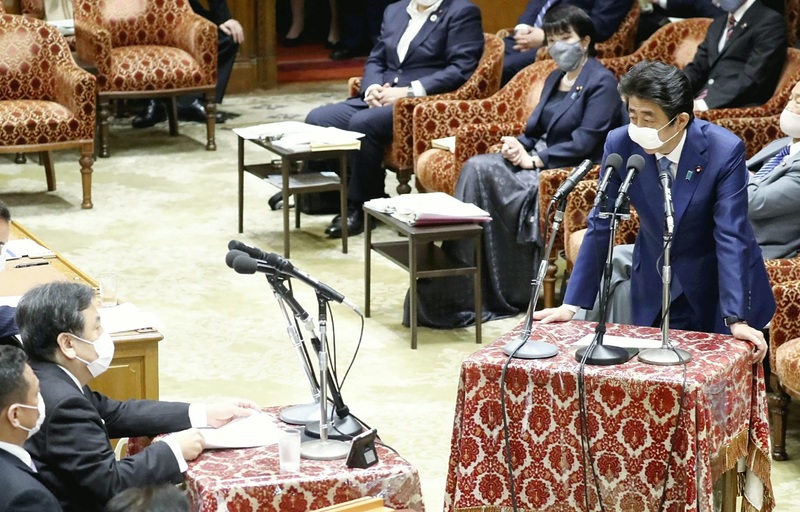
Prime Minister Shinzo Abe was continually labeled a hawk or rightist, but the opposition parties' dealings with Abe are a good indication of whether he actually was one.
In 2015, Katsuya Okada, then leader of the opposition Democratic Party of Japan, said he would aim for the position of the Liberal Democratic Party's Kochi-kai faction, which is said to comprise liberal elements in the party. Believing that the "LDP led by Abe" would intensify its rightist tone, Okada sought to gain support from conservative-centrist elements, which would be at loose ends.
Yukio Edano, the then DPJ secretary general and currently a leader of the Constitutional Democratic Party of Japan, also stressed, "It's the DPJ that is the mainstream of conservatism."
Unable to gain support, however, from conservative-centrist elements, the CDPJ, which originated from the DPJ, has shifted toward cooperating with the Japanese Communist Party. Things have turned out contrary to the opposition party's expectations, because it misjudged the political posture of Prime Minister Abe.
The Abe Cabinet pursued a middle-of-the-road policy line -- close to liberalism -- in its socioeconomic policies, thereby adopting the assertions made by opposition parties.
Abe worked hard to realize a minimum hourly wage of 1,000, yen which opposition parties had previously called for. He urged business circles to implement wage hikes as if he were a representative of a labor union. Abe clearly promoted policies that were distinct from the LDP's traditional line, such as work style reforms and tuition-free education.
He succeeded in changing the LDP's image as a party supported mainly by the elderly, thus stretching his wings to also cover younger generations. According to a survey conducted by the Yomiuri Shimbun, the approval rating for the Abe Cabinet among people in their 20s and 30s hovers around 50 to 60 percent, higher than other age groups. Expansion of one's support base is indispensable for building a long-lasting administration.
Abe once said, "I'm a grandson of Nobusuke Kishi, so everyone thinks of me as an adamantly conservative politician. But I'm also a grandson of Kan Abe. I think about things from the standpoint of both a hawk and a dove."
Former Prime Minister Nobusuke Kishi, Abe's maternal grandfather, was a leading conservative politician. In contrast, his paternal grandfather Kan Abe was a politician with the common touch, known for advocating antiwar policies.
The situation of "Abe as the sole all-powerful leader" was prompted by the opposition parties' failure to recognize his dovish aspects.
Prime Minister Yasuhiro Nakasone, who was in power for five years in the 1980s, moved ahead with the privatization of the former Japanese National Railways, as well as urban development. He was said to have changed the LDP, which had its support base mainly in regional areas, into a political party with a primarily urban base. Prime Minister Junichiro Koizumi won strong support from voters with no party affiliation for a long time -- from 2001 to 2006 -- by plunging a scalpel into the traditional support base of the LDP.
Abe also broadened his range of policies, thus continuing to overwhelm the opposition parties.
Looking at the difference in the Diet seats between the ruling and opposition parties, the present political system reminds us of the so-called "1955 system" which comprised the LDP, the continual ruling party, and "perennial opposition parties," including the Japan Socialist Party.
However, the Abe administration has not given us any sense of the broad-mindedness that the LDP had back then. A key difference is that since the introduction of the single-seat constituency system, the ruling party has always been exposed to the risk of losing power. Unlike the medium-sized constituency system, under which the LDP was able to maintain a majority with ease, the ruling party could lose power if buffeted by a headwind.
In the House of Representatives election in 2017, where the LDP marked a landslide victory, the party could have lost more than 60 of its Diet members if there had been a five-percentage point fluctuation in the percentage of their votes amid the total in the single-seat constituencies.
Couldn't this be called a seemingly stable administration built on thin ice?
Prime Minister Abe has always been forced to take a fighting stance. In the Diet, he refused to cooperate with opposition parties, rejecting them thoroughly. He may have preferred an immediate victory over an attempt at tackling a long-term challenge through cooperation between the ruling and opposition parties.
The Abe Cabinet has been criticized by some as "spreading division in society." But it is also a fact that his administration steadfastly coped with challenges that Japan was pressed to tackle, both at home and abroad. The historical evaluation of this record-long administration will be made in the years to come.
Read more from The Japan News at https://japannews.yomiuri.co.jp/