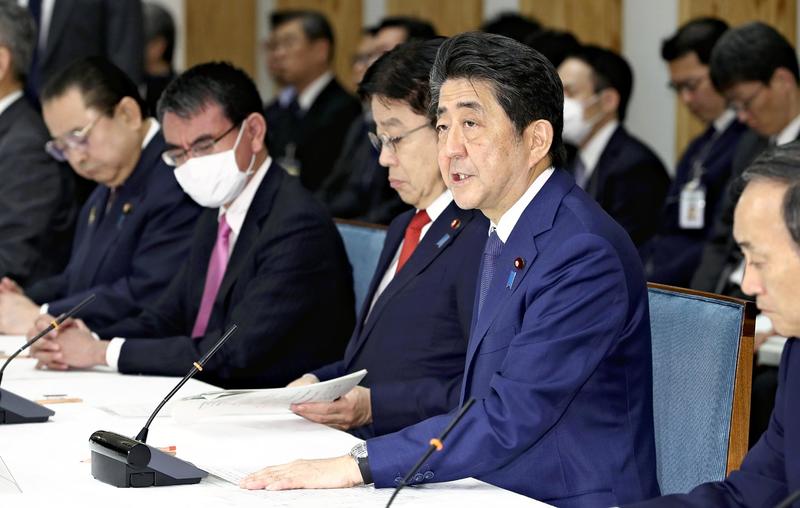
Prime Minister Shinzo Abe ordered the compilation of a basic policy for combating the new coronavirus Thursday, which is expected to stipulate that residents could be requested to stay inside for three weeks if a state of emergency is declared.
Abe issued the instruction at the first meeting of a government task force that was established based on a revised special law for fighting the coronavirus.
In a related development, the governors of Tokyo and four nearby prefectures have asked residents to refrain from nonessential outings to help quell the outbreak.
The task force is the first set up based on a special measures law passed in 2012. Following the task force's establishment, each prefecture will form its own task force headed by its governor as a national approach to fighting the virus takes shape. At the meeting, Abe said the central government will work "even more closely" with prefectural governments and jointly push ahead with countermeasures.
The government was expected to form a basic policy as soon as Friday, based on the opinions of an advisory committee set up under a panel of experts.
If infections spread further in Japan, the prime minister can, based on the view of the committee, declare a state of emergency and designate the regions it will cover, as well as how long it will remain in place. Governors of prefectures in such regions, will become able to take steps including asking residents to refrain from nonessential outings; requesting or ordering restrictions on or prohibiting use of schools, movie theaters and other facilities; and forcibly purchasing medical supplies and other items.
According to a draft of the basic policy revealed Thursday, it is anticipated that about 21 days would be the appropriate duration for the period during which governors, including those whose prefectures are covered by a state of emergency, could ask residents to refrain from going outdoors and restrict usage of certain facilities.
The period for which people would be asked to refrain from outings was determined based on a 14-day health observation period given that the coronavirus has an incubation period of up to 14 days, and the average time -- seven days -- between infections and cases being reported. If these steps were implemented, this period could be shortened or extended depending on the opinion of the committee and the conditions of the affected region.
The basic policy will include steps to slow the spread of infections by keeping clusters of cases contained in each region.
The government has refrained from issuing a state of emergency so far. At a press conference Thursday, Chief Cabinet Secretary Yoshihide Suga said such a declaration was not warranted at the present time.
On Thursday evening, Tokyo Gov. Yuriko Koike held talks with Abe. Koike asked for clearer standards for treating patients with mild symptoms; ensuring that temporary accommodation facilities will be available; tighter border controls; and economic countermeasures to cope with the coronavirus outbreak.
Read more from The Japan News at https://japannews.yomiuri.co.jp/