
Shortly after Prime Minister Shinzo Abe became Japan's longest-serving prime minister in the history of the country's constitutional politics, he announced his intention to step down. While in office, his policies and actions achieved results in domestic policies and foreign affairs, but challenges remain with his leaving. The following is a retrospect of Prime Minister Abe's tenure in office.
--Active diplomacy
Advocating for "diplomacy based on a bird's-eye view of the world," Prime Minister Abe visited 80 countries and regions. In 2013, he established the National Security Council, thereby strengthening Japan's foreign policy and national security both under the leadership of the Prime Minister's Office. The nation's postwar security policy changed in 2015 after Abe-led legislation for the right of Japan to make limited use of collective self-defense was passed into law.
When the situation in East Asia recently became increasingly tense, Abe exercised his diplomatic skills by using the Japan-U.S. relationship as a cornerstone in combination with the 2015 security legislation to boost deterrence in the region.
In 2016, then U.S. President Barack Obama and Prime Minister Abe made reciprocal visits to Hiroshima and Pearl Harbor in Hawaii respectively.
--Close ties
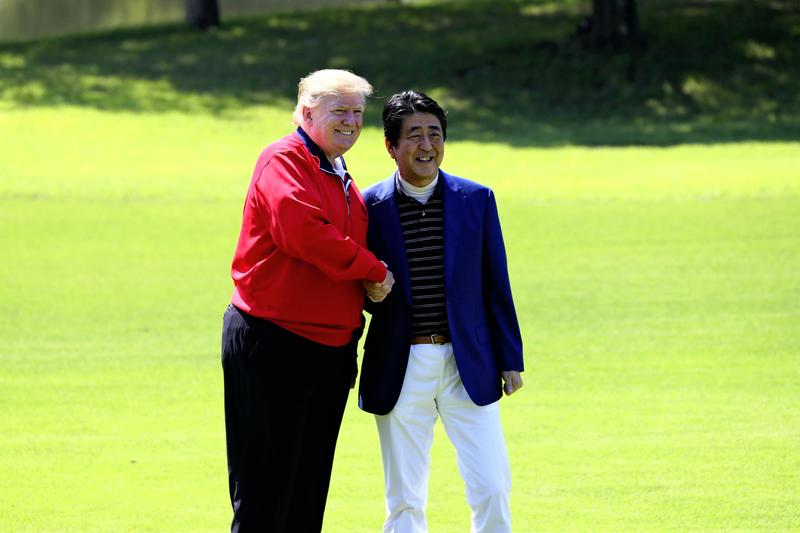
Abe formed a close relationship with U.S. President Donald Trump, with some saying it brought the two countries' ties to record highs that proved useful in bilateral talks on pending issues such as trade.
Not only with the United States, but under the scheme of advocating a "free and open Indo-Pacific," Abe was also able to advance bilateral partnerships with Australia, India, and Southeast Asian countries.
When the Japanese government nationalized the Senkaku Islands in Okinawa Prefecture, Japan's relations with China saw a dip. In efforts to improve ties with China, Abe made an official visit in October 2018 -- the first visit in 7 years made by a Japanese prime minister.
Due to the impact of the new coronavirus, Chinese President Xi Jinping's scheduled visit to Japan as a state guest in April this year was postponed due to the novel coronavirus outbreak. Prospects for a future visit remain dim, and Chinese government vessels continue to intrude into Japan's territorial waters near the Senkaku Islands.
On the issue of the northern territories, four islands off the northeast coast of Hokkaido, Abe effectively switched his policy of seeking the "return of four islands" from Russia to the "return of two islands." He was aiming for the resolution to be "the final settlement of accounts in Japan's postwar diplomacy," but significant progress remains static.
No breakthroughs were made either regarding the North Korean abductions of Japanese citizens, though Abe did call for holding no-conditions-attached Japan-North Korea summit talks.
With the South Korean administration of then President Park Geun-hye, the Abe administration reached a "final and irreversible resolution" of the comfort women issue in December 2015. But under the South Korean administration led by President Moon Jae-in, who considers the resolution problematic, the bilateral relations between the two countries deteriorated rapidly after South Korea's top court issued a controversial ruling on former wartime requisitioned workers from the Korean Peninsula.
--Priority on economy
Over the past 7-1/2 years or so since he made his comeback as prime minister, Abe maintained his stance of making the economy top priority. He propelled the Abenomics economic policy package, comprised of three arrows: "bold monetary easing," "flexible fiscal spending," and a "growth strategy that will stimulate private-sector investment."
Thanks to the large-scale monetary easing, the administration helped to correct an excessive appreciation of the yen, which was then hovering at the around 80-89 yen level against the dollar, thereby helping manufacturers and export-oriented corporations improve their business performances. The Abe administration also assisted in job creation, bringing the effective job openings-to-applicants ratio to levels higher than 1 nationwide. The Nikkei Stock Average, hovering around 10,000 yen when Abenomics kicked off, climbed to a high of 24,270 yen in October 2018.
Backed by high public approval ratings, Abe raised the consumption tax rates twice. When he raised the tax rate from 5% to 8% in April 2014, the nation's economy slumped by more than expected. Because of this, the administration exercised caution in raising the rate again to 10%.
In November 2014, Abe announced a postponement to the planned tax hike by one and a half years to April 2017. To seek a public mandate for his decision, he dissolved the House of Representatives and won the public's confidence. As consumer spending remained sluggish thereafter, however, he delayed once again the tax hike.
Although his administration raised the consumption tax rate to 10% in October 2019, he had some of the increased tax revenues allocated to make some of education free of charge by changing part of the purpose for which the tax revenue increase was to be spent.
Thus, Abe set a course to realize an all-generation social security system, but the administration's target of restoring fiscal health drifted further away.
The growth strategy that Abe has prioritized is still a work in progress. Structural problems remain unsolved, such as delays in digitization and an aging society with a low birthrate.
--Coronavirus hits Abenomics
The spread of infections of the novel coronavirus has cast a dark shadow over the finishing touches of Abenomics. The nation's gross domestic product (GDP) during the 2020 April to June quarter shrank an annualized 27.8% in seasonally-adjusted, real terms -- a record postwar drop.
To cope with the impact of the coronavirus, the government compiled a supplementary budget twice for this fiscal year and budget expenditures for fiscal 2020 have totaled as much as 160.3 trillion yen. With the amount of new government bonds issued this fiscal year reaching 90.2 trillion yen, the debt issuance dependency ratio has gone up to a never-before-seen high of 56.3%.
Read more from The Japan News at https://japannews.yomiuri.co.jp/













