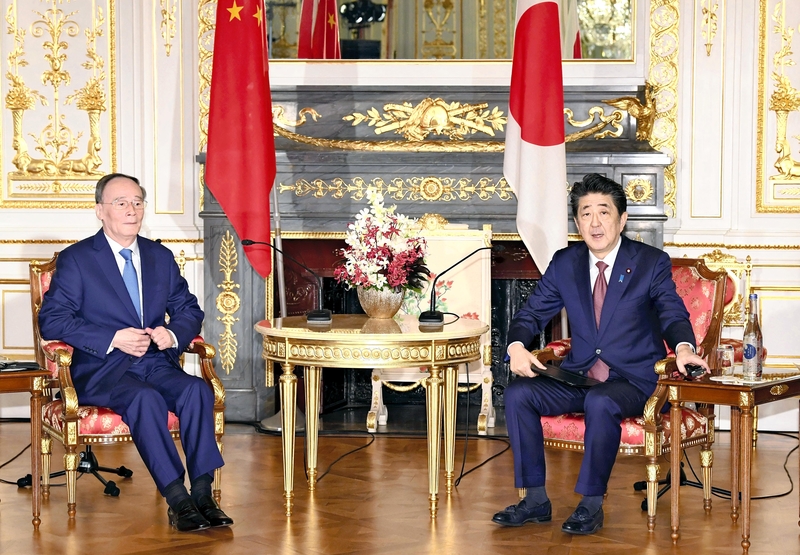
Prime Minister Shinzo Abe performed a delicate balancing act during his brief talks with Chinese Vice President Wang Qishan on Wednesday, with an eye on Chinese President Xi Jinping's planned visit to Japan next spring.
During their about 20-minute meeting at the State Guest House Akasaka Palace, Abe and Wang confirmed both nations would cooperate to make sure Xi's visit to Japan as a state guest would be a meaningful occasion.
But Abe also raised issues of concern with Wang, who was visiting Tokyo to attend the Sokuirei-Seiden-no-Gi enthronement proclamation ceremony for the Emperor. Abe pressed China to respond positively on issues including incursions by Chinese government vessels into Japanese territorial waters near the Senkaku Islands in Okinawa Prefecture.
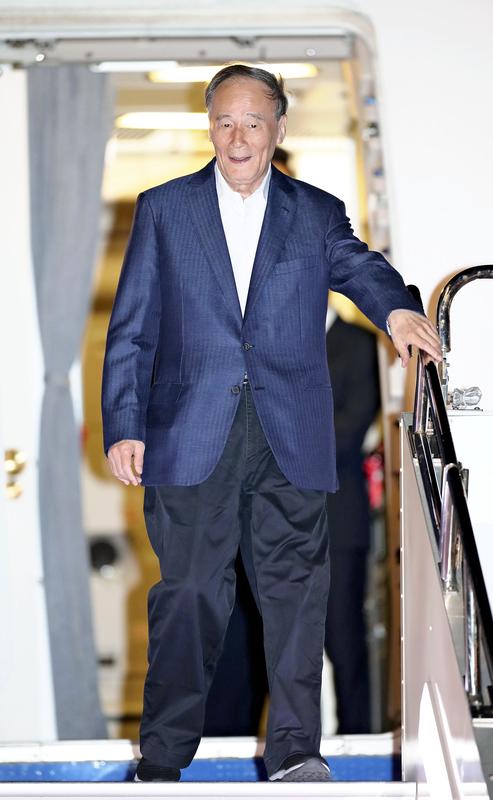
During their meeting, Abe and Wang reaffirmed that stepped-up visits by prominent government officials since last year would continue and that bilateral ties were stably developing. They also agreed to further strengthen cooperation in the economic field.
Arrangements are being made for Xi to visit Japan in April next year. The Japanese government had prepared for this visit by Wang, who had been dispatched to the ceremony as Xi's special envoy, by treating it as a "prelude to Xi's visit," a senior Foreign Ministry official said.
In terms of title alone, Wang is not on the same level as a Japanese prime minister. However, he was afforded the treatment usually reserved for another country's leader because he is a powerful figure and served as a member of the Standing Committee of the Communist Party of China's Political Bureau. Wang also held talks with Deputy Prime Minister Taro Aso, who also serves as finance minister, on Tuesday and had lunch with Chief Cabinet Secretary Yoshihide Suga on Wednesday.
Although Abe's meeting with Wang was held in a welcoming mood, Abe did raise the Senkaku Islands issue and strongly urged Wang to deal with the issue of a Hokkaido University professor who has been detained by authorities in Beijing since September, and the detention of other Japanese nationals in China. Abe also expressed concern over the situation in Hong Kong, where antigovernment protests are continuing, and called for a resolution through peaceful dialogue.
Some Japanese government officials have suggested it was "difficult" to discuss pending problems because the meeting was short and Wang had visited Japan to celebrate the Emperor's enthronement. However, a widespread view within the ruling parties, in particular, was that Abe should adopt an "undaunted attitude and tell China what it should be told." Abe apparently boldly mentioned several of these pressing concerns.
The Chinese side also considered Wang's trip to be laying the foundation for Xi's upcoming visit. According to a source who is well-informed about Japan-China relations, China promised Japan in August -- well in advance -- that Wang would pay a visit.
The Xi administration's early decision was spurred by the instability in China's relationship with the United States due to rising trade friction. Given that both Beijing and Washington have repeatedly imposed and then postponed economic sanctions, the Chinese side is also motivated to boost relations with Japan "to split Japan and the United States, and bring Japan closer to China's embrace," a China-based researcher of relations with Japan said.
The United States sent its vice president to the enthronement ceremony held to mark the start of the Heisei era, but this ceremony was attended by the U.S. transportation secretary, a member of the Cabinet. Given this, China believes sending Wang to this week's ceremony "had an even bigger effect" on bilateral ties, the researcher said.
Read more from The Japan News at https://japannews.yomiuri.co.jp/