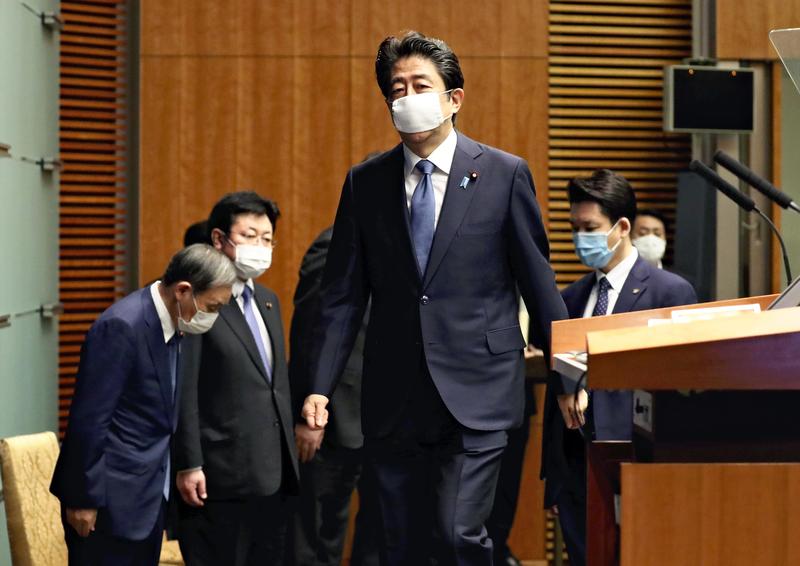
Prime Minister Shinzo Abe said Thursday the National Security Council will this summer discuss steps to strengthen Japan's deterrence, and that possessing the ability to strike enemy missile bases would be one issue up for consideration.
Acquiring this ability would mark a major shift in the nation's security policy.
"We will work out a new course of action and move quickly to implement it," Abe said at a press conference, just days after the government announced it was suspending a plan to deploy the U.S.-developed Aegis Ashore land-based missile defense system.
Abe acknowledged that North Korea's missile technologies have improved. In a nod to concerns about the emergence of missiles that would be difficult to shoot down with Japan's existing defense system, Abe said: "What should the nation do to bolster its deterrence and ability to respond? The NSC will exhaustively discuss Japan's security strategy."
The prime minister also expressed a willingness to consider a proposal from a Liberal Democratic Party division that the nation possess the ability to strike enemy bases. "We must seriously accept the situation. I want the government to hold fresh discussions on this," Abe said.
The government's position is that having the ability to strike enemy bases is allowed by the Constitution, but it has not made a policy decision to possess such a capability.
Abe's willingness to get the ball rolling on discussions regarding the ability to strike bases overseas reflects the urgency of avoiding any security "vacuum" created by suspending the Aegis Ashore deployment and rebuilding an effective defense structure.
"Peace isn't something someone gives to you," Abe said. "We will achieve it ourselves."
During the press conference, Abe spoke determinedly about speeding up discussions on the nation's new security posture. "At a time when the other side's abilities are steadily increasing, is it right to be bound by our previous discussions?" he asked.
Abe especially emphasized how Japan should deter a possible attack. "A deterrent makes an adversary, who is considering firing a missile at Japan, believe that it's better to abandon that plan. I want to hold new discussions on the shape our deterrent should take," Abe said.
Possessing the ability to strike an enemy's base was uppermost in Abe's mind. Since the end of World War II, Japan has stuck to an exclusively defense-oriented principle and, under the Japan-U.S. alliance, relied on the United States to provide the capability to attack enemy bases.
Even so, the current interpretation of the Constitution allows for possessing the ability to strike enemy bases in self-defense, provided the adversary has started preparations for a missile attack on Japan, and given that it is unthinkable that the spirit of the top law requires the nation to sit and wait for its own destruction. Japan's nonpossession of such ability has been a "policy decision."
The government already has decided to introduce long-range equipment capable of firing missiles more than several hundred kilometers. Among them are aircraft-mounted "stand-off" long-range cruise missiles for defending Japan's islands, and surface-to-surface hyper velocity gliding projectiles. It appears a plan for converting such missiles for use in attacking enemy bases will be considered.
Following a string of ballistic missile launches by North Korea in 2016 and '17, the government and the ruling LDP discussed the appropriateness of Japan possessing the ability to hit enemy bases. However, North Korea temporarily refrained from provocations such as ballistic missile launches following a U.S.-North Korea summit meeting in June 2018, so the discussions fizzled out.
Pushing ahead with consideration of possessing the ability to strike enemy bases will spark criticism that the government might make the Self-Defense Forces fight in a war. Observers believe this would reduce the likelihood of Abe achieving his long-cherished dream of revising the Constitution.
It seems Abe's announcement was aimed at adding a new aspect to his national security legacy at a time when discussions on amending the Constitution have grown stagnant.
However, quickly translating these plans into reality when the Abe Cabinet's public support rate has been slipping will likely be far from easy.
Read more from The Japan News at https://japannews.yomiuri.co.jp/