In light of a U.S.-North Korea summit to be held by the end of May, family members of Japanese citizens abducted by North Korea held an emergency meeting in Tokyo on Thursday. Speakers expressed expectations about the return of the abductees.
Also on Thursday, the two Koreas decided to hold a summit on April 27. Although the families of the abductees see these developments as a once-in-a-lifetime opportunity, they also have deep-rooted distrust of North Korea due to its many broken promises -- including the scrapping of an agreement to reinvestigate the fate of the abductees.
'Now or never'
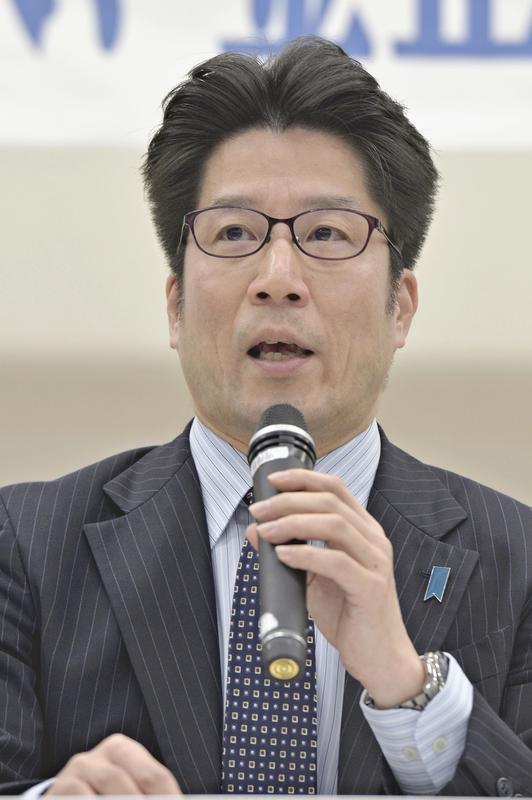
"The situation with North Korea is changing. This is our chance, and it's now or never," said Shigeo Iizuka, 79, to supporters on Thursday night. Iizuka is the older brother of Yaeko Taguchi, who was abducted in 1978 aged 22. Iizuka is a representative of the Association of the Families of Victims Kidnapped by North Korea.
North Korea, which repeatedly conducted nuclear tests and missile launches until last year, has taken the dialogue route since the beginning of this year. North Korean leader Kim Jong Un visited China from Sunday to Wednesday, where he met Chinese President Xi Jinping. On April 27, he will hold a summit with South Korean President Moon Jae In.
The situation surrounding North Korea is developing rapidly ahead of the U.S.-North Korea summit.
U.S. President Donald Trump met with Iizuka and others during a visit to Japan in November 2017. Trump listened seriously to the families of the abductees.
"I hope Mr. Trump will strongly ask Mr. Kim about concrete measures for returning the abductees to Japan," Iizuka said.
Distrust lingers
North Korea has betrayed the families of the abductees many times.
"We must never be deceived again," said Takuya Yokota, 49, at the meeting. He is the younger brother of Megumi Yokota, who was abducted in 1977 aged 13. "The sanctions should not be relaxed until North Korea takes concrete action to return all the abductees," he said.
North Korea announced in June 2008 that it would reinvestigate the fates of the Japanese abductees. However, in September that year, it said it would postpone the reinvestigation.
During Japan-North Korea intergovernmental consultations held in Stockholm in May 2014, North Korea agreed it would conduct a comprehensive and full-scale investigation. However, in February 2016, it unilaterally announced a halt to the investigation.
"We do not want vague promises, such as a reinvestigation," said Koichiro Iizuka, the eldest son of Taguchi. "I hope Mr. Trump tells [Kim Jong Un] to return all victims immediately," the 41-year-old added.
Fear of being forsaken
On the other hand, there are persistent concerns that the abduction issue will be cast aside in the upcoming discussions, which will focus heavily on the nuclear and missile issues.
Takuya and Koichiro plan to visit the United States sometime between the end of April and May to call on the U.S. government official in charge of the abduction issue to help resolve it.
A resolution was adopted at the emergency meeting of the families of the abductees. It included demands such as, "The government should take advantage of the U.S.-North Korea summit and other events to realize the simultaneous return of all the abductees."
The family members handed the resolution to Prime Minister Shinzo Abe on Friday, asking him to call on Trump to address the issue.
12 cases confirmed
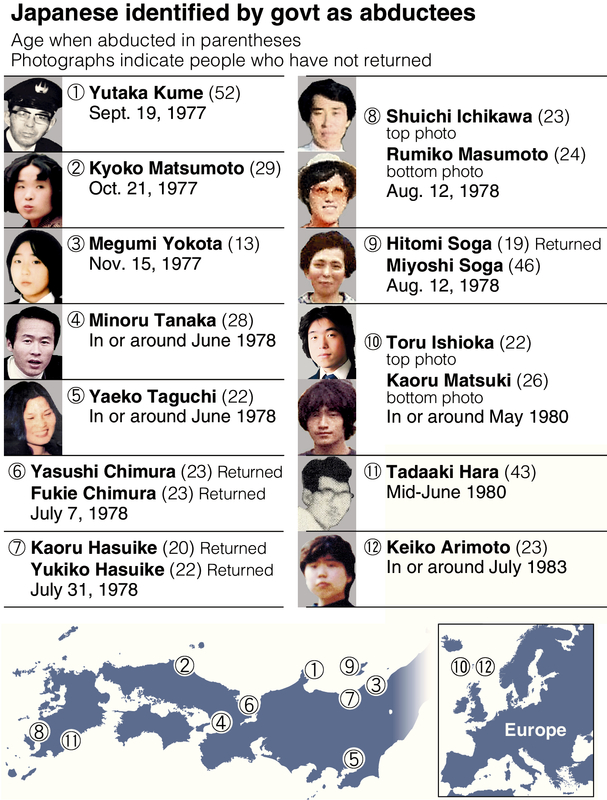
The government has recognized 12 cases of Japanese citizens being abducted by North Korea. Those cases involve 17 victims. North Korea admitted to the abductions of Japanese citizens at a summit with Japan in September 2002. Five abductees, including Kaoru Hasuike, 60, and his wife, returned to Japan in October the same year.
However, the country has not reinvestigated the issue since, and the return of the remaining 12 abductees, including Megumi Yokota, has not been realized.
The first Japanese citizen abducted by North Korea was Yutaka Kume, kidnapped in September 1977 aged 52. The abduction -- called the Ushitsu Incident -- was followed by nine abduction cases between 1977 and 1978.
Police suspect those abductions were ordered by intelligence agencies such as the external intelligence department and the strategy department, which were directly under Kim Jong Il, who later became the North Korean leader.
A series of abduction cases occurred in Europe in the 1980s targeting Japanese nationals studying there. They include Keiko Arimoto, who was abducted aged 23 when studying in Britain. It has been revealed that members of the Yodo-go group and their wives were involved in those cases. The Yodo-go group, which is affiliated with the Red Army Faction, is known for hijacking a Japan Airlines airplane and directing it to North Korea.
The Metropolitan Police Department and others have so far obtained arrest warrants for 11 suspects, including North Korean spy Sin Gwang Su, 88, and members of the Yodo-go group. The MPD asked Interpol to issue notices against them.
The National Police Agency set up a unit exclusively for the abduction issue. As of Feb. 1, 2017, it has collected information on about 883 missing people who might have been kidnapped by North Korea.
Read more from The Japan News at https://japannews.yomiuri.co.jp/