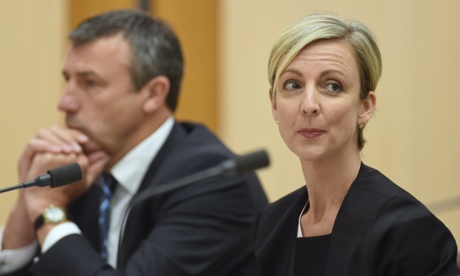
The ABC audience will be better served in local news when the eight local 7.30 programs are no longer on air, the ABC’s director of news, Kate Torney, told a Senate estimates committee on Monday.
Torney and her managing director, Mark Scott, defended the nature of their cuts to news and local production under sometimes hostile questioning from senators at the three-hour additional estimates hearing.
After Torney said she believed that ending the 7.30 programs would result not in a decrease but in an increase in the coverage of local issues, the committee chair, Queensland Liberal senator Anne Ruston, said: “Do you actually believe that the changes you’re proposing in relation to 7.30 and the news will improve the local content for people living in South Australia, Western Australia, Queensland and Tasmania?”
Torney: “Senator I do, because I believe this will be a better service to all ABC audiences and I think you won’t have to tune in at one time in the schedule to have access to the stories that are being produced by that team.”
The Queensland National party senator Matthew Canavan repeatedly asked Torney whether the resources that were being cut from 7.30 were being transferred to the news bulletins, but he became frustrated with the answers.
“Ms Torney, I’m not really understanding your answer to my question; it was a pretty simple question,” Canavan said. “Has any of the resources from shutting down the 7.30 state-based shows gone to increase resources of the 7pm news broadcasts on a state basis?”
Torney said some of the staff would be retained and would work across TV, radio and online where more of their content would be seen than before, but she admitted the studio production costs from the eight shows was a saving.
Scott said while it wasn’t a popular decision to end the local editions of 7.30, the audiences had started to drift away from the Friday editions and they had to listen to the audiences and not “quarantine” state-based coverage in one timeslot.
He was also under pressure to admit that some of the changes to the ABC he outlined to staff last week were measures he wanted to make long before the government imposed a 5% budget cut over the next five years.
He was asked by the independent senator Nick Xenophon if the savings from shutting down the ABC TV studio in Adelaide would be used to fund the ABC’s digital expansion.
“We are going to be using that money to invest in online and mobile,” Scott said.
Xenophon: “So you’re shifting it sideways, you’re cutting Adelaide, it’s not going back as an efficiency dividend?”
“We’re putting it in as part of the $20m investment pool I’ve talked a lot about here. And what are we spending that money on? We’re spending that money to enhance online news and deliver that in a mobile sense, we’re spending that money to stream ABC local radio stations and we’re spending that to enhance iView.”
The hearing came hours after the Department of Communications released the Lewis review on its website.
In a note attached to the review the minister for communications, Malcolm Turnbull, repeated his belief there was no need for the ABC to reduce the amount of money it spends on what he called “front-of-house” or programming.
“One ‘back-of-house’ element in the public broadcasters’ overhead, that costs approximately $290m a year, is radio and television transmission and distribution,” Turnbull said.
“It was not included in the efficiency study because a separate analysis was already underway which has resulted in a new funding model and contract process, with negotiations currently underway, which is expected to deliver material transmission savings that will in turn make a very substantial contribution to the savings required by the government.
“These transmission savings added to efficiency measures identified by the study are well in excess of the budget savings required.”
The ABC will appear before Senate estimates again on 12 December.