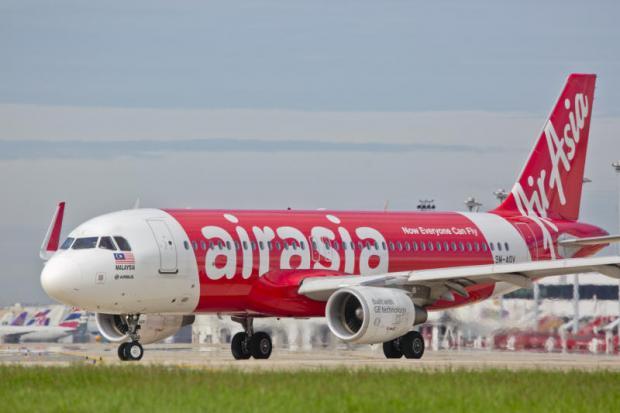
SET-listed Asia Aviation Plc (AAV), the majority shareholder of Thai AirAsia Co (TAA), has announced its operational results for 2018, reporting total revenue of 40.2 billion baht, up 8% year-on-year.
Higher fuel costs and a slowdown in Chinese tourists shrank profit to 70 million baht, compared with 1.47 billion in 2017.
Santisuk Klongchaiya, chief executive of AAV and TAA, said that while fuel costs on the global market were higher in 2018, the carrier was able to maintain low fares through efficient capital management and diligence.
Fuel costs, which account for 37% of the airline's expenses, rose to an average US$85.20 a barrel in 2018, up 32% from $64.30 a barrel in 2017, the company reported to the SET.
The boat accident off Phuket that killed 47 Chinese tourists last July resulted in a decline in arrivals from the mainland in the following months, but the situation improved notably in the fourth quarter last year after the government waived the fee for visas on arrival for 21 nations including China from Nov 15, 2018 to the end of April this year.
Mr Santisuk said the airline last year served 21.6 million passengers with an average load factor of 85%, compared with 19.8 million in 2017 with an average load factor of 87%.
In 2019, the airline aims to procure four more aircraft to secure robust growth in Cambodia, Laos, Myanmar and Vietnam (CLMV), as well as Indian networks. Last year, the airline served 2.2 million passengers in CLMV, accounting for 10% of all passengers served and up 12% from 2017.
The airline completed the year with a fleet of 62 aircraft (six aircraft added to a 2017 fleet of 56). In the fourth quarter of 2018, the airline has seen a gradual recovery in passengers due to positive sentiment from supportive state policies that included a waiver on visa fees for tourists seeking visas on arrival. As a result, for 2018, TAA achieved total revenue of 40.19 billion baht and profit for the year of 127.5 million baht.
In 2019, the airline will acquire four more aircraft to take its fleet to 66 and will work on diversifying its network, including adding a seventh flight hub in Chiang Rai and more international routes between regional bases.
To stabilise revenue, the airline will increase passenger share in the CLMV and Indian markets after already establishing a stronghold among Chinese tourists. A target of 23.15 million passengers has been slated for 2019, with an average load factor of 86%.
The airline will add three new routes to Vietnam, namely Bangkok-Can Tho (three flights a week) starting May 2, Bangkok-Nha Trang (four flights a week) starting May 1 and Chiang Mai-Da Nang (one daily flight).
Meanwhile, the Office of Trade Competition Commission (OTCC) said that if AAV is set to buy a stake in rival low-cost airline Nok Air, it must abide by the Trade Competition Law because the acquisition could create market dominance.
Santichai Santawanpas, a spokesman for the OTCC, said AAV needs to get permission from the commission, which will examine whether the merger means to raise the market share of AirAsia in the low-cost airline business to exceed 50% or annual sales above 1 billion baht.
Such market domination of the business may be approved if the operator pledges to operate fairly, he said.
Asia Aviation did not specify how much of Nok Air it would buy, but there is a report that the targeted stake is the 53% held by the Jurangkool family.