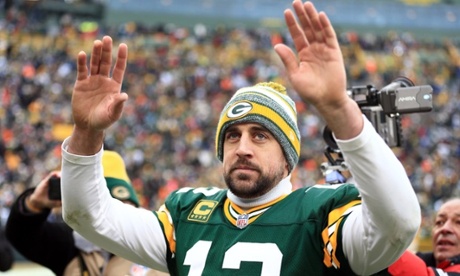
The logic that led to Aaron Rodgers being crowned as the NFL’s Most Valuable Player is easy enough to follow. He was the best in the league this season at his sport’s most important position. Quarterbacks not only get their hands on the football more often than anybody else, but in most cases also have the authority to change plays at the line. By the nature of their role, they influence proceedings more than any team-mate ever could.
No rival shouldered that responsibility as brilliantly as Rodgers in 2014. He threw 520 passes but was intercepted just five times – the best ratio of any player who finished the year with more than 100 attempts. His passer rating was an extraordinary 112.2 and his 8.4 yards per attempt second only to Tony Romo. He led his team to the NFC Championship Game despite finishing the season with a torn calf muscle (although his playoff performance will not have been considered by awards voters, who submit their nominations at the end of the regular season).
And yet, his triumph at Saturday’s NFL Honors ceremony still left a bitter taste in the mouth. Rodgers’ achievements were worthy of recognition. But another player had deserved the plaudits even more.
JJ Watt does not play at an inherently glamorous position. In a typical 3-4 scheme, a defensive end’s first priority is to occupy blockers and close down running lanes, leaving linebackers free to serve as their team’s primary pass rushers. It is a fact worth keeping in mind when you consider that only six players in NFL history have ever managed more than the 20.5 quarterback sacks that Watt registered this year.
He achieved the same tally in 2012, making him the first player ever to reach 20 in two separate campaigns. But that is only the tip of the iceberg. Watt also racked up 78 tackles in 2014 – second-most on Houston’s team – giving the lie to any suggestion that his pass-rushing feats were achieved through ignoring his duties elsewhere. He also forced four fumbles, recovered five and broke up 10 passes. To put the last number into perspective, even the league’s most productive cornerbacks finished the year in the low 20s.
Most remarkably, he also scored five touchdowns. One came on an 80-yard interception return, and another on a 45-yard run-back after a fumble. The remaining three were achieved on offense, after the Texans began using Watt – who had some experience of playing tight end in high school and college – as a goalline pass-catcher as well.
Short of taking snaps at quarterback himself – and given Houston’s poor production from that position over the last few seasons, some fans might be happy to see him try – Watt could hardly have done any more. That all this was still not enough for him to be named MVP makes it hard to imagine how the award would ever go to a defensive player again.
It has, admittedly, happened only twice before. Vikings lineman Alan Page was the first, in 1971, and Giants linebacker Lawrence Taylor the second 15 years later. But it has become even harder for defenders to make an impression since then, as quarterbacks – aided by a gradual rules shift – become increasingly prolific.
Rodgers was one of nine players with more than 30 passing touchdowns this season, whereas only Dan Marino had more than 25 when Taylor claimed his award in 1986. Nobody had more than 21 in the year when Page became MVP.
Instinctively, it feels like the increasing number of quarterbacks posting such numbers should make it harder for a player at that position to be named as MVP – their achievements devalued by the fact that they have become commonplace. As great as Rodgers was this season, you could not really characterise him as an outlier like Watt.
But the value of the MVP is itself being undermined by semantics. The 50 voters who assign the award were justified in choosing Rodgers, because he was, quite literally, the most valuable player in the league. Take him away from the Packers, and you would likely see a more dramatic drop-off than if the Texans were deprived of Watt (although Houston would certainly suffer dramatically), because a capable quarterback is necessary to win games in what is now a passing league.
Some might also point that Watt failed to elevate the Texans into a playoff team – although the notion that an individual must reach the postseason to be the most valuable is questionable in a team sport. In Watt’s case, it is perhaps even more remarkable that he was able to wreak havoc while playing on an otherwise modest defense, where the lack of talent around him allowed opponents to double- or triple-team him on many plays.
One former NFL coach made the argument to me recently that the league should rebrand the MVP award as ‘Most Outstanding Player’ – as is used in the Canadian Football League and NCAA. It is a subtle linguistic change that could make all the difference in the world. Watt might not literally have been the most valuable player in the league this season, but he clearly stood out like no other. Somehow, that achievement, feels more worthy of recognition.