As you age, it's natural to lose some mobility, and the hips are where many people will experience stiffness. This is made worse by modern life’s habits spent sitting, further reducing their range of motion.
Fortunately, this isn’t irreversible. And, according to Yoga-Go instructor Melissa Leach, there's one pose that's particularly effective at mobilizing your hips.
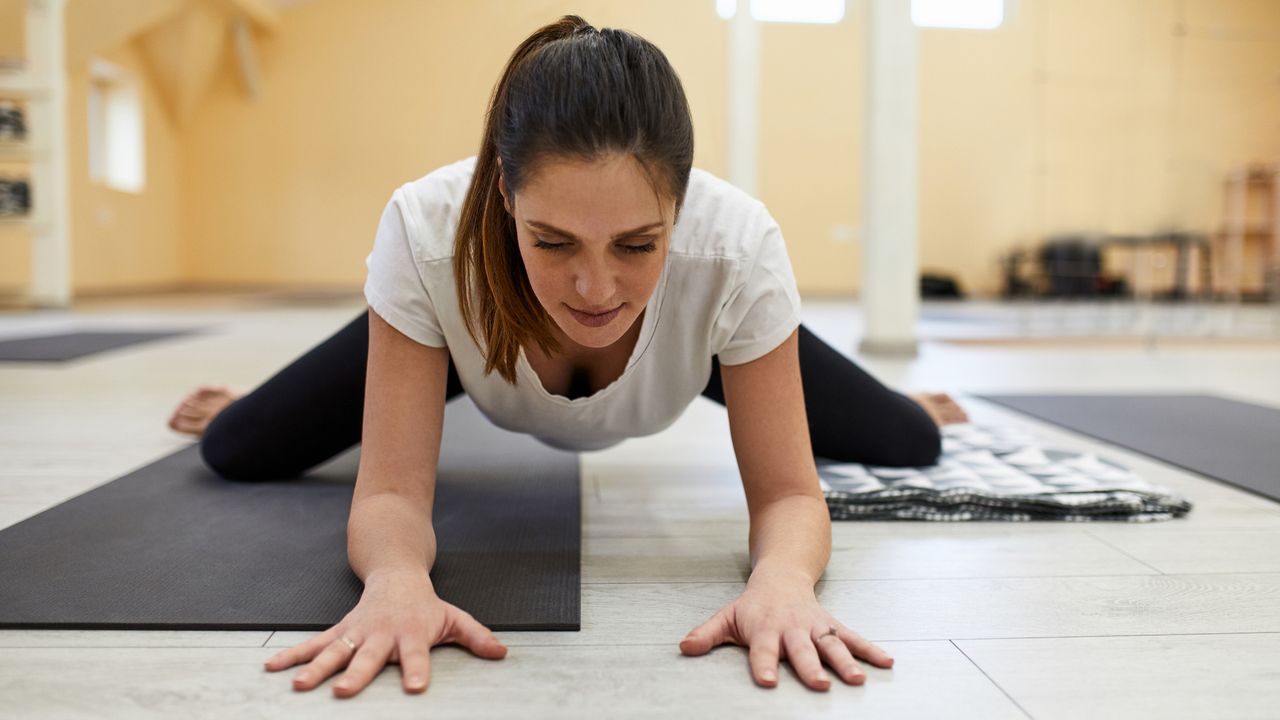
"Mandukasana, or frog pose, is a hip-opening posture designed to stretch the groin, inner thighs, pelvis and hip joints to improve hip mobility and relieve lower-back tension," she tells Fit&Well.
“As you enter your 40s, muscles naturally begin to lose mass and strength," Leach explains. "Flexibility can also begin to decrease as joints become stiff."
“Frog pose promotes hip mobility and flexibility as it is an intense hip opener," she says. “It can relieve tightness caused by everyday activities such as driving, sitting or cycling."
It's not the most common yoga pose and the traditional version requires a base level of hip mobility. However, that doesn't mean you shouldn't give it a go.
Below, Leach has shared some modifications for people of all ages and flexibility levels, so you can experience the benefits.
How to do frog pose
Hold: 30-60sec
- Start on your hands and knees then slide your knees wider apart.
- Rest your lower legs flat on the floor.
- Adjust your shins so they’re parallel and your ankles in line with your knees, not flaring in or out.
- Lower your torso onto your forearms, keeping your chest open.
- Keep your core lightly engaged by squeezing your abdominals and tucking your pelvis.
- Gently push your hips back toward your heels, feeling a stretch in your inner thighs.
- Hold for 30 to 60 seconds while breathing deeply.
- To release the pose, walk your hands forward slightly and slowly bring your knees together again.
Good form is essential to getting the most out of this posture and avoiding injury. According to Leach, that means you shouldn’t push yourself and instead, respect your body’s natural limits.
“Rather than pushing your knees as wide as possible, only go as wide as what feels comfortable while maintaining proper tension and alignment,” Leach advises.
“Make sure your ankles stay in line with your knees with 90° angles at the joints,” she adds.
It can also be helpful to think about the direction of your hips, in order to practice good form. “As you move into the stretch, focus on pushing your hips backwards rather than dropping straight down, which can be a common mistake,” Leach says.
How to modify frog pose
Use a block to support your hips
If you have tight adductors (inner thighs) or limited flexibility in your hips, Leach recommends placing a yoga block or a cushion underneath your hips in the pose.
“This helps to reduce the pressure on your hips, alleviating any potential discomfort,” she explains.
Prop up your chest with a bolster
You can also place a cushion under your chest, which will further support stiff hips by reducing the intensity of the stretch, according to Leach.
Try a half frog pose
If this pose feels too challenging, Leach suggests trying a half frog pose, which involves keeping just one leg flat to the floor to your side, while stretching the other leg out behind you.