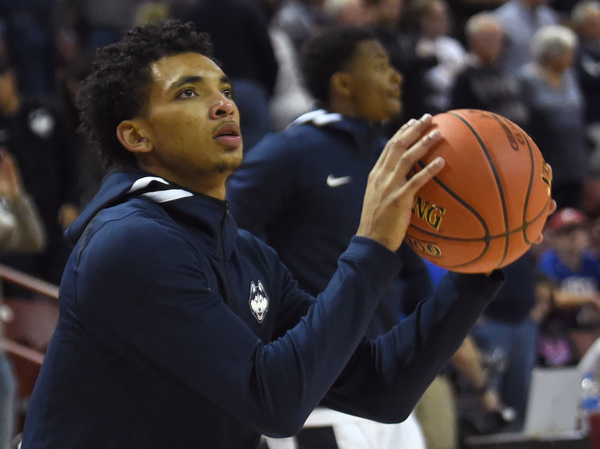
Sooner or later, as the course of the pandemic allows, the lights will go on and James Bouknight will stand in the glare. The NBA's talent evaluators will be watching, listening. Opposing coaches will be looking for a sign of vulnerability for their relentless defenders to exploit.
Bouknight, 20, is ready for all this, he and everyone around him is certain about that. He's bigger, stronger, wiser and more sure of himself as his sophomore season dawns at UConn.
"My confidence is at an all-time high," Bouknight says. "I feel like I have different abilities. I've been working on my game all summer, getting stronger, faster, more explosive. I'm the closest with my teammates that I've ever been, I feel like we're in a good space right now, and I'm in a good space."
Good space was far from the place one would have found Bouknight a year ago, as his freshman season with Dan Hurley's UConn men's basketball team was approaching. Oh, he had come in with high expectations, and earned high praise for his skills then, too.
But in the early morning hours of Sept. 27, 2019, Bouknight left a get-together on campus, jumped behind the wheel of someone else's Audi sedan and made a series of bad decisions, all well chronicled later, because that comes with playing for UConn.
After hitting a road sign in Storrs Center, he ran from police. He was later charged with evading responsibility, interfering with a police officer, traveling too fast for conditions and operation of a motor vehicle without a license. Coach Dan Hurley suspended Bouknight after the incident became public.
"He was aware," says Maurice Clarett, the former college football star whose own career was derailed by off-field troubles. "Listen, you know when you do stupid crap. He was like, 'man, I did this. I shouldn't have done it. I'm going to mess up my opportunity.' The thing is, when you do bonehead stuff, you don't expect to get caught. When you get caught, you're like, 'man I shouldn't have done it.' But you have to own it. That's how you get through it. To be free, you have to own stuff."
Clarett, 37, who had told the Huskies his story a few months earlier as part of a summer lecture series Hurley had arranged, became a consultant for the program and took a special interest in Bouknight.
"I love the dude," he says. "We can make a moment bigger than it is, if we let it define us. You hold yourself accountable and then you move on."
Bouknight had support around him. His mother, Patty Leo, and father John Bouknight and his immediate family back in Brooklyn; his older teammates at UConn, like Christian Vital and Alterique Gilbert, who admonished him to "stay in the fight;" his prep school coach, Jacque Rivera, and his AAU coaches in New York. "There's a support system that wraps itself around your life when you need it most," Rivera says.
Hurley, who has described himself as "a mess" as a young college player in the early 1990s, took on the challenge of putting Bouknight's basketball dreams back on the rails with his mix of empathy and tough love.
"Credit the growth to Coach Hurley," Rivera says. "For taking his hand and walking him through this entire process is the transition of taking somebody from a boy to a man."
On Nov. 18, 2019, Bouknight, with his attorney, Rob Britt, appeared in Rockville Superior Court, where he was accepted into the accelerated rehabilitation program, agreeing to pay for the damage caused in the incident.
"I'm extremely sorry for what happened," Bouknight told reporters in the lobby when the process was finished. "I'm learning from this. I'm learning I need to be the student, best athlete, best citizen I can be."
One year later, with no further trouble, Bouknight completed the requirements of the accelerated rehabilitation program and the case was dismissed.
"Coming in here as a super-talented freshman," Hurley says, "but not quite at the maturity level, his maturity level and development as an individual has been really, really, impressive."