There is a new series that popped up on Netflix that is absolutely terrifying.
I admit to enjoying the occasional horror movie or series. In my local multiplex I recently saw Pet Sematary (not as good as the original) and Jordan Peele's Us (bordering on stupid, if not already there).
There is nothing like maggot-ridden zombies or ghosts haunting American suburban families to send me to restful sleep, and Netflix is chock-a-block with such things.
Having waded through Black Mirror, Z Nation and Stranger Things, a new series has popped up that blows every single one of them out of the water.
It's terrifying. I watched it over Songkran and it chilled me to the bone.
It's called Our Planet, and it's a nature series.
This is a series which, at the end of each episode, leaves you with a panic-stricken pit in your stomach. I could never binge-watch this series like I did with, say, Parks And Recreation or Broadchurch. Watching more than one episode of Our Planet at a time would incite me to jump out of a tall building.
Our Planet explains, step by step, how our world is changing. The ice caps are melting. The food chain is collapsing. That change is rapid and is about to affect every single one of us in a big big way. And it's not good.
Actually that's not right; the world is not in peril. We human beings are.
I caught a glimpse of it last Monday in the eastern province of Rayong, where I wrote this column.
My school is staging the camp for 200 kids in Ban Chang, as we have done every six months for the last few years. My job, as head of the operation, is something akin to camp leader, which is a pleasant way of saying "performing monkey". I am wheeled out in the beginning of each day, and then again at the end. Only this time, I nearly was literally wheeled out.
Yesterday, on day one, for a few seconds there I felt the world going dark, a weird kind of detachment from what I was doing -- and the sudden realisation that if I didn't stop running around, I would be on the floor, and not in a good way.
Yesterday in my world was last Monday, when temperatures in Rayong edged towards 40 degrees. A humid, still, stifling 40 degrees.
It wasn't a pretty sight. My camp session requires me to jump around, run around, even sing a song which requires a little ungainly dancing. It's a routine I have done a hundred times before, only this time, I was aware of the oppressive heat surrounding me. Without proper hydration, and with advancing years, I walked off that stage with the express intention of needing to sit down before I fainted.
Rayong is unusually hot this year. It's not just Rayong. It is the whole country. Temperatures are 1.5 degrees higher than last year according to the Bureau of Meteorology.
It conforms to the worldwide trend of rising temperatures and the fact that the whole world, this year, got one degree hotter. In Australia over summer the roads melted, the train tracks buckled, and fish died in lakes.
I can't explain how oppressive the heat was last Monday. It wasn't just uncomfortable. It was a harbinger of what's coming.
How much longer can temperatures rise one degree per year before we are all dead? Well … about 10 years, right? I can't imagine too many of us doing what we are doing right now in our daily lives if the temperature is scraping 50 degrees.
Perhaps the rise is exponential. Maybe next year in Rayong it's going to be 42 degrees, then 45 in 2021. This news worries me -- I'm much too young to die! And please, not in front of 200 children.
Ten years is about how long we've got, according to that recent United Nations report on climate change. Humanity has to make drastic changes right now, such as weaning ourselves off the drug that is oil. But is that truly going to happen? Right now? Of course it's not. There is too much economically at stake. We humans are creatures of habit, not to mention greed and avarice. And creatures of stupid, too, as the president of the United States has shown himself to be. The world is burning up, and he wants to burn more good ol' American coal.
The day after my Rayong near-meltdown, CNN reported that Greenland is now melting at such a rate that it is having an effect on sea levels around the world. It is melting six times faster than it was in the 1980s. So let's get this straight; not only are we going to burn up, but we're also going underwater.
I agree with the kid who came out and made a very wise observation two weeks ago when Notre Dame Cathedral tragically burned down.
In the first 48 hours of the destruction, approximately US$730 million were pledged in restoration funds. That rose to a billion bucks by the end of the week, thanks to wealthy French companies such as L'Oreal and Total.
It took a 16-year-old kid to put it all into perspective.
How is it that we humans can collectively rise to a challenge -- in Notre Dame's case almost instantly -- when we are standing on the brink of our extinction and doing nothing about it?
Greta Thurberg is that kid; one of a handful of well-known environmental activists who have yet to see their 18th birthday. She's from Sweden. She's the kid who made the news last year when she played hooky and sat outside Swedish Parliament, protesting about the government's inaction over climate change.
How angry she must feel to be cheated of her future, thanks to my generation's addiction to oil and other climate-changing behaviour. Greta's protest sparked off waves of kids doing the same. Aussie kids did it, standing outside Parliament, with our less-than-stellar Prime Minister, Scott Morrison, reacting by telling them to "go back to school" and stop being so active over climate change. This impending Australian election will hopefully send Morrison to his oblivion before it is humanity's turn.
Greta spoke at the EU Parliament this week. "I want you to panic," she said to her influential audience. "I want you to act as if your house was on fire."
Another child protester, a 12-year-old Irish girl Sumaya Mohammad, addressed the Joint Committee on Climate Action in March and her speech was devastating.
"You guys grew up worrying about what job you'd get, how you'd do in exams, who you'd fall in love with. We grow up worrying about how long we have left to live," she said.
She's right. I can't remember it being so constantly and relentlessly hot as it was in Rayong this week.
We humans are so amazing in so many ways. We are also so fundamentally stupid and blinkered in our vision. It is ironic that perhaps in as little as in 10 years' time, the magnificent Notre Dame will be returned to all its glory, a rising spire on Paris's skyline, as glorious as it ever was.
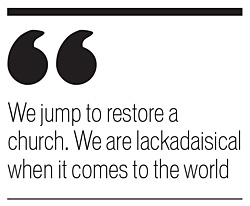
Such a pity there may be just a handful of us around to enjoy it, if any. We jump to restore a church. We are lackadaisical when it comes to the world.