You won’t find Trappes or Sarcelles in any Parisian travel guide. These two suburbs of the French capital, Trappes to the south and Sarcelles to the north, are not on the tourist route and among Parisians they’re notorious for recent cases of civil unrest.
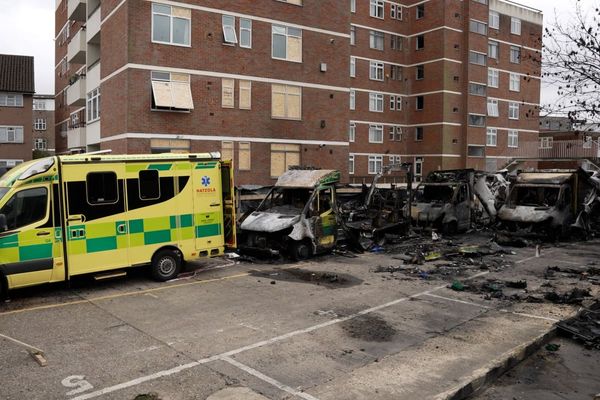
In 2013 a riot erupted in Trappes after police arrested a man who had tried to prevent them checking the identity of his veiled wife. Last year in Sarcelles, a 500-strong mob destroyed several Jewish shops when a pro-Palestinian rally turned violent.
Yet neither Trappes nor Sarcelles deserves its reputation as a Gallic Dodge City and the two suburbs – known in French as the banlieues – will have much about which to feel proud when France take to the field for their opening World Cup match against Italy on Saturday evening. The starting loosehead prop Eddy Ben Arous was born in Trappes while, on the other side of the scrum, the tighthead Rabah Slimani is a son of Sarcelles. How times have changed. The two props who played for France in the 1987 World Cup final, Pascal Ondarts and Jean-Pierre Garuet-Lempirou, were men of the deep south-west, born and bred on the edge of the Hautes-Pyrénées.
Most of the French squad in the inaugural World Cup had similar roots, and only Serge Blanco bucked the trend, the brilliant full-back born in Caracas to a Venezuelan father and French mother. Diversity runs through the 2015 France squad. Not only are there three South Africans among the 31 players, there is also a New Zealand-born Samoan (Uini Atonio) and a Belgian (Vincent Debaty). The captain, Thierry Dusautoir, was born in Ivory Coast while his fellow flankers Fulgence Ouedraogo and Yannick Nyanga hail from Burkina Faso and the Democratic Republic of Congo respectively. The trio of flankers arrived in France as boys and learned the game at clubs in the south of the country, French rugby’s traditional heartland.
It wasn’t so easy for Ben Arous and Slimani, nor for Mathieu Bastareaud and Wesley Fofana, fellow Parisians from ethnic minorities. Bastareaud, who will also start in the centre at Twickenham against Italy, was discovered by Alain Gazon, now the director of Racing 92’s rugby school but for more than 20 years a tireless physical education teacher in the Paris suburb of Massy. “Massy has a population of about 40,000 and around 30% is of immigrant origin,” says Gazon. “There are Malians, Ivorians, Algerians, Moroccans and Tunisians and, initially, it was a challenge to convince their parents to let their children play rugby because they knew nothing about the sport or its culture.”
Gazon explains that his objective was to keep the kids off the streets and on the rugby pitch. “Gradually I won the parents’ trust and, backed by the local council, we began to get more of the kids from the estates playing rugby.”
Gazon’s first major success was the wing Jimmy Marlu, who was signed from Massy by Clermont in 1996 and was a member of the France squad at the 1999 World Cup. The French reached the final that year but, despite their success, rugby remained – in the eyes of most of the country’s ethnic minorities – a sport that was outside their ken. It took the 2007 World Cup to radically transform the image of rugby in France.
“In the last 10 years rugby has undergone what we call in France a huge médiatisation” explains Jean-Paul Dispans, manager of Stade Français’s rugby school. “Professionalism has obviously played its part but France’s hosting of the 2007 World Cup was very important because, for the first time, rugby became mainstream in the media. It emerged from its rather narrow world and people across France, not just from ethnic minorities, saw that it was a sport for everyone.”
The year before France hosted the World Cup, Dispans had welcomed to Stade Français a shy, slightly overweight 16-year-old from Sarcelles. “Rabah Slimani was a No8 when he arrived but I quickly saw he was best suited to the front row,” recalls Dispans. “What stood out about Rabah, other than his physique, was his work ethic. He was focused, determined and willing to work hard at improving his game.”
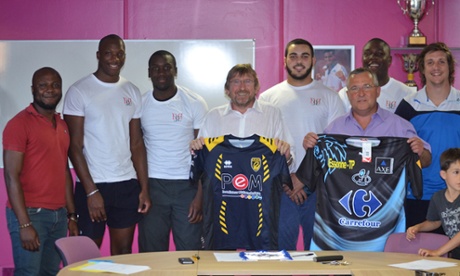
Stade Français also work hard, as do Racing 92, in talent spotting local kids regardless of their background. One of Stade’s summer signings was the 20-year-old Sekou Macalou, the France under-20 flanker regarded as an outstanding talent. Like Slimani, Macalou began his career at Sarcelles, then played a couple of seasons for Massy in ProD2 [France’s second division] before signing a three-year deal with Stade Français. One of Macalou’s former team-mates at Sarcelles, Judicaël Cancoriet, has just signed a similar contract with Clermont, a remarkable claim to fame for a small club in a region where most kids walk around in replica PSG shirts.The driving force behind Sarcelles is Bruno Balluais, president of the club for 20 years. Sarcelles hosts an annual summer tournament in conjunction with local schools, the most recent of which involved 1,400 children. Slimani played in one such tournament a decade ago but Balluais says it’s not just about identifying talent.
“A lot of the kids come from tough backgrounds and haven’t really had any rules in their lives,” says Balluais. “We want to teach them the fun of playing rugby but also get them to learn about discipline, rules and respect for others.”
Organised sport in French schools is virtually non-existent. Instead children must join local clubs and indulge their passion on a Wednesday afternoon and at weekends. But Dispans believes this gives the French an advantage over the British method. “In England youth rugby is still very much tied to the schools whereas in France it’s linked more to clubs and local community associations. So it’s more accessible to inner-city kids who don’t have the chance to play rugby at school.”
What the likes of Dispans, Balluais and Gazon are doing is making rugby not just accessible to France’s ethnic minorities, but aspirational. “The presence of Bastareaud, Wesley and the others is very important to the kids from the estates,” says Gazon. “They see what’s possible.” For the French team, too, unexpected finalists in 2011, anything is possible at a World Cup.