When Parliament reconvenes for the monsoon session, the most important political battle may not be fought across the treasury and opposition benches but within the opposition itself.
A dramatic split in the Trinamool Congress, the collapse of the Congress-DMK alliance, and fresh uncertainty surrounding Shiv Sena (UBT) have together altered the parliamentary arithmetic that underpins the INDIA bloc. The changes are significant enough to potentially strengthen the Narendra Modi government's hand on some of its most ambitious legislative goals, including a possible revival of the contentious delimitation-linked women's reservation bill that failed earlier this year.
Also Read: As Shiv Sena, TMC splits swell NDA ranks, TDP and JDU lose some of their bargaining chip
For months, the BJP's challenge was straightforward. Despite commanding a comfortable majority in the Lok Sabha, it lacked the numbers needed to push through bills, which require support from two-thirds of members present and voting.
That weakness was exposed in April when the government's Constitution (131st Amendment) Bill failed to secure the required backing in the Lok Sabha. The Modi Government managed the support of 298 members, well short of the threshold of 352 required for a constitutional amendment. BJP and its allies had secured 293 seats in the 2024 Lok Sabha elections.
The political landscape has shifted considerably since then.
Also Read: Can Eknath Shinde get 6 of 9 UBT MPs for a split? Numbers on a knife's edge
The TMC factor
The biggest change has emerged from West Bengal. Rebel Trinamool Congress MPs merged with a lesser known Nationalist Citizens Party of India (NCPI) that made its electoral debut in the 2023 Assembly polls in Tripura.
They claim the support of 20 of the party's 28 Lok Sabha MPs and have indicated their willingness to back the NDA on key legislative issues
If those numbers hold, the government's demonstrated support base in the Lok Sabha would rise from 298 to 318 MPs.
On paper, that still leaves the BJP-led alliance far short of the current two-thirds mark of 360 MPs in the 540-member House, after accounting for three vacancies.
But the gap is no longer insurmountable. More importantly, it transforms the BJP's challenge from building an entirely new coalition to securing a smaller number of additional votes, abstentions or strategic absences.
The implications extend beyond the Lok Sabha.
The crisis within the TMC has already triggered resignations in the Rajya Sabha, reducing the party's strength and creating vacancies that could eventually benefit the NDA.
Earlier this year, seven AAP Rajya Sabha members had already crossed over, lifting the BJP's strength in the Upper House and nudging the NDA's tally closer to the numbers required for difficult legislation. The NDA currently has 148 members in the Rajya Sabha and is inching closer to a two-thirds majority of 163 votes.
The DMK dilemma
The breakdown of the Congress-DMK alliance following the Tamil Nadu Assembly elections has weakened one of the strongest pillars of the INDIA bloc and opened new possibilities in Parliament.
The DMK's 22 Lok Sabha MPs were among the strongest critics of the Centre's delimitation proposal earlier this year.
Their objections centred on a fear shared across much of southern India: that any redistribution of parliamentary seats based on population growth would disproportionately benefit northern states while reducing the relative influence of states that had successfully controlled population growth.
Ahead of the Tamil Nadu elections, outgoing Chief Minister M.K. Stalin had insisted that any delimitation exercise should be based on the 1971 Census and sought written assurances from the Centre on the issue.
Yet the changed political environment has sparked speculation that the BJP could seek some form of understanding with the DMK.
Because constitutional amendments require a two-thirds majority of members present and voting, abstentions effectively reduce the threshold required for passage. If all 22 DMK MPs were absent during voting, the BJP's path to securing the necessary numbers would become considerably easier.
What happened over the delimitation matter
The debate is not merely about women's reservation.
The earlier legislation became controversial because opposition parties argued that it would fundamentally reshape India's political geography.
At the heart of the dispute lies delimitation — the process of redrawing parliamentary constituencies and redistributing Lok Sabha seats among states.
Southern states, including Tamil Nadu and Kerala, fear they could lose relative influence if future seat allocation is based on more recent population figures, while northern states such as Uttar Pradesh and Bihar could gain substantially.
The BJP, however, argues that the end of the constitutional freeze on delimitation makes some form of legislative intervention necessary. That argument is expected to form a key part of any outreach to the DMK.
Another front opens in Maharashtra
Complicating matters further for the opposition are fresh rumblings within Shiv Sena (UBT).
Reports that some MPs may be in touch with Chief Minister Eknath Shinde's Shiv Sena have prompted the party leadership to move quickly to project unity. "We called a parliamentary meeting. A whip has been released, so it should mean every MP should be present," Shiv Sena (UBT) MP Anil Desai said this week.
Party leader Arvind Sawant dismissed speculation about imminent defections.
"These recent developments and actions are not being done in consultation with Uddhav Thackeray or us. We are receiving this news through media reports. No one from our party has stated they are leaving," he said.
The backdrop is what Maharashtra's political circles have dubbed "Operation Tiger" — speculation that several of the party's nine Lok Sabha MPs may be considering a switch to the Shinde camp.
Whether those rumours translate into actual defections remains uncertain.
But for an opposition alliance already grappling with turbulence in West Bengal and Tamil Nadu, the timing could hardly be worse.
A changing coalition calculus
According to an analysis by ET Bureau, the churn within the opposition could have consequences beyond Parliament's floor arithmetic. If the breakaway in the TMC materialises and more Shiv Sena (UBT) MPs cross over to the NDA fold, the BJP would not only strengthen its legislative position but also subtly reshape the internal balance of power within its own alliance.
Since falling short of a majority in the 2024 Lok Sabha election, the party has relied heavily on the Telugu Desam Party (TDP) and Janata Dal (United) to keep the NDA in power, giving both allies considerable leverage over government formation, policymaking and strategy.
That new reality was reflected in the coalition's early decisions, with the first Budget of the third Modi government carrying significant allocations and flagship projects for Andhra Pradesh and Bihar.
A strengthened Eknath Shinde-led Shiv Sena, combined with a breakaway Trinamool faction aligned with the ruling coalition, would create additional centres of support for the BJP, giving it greater room to manage alliance politics and reducing the influence of any single partner over the government's legislative agenda.
The development does not make TDP or JD(U) any less important, particularly on constitutional amendments that require a two-thirds majority in Parliament. But politically, it signals a broader strategy by the BJP to widen its coalition beyond its present allies.
A monsoon session unlike any other
The NDA still lacks the numbers to push through a constitutional amendment on its own. Any attempt to revive delimitation-linked legislation would require careful negotiation, strategic floor management and support from parties beyond its formal alliance.
Yet the arithmetic is unquestionably moving in the BJP's favour.
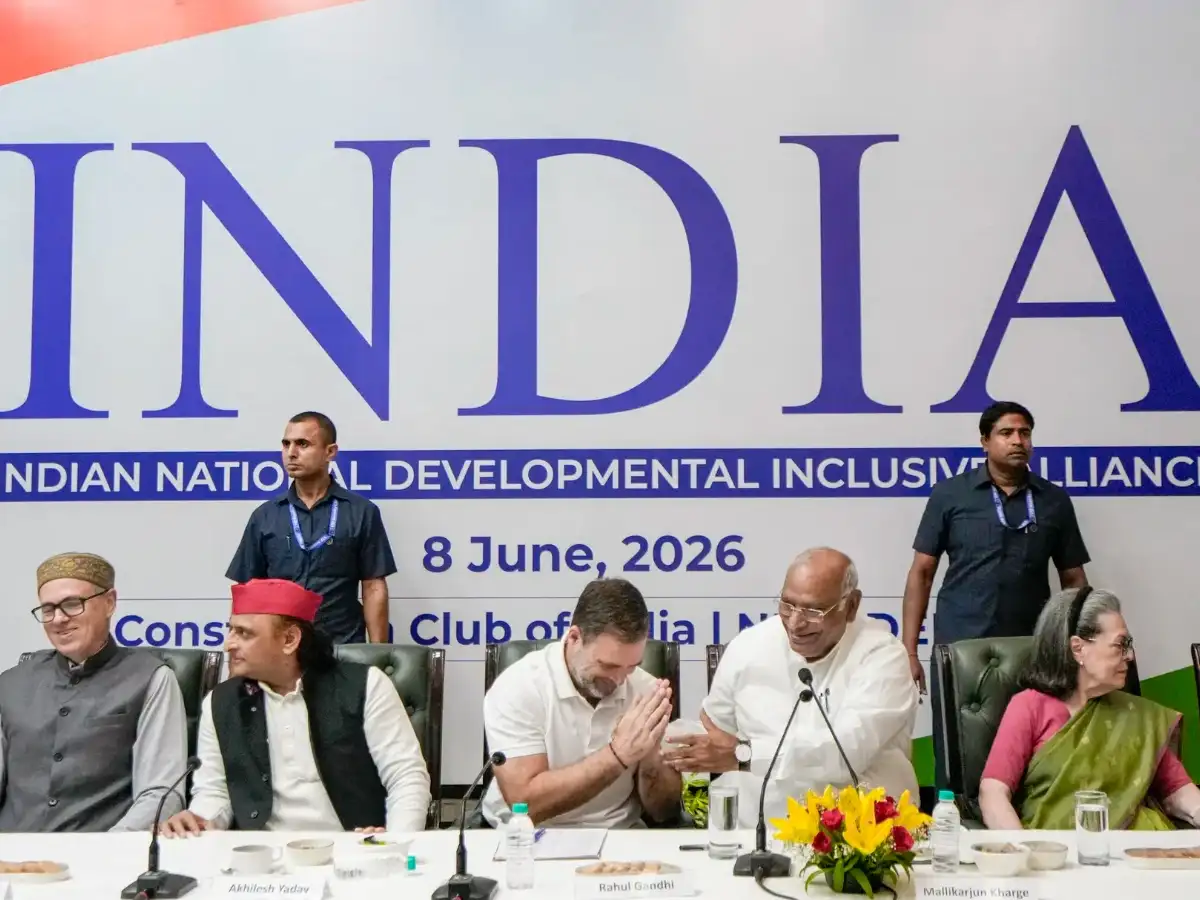
The INDIA bloc was conceived as a broad coalition capable of preventing precisely such an outcome by aggregating regional strengths into a national parliamentary counterweight.
As Parliament prepares to meet again, that coalition appears more fragmented than at any point since its formation.