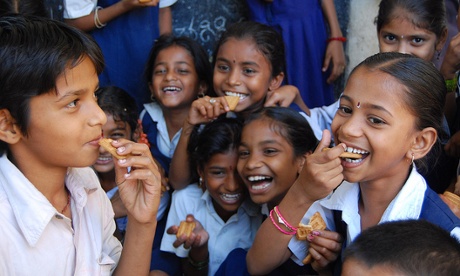
Nutrition is an issue that cannot be ignored. Every night some 805 million people go to bed hungry, while over a billion more suffer from micronutrient deficiencies. The proportion of children worldwide who receive enough of the right nutrients is actually the minority group, with 55% of all children deficient in one or more key nutrients.
These stark realities paint a bleak picture. Experts earlier this year gathered at the Federal Ministry for Economic Cooperation and Development (BMZ) in Berlin to discuss how we can do more to address the global malnutrition crisis. Nutrition for Development, a one day event hosted by BMZ, the Global Alliance for Improved Nutrition (GAIN) and Care Germany-Luxemburg, offered a unique opportunity for leading nutrition stakeholders to discuss the findings of the Global Nutrition Report (GNR) and Welthungerhilfe.
The first study of its kind, the GNR is a wake-up call for the international community. Assessing over 80 key indicators and covering 193 countries, the GNR urges policy makers and development professionals to see the truly global nature of the problem – affecting industrialised as well as developing countries.
“This report is also about overweight and obesity, with almost half of all people on our planet malnourished in one way or another” noted Lawrence Haddad, lead author of the report and Senior Research Fellow at the International Food Policy Research Institute (IFPRI), in his introduction to the report. “Malnutrition affects every country in the world” agreed Mathias Mogge, Executive Director of Programmes at NGO Welthungerhilfe.
But despite the widespread nature of the problem, malnutrition has been slow to move up the development agenda. Initiatives such as Scaling Up Nutrition (SUN) and the World Health Assembly (WHA) targets have helped push progress, but success between countries is far from consistent.
In 2013 Overseas Development Assistance (ODA) specifically earmarked for nutrition stood at $960m, a seven-fold leap from where it was 2005 at just $140m but still only a tiny proportion of the $135bn total ODA funding budget – and it’s not enough.
“The investment needed is substantial”, said Joachim von Braun, Director of the Center for Development Research (ZEF) and Vice Chair, here at GAIN, “we’re on track to reach one billion people this year.
But with an estimated two billion people suffering from micronutrient deficiencies, more is needed.” Ingrid Sehrbrock, Vice-President, CARE Germany-Luxemburg e.V, agrees. “Hunger and malnutrition are a global risk for global health. It kills more than AIDS, malaria and tuberculosis combined.”
This year though, we have an opportunity. The new Sustainable Development Goals (SDGs), due to be adopted by the United Nations later this year, currently mention nutrition only once. This needs to change. By embedding nutrition throughout the targets all the experts present agreed we have a chance to make real progress not only on malnutrition, but also other key development indictors.
As highlighted in the GNR, good nutrition is a foundation for sustainable development more broadly. In Malawi the cost of existing levels of stunting total some 10% of GDP, while in Brazil incomes rose by a third when infants were breastfed for 12 months.
“It is possible to scale up nutrition interventions” urged Haddad; “We need to speak to other sectors and we need to speak the right language”. Often that language is money, but even here the case for nutrition is convincing.
According to the GNR for every $1 spent on nutrition the return is $16, representing a 10% compound return rate over 30 years and making nutrition a highly attractive area for private sector investment.
An approach GAIN has long advocated, in his opening address Thomas Silberhorn, Parliamentary State Secretary to the Federal Ministry for Economic Cooperation and Development in Berlin, agrees: “Government, civil society and the private sector need to work closely together to address the multidimensional challenge of malnutrition.”
Recognising upfront the complex and interlinked nature of any effective response, Silberhorn endorses an “integrated approach” to the malnutrition challenge, and urged the G7 to do more. Within the framework of its special Initiative “One World – No Hunger” launched in 2014, Germany has initiated a series of projects in ten particularly food insecure focus countries, which actively pursue such an integrated approach.
So how can we do more? Working towards an embedded presence in the SDGs is undoubtedly a priority, but to do so we need to get nutrition onto peoples agendas in the first place.
Data is a big part of the problem. Given the complex nature of malnutrition it’s often hard to know exactly how much governments are spending on nutrition, with almost half lacking enough data to assess if they are meeting targets.
Another common theme was the idea of nutrition as a “right that needs to be enforced”, as summed up by Joachim von Braun from GAIN. In particular, many participants highlighted the rights of women and the central role they play in the fight against malnutrition.
At the recent G7 summit in Germany leaders agreed that food security and nutrition should play a central role in the post 2015 development agenda, setting an ambitious goal to lift 500 million people out of hunger and malnutrition by 2030.
But for all the agreement that more needs to be done, and the in-depth analysis the GNR provides, will it be enough to make the world take meaningful action. For the sake of the two billion undernourished – and one billion overnourished – people in the world, we better hope so.
Find out more about the work GAIN does by looking at the program section of our website and use our interactive map to see the work we do with our partners on a global scale.
Content on this page is paid for and provided by GAIN, a sponsor of the Guardian Global Development Professionals Network.