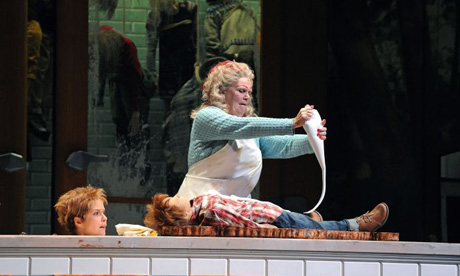
On Monday afternoon, I went to Opera North's new Howard Assembly Rooms in Leeds to watch a performance of Humperdinck's dark and funny opera Hansel and Gretel. It was a tiny production, with a cast of six and a six-piece orchestra. It's been doing the tounds in Kendal, Bridlington, Newark and Stockton-on-Tees. Glamorous? Not really.
The following night, I took my £10 ticket to see the same opera at Covent Garden (yes, you can go to the ROH for an affordable price). In the pit: the great Royal Opera House orchestra, conducted by living legend Sir Colin Davis. Onstage: a variety of other living legends including Thomas Allen, the divine Anja Silja as the witch, and Angelika Kirchschlager as Hänsel.
At Leeds, I had the unusual operatic experience of being the oldest person in the theatre. Nearly everyone else was a squirming 9-year-old – and, I have to say, they were fabulously engaged and excited by what was going on. At the Royal Opera there hardly a child to be seen, although this is a quintessential family opera (though not easy viewing – it has the cruelty and darkness contained within so many of Grimms' fairytales).
And which production told me more about the piece?
Opera North's – by young director Oliver Mears – by a length and a half. For a start, it was just so meticulously acted. Frances Bourne was an uncannily detailed Hansel – she just was a thuggish little boy. Claire Wild was a brilliant young girl, too. And you can say many things about Kirchschlager – but you can't accuse of her of being a great actor. There was far too much skipping, gambolling and gurning from the Royal Opera's pair of "children".
Meanwhile, for me Mears communicated so much more about the piece – that this is an opera about abject poverty and desperate wish-fulfillment. When his Hansel and Gretel ran through the door of their sink-estate flat, threw their school bags on the floor and mucked around their foodless, parentless kitchen in the first scene you got a real sense of them as hungry, neglected kids. And that atavistic terror, the childish fear of being abandoned by those who are supposed to care for us, is at the heart of the opera. Moshe Leiser and Patrice Caurier, directing for the ROH, might have filled their versions with all kinds of fascinating visual references, from Matthew Barney to Mauricio Cattelan, but did it get to the heart of the piece? Not for me.
The clincher? Oliver Mears had the witch pushed into a giant microwave. Mark Le Brocq revolved on a turntable before turning redder and redder and finally emitting large quantities of smoke. It was just priceless.
What's my point? Well, it's always a brilliant treat to go to the Opera House, and its production was spectacular, luxurious and beautiful. But if I had to go and see one of those productions again, I'd pick Opera North's. Bigger, it turns out, doesn't always mean better.