Keeping homes and offices comfortable all year round is not without the use of significant amounts of energy. Buildings consume about 30% of the total energy consumed worldwide, while HVAC (Heating, Ventilation, and Air Conditioning) consume almost 17% of the energy consumption in buildings, according to an investigation by the journal Advanced Materials . In trying to find ways for countries to cut emissions without compromising indoor comfort, there have been efforts from researchers to come up with materials for buildings that could adapt to weather changes.
Get breaking news anytime, anywhere. Download the TOI app now!
According to research, an innovative switchable electrochromic material has been developed that is capable of switching between absorbing energy from the sun in cold months and emitting energy to space in warm months. During lab tests and outdoor demonstration tests, the material was able to achieve temperatures that were about 33°C above ambient during heating mode and 1°C below ambient temperature during cooling mode during daytime. Simulations performed by the scientists show that the new material can help save HVAC energy consumption in some parts of the US.
One coating to fit all seasons
Many coatings are already available in the market, but each of these coatings serves only one purpose. Some coatings are reflective in nature, which helps to keep buildings cool, whereas other coatings can absorb solar radiation and help to add some extra heat. The problem is that climate varies with changing seasons.
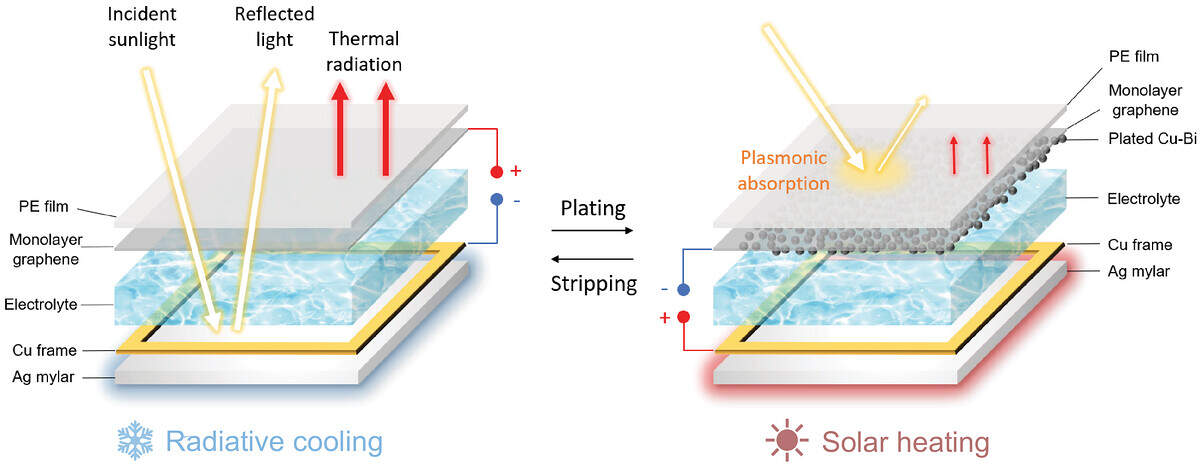
The researchers behind the Advanced Materials study aimed to solve this problem by creating a coating that can switch between heating and cooling modes whenever needed. Instead of using moving parts, the material changes its behaviour when a small electrical voltage is applied.
In cooling mode, the coating reflects most incoming sunlight while efficiently releasing heat through passive daytime radiative cooling. In heating mode, it absorbs much more solar energy while reducing heat loss, allowing the surface to warm considerably under sunlight.
One feature highlighted in the study is that the coating is non-volatile. After switching into either heating or cooling mode, it remains in that state even when the electrical power is turned off. Electricity is required only to change between the two modes rather than to maintain them continuously.
As mentioned by the scientists, this feature can make the technology appealing to buildings, as it will allow making adjustments in seasons using electricity for just a few moments rather than constantly.
The way the coating manages to produce heating and cooling effects
This coating consists of ultrathin graphene with engineered copper-bismuth nanoclusters, which gives it two distinct thermal properties. As claimed by the scientists, traditional electrochromics find it hard to control the radiation from the sunlight and mid-infrared heat radiation simultaneously.
To overcome this challenge, the team developed a manufacturing process that deposits amorphous copper-bismuth nanoclusters onto defect-activated monolayer graphene. According to the study, this structure enables a strong contrast between the heating and cooling states.
When operating in cooling mode, the material absorbed only about 8% of incoming solar energy while maintaining very high thermal emissivity, allowing it to release heat efficiently. In heating mode, solar absorption increased to nearly 48%, while thermal emissivity dropped substantially, helping retain warmth.
The researchers also modified the graphene surface to improve the uniformity of the deposited metal layer. They combined this with a pulse electrodeposition technique that helped produce a more even coating without introducing additional materials that could reduce cooling performance by absorbing unwanted sunlight.
Laboratory durability tests showed that the device continued to switch reversibly for more than 1,000 cycles. The authors observed some gradual performance degradation over repeated cycling and suggest that future electrolyte designs could improve long-term durability.
To evaluate the technology outside the laboratory, the team carried out an outdoor proof-of-concept test on the rooftop of Stanford University's Electrical Engineering Building. During the daytime experiment, the cooling mode lowered the device temperature to approximately 1°C below the surrounding air, while the heating mode raised it by an average of about 33°C above ambient temperature.
The authors observe that such outdoor tests should be regarded as proof of concept of the technology, but not as an indication of its readiness for mass commercialisation.
Simulations reveal energy savings potential
In order to assess the performance of the technology on buildings, the authors applied EnergyPlus software – a whole-building energy simulation tool – to simulate a mid-rise apartment with the adaptive coating in different U.S. climates.
The simulations suggest that switching between heating and cooling modes according to weather conditions could reduce annual HVAC energy consumption by an average of 73.69 MBtu in the simulated scenarios. The projected savings were greater in warmer climates, where passive radiative cooling has a larger impact on reducing cooling demand.
The researchers also estimated that the adaptive coating could reduce annual carbon dioxide emissions by approximately 4,063 kilograms per building in the simulated U.S. scenarios. They attribute this mainly to lower electricity demand for cooling, while noting that the estimates are based on building simulations rather than real-world deployment.
Although the results are encouraging, the authors emphasise that further work is needed before the technology can be used widely. They identify improving durability, increasing manufacturing scalability and enhancing heating performance in colder climates as important next steps.
The study also notes that scaling the graphene electrode to larger areas presents engineering challenges because electrical resistance increases across bigger surfaces. Future research will focus on refining the materials, improving long-term reliability and making the technology more practical for large-scale applications.
Building coatings that switch between heat absorption and reflection could improve energy efficiency if further research confirms their performance. The technology should not be considered as an alternative to existing HVAC systems; instead, it may assist buildings in adjusting better to weather conditions.