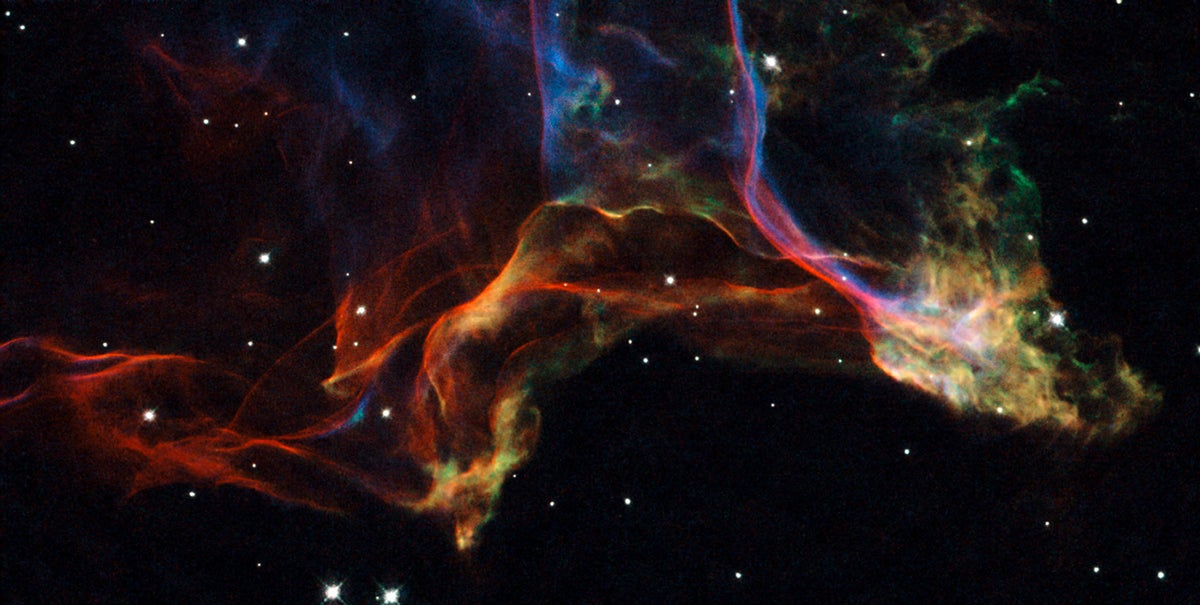
A giant “hiccuping” star has been documented for the first time in the final stages of its life before exploding.
The rare cosmic event, which only occurs with exceptionally large stars between 60 to 150 times the mass of the sun, has been predicted in theory but never seen before.
Researchers said that confirming “hiccuping” stars is a major step in understanding how outsized stars work and how they have shaped the universe.
The team documented a process called Pulsational Pair Instability” (PPI), in which massive stars develop very hot cores which contract and expand quickly in the final years or days of their lives.
On each occasion the star pulsates, it ejects a shell material which strips down the core star. These shells can collide into each other, creating intense bursts of light.
Lead author Dr Charlotte Angus, from the Astrophysical Research Centre (ARC) at Queen’s University, said the shell collisions are much fainter than the final supernova explosion, meaning it had previously not been possible to confirm the theory.
She added: “In December 2020, we identified a new bright supernova, now named ‘SN2020acct’, in a nearby spiral galaxy called NGC 2981. The light from SN2020acct disappeared pretty quickly.
“But then in February 2021, we saw light coming from the same region of the galaxy again.
“This is very unusual as supernovae normally don’t reappear.”
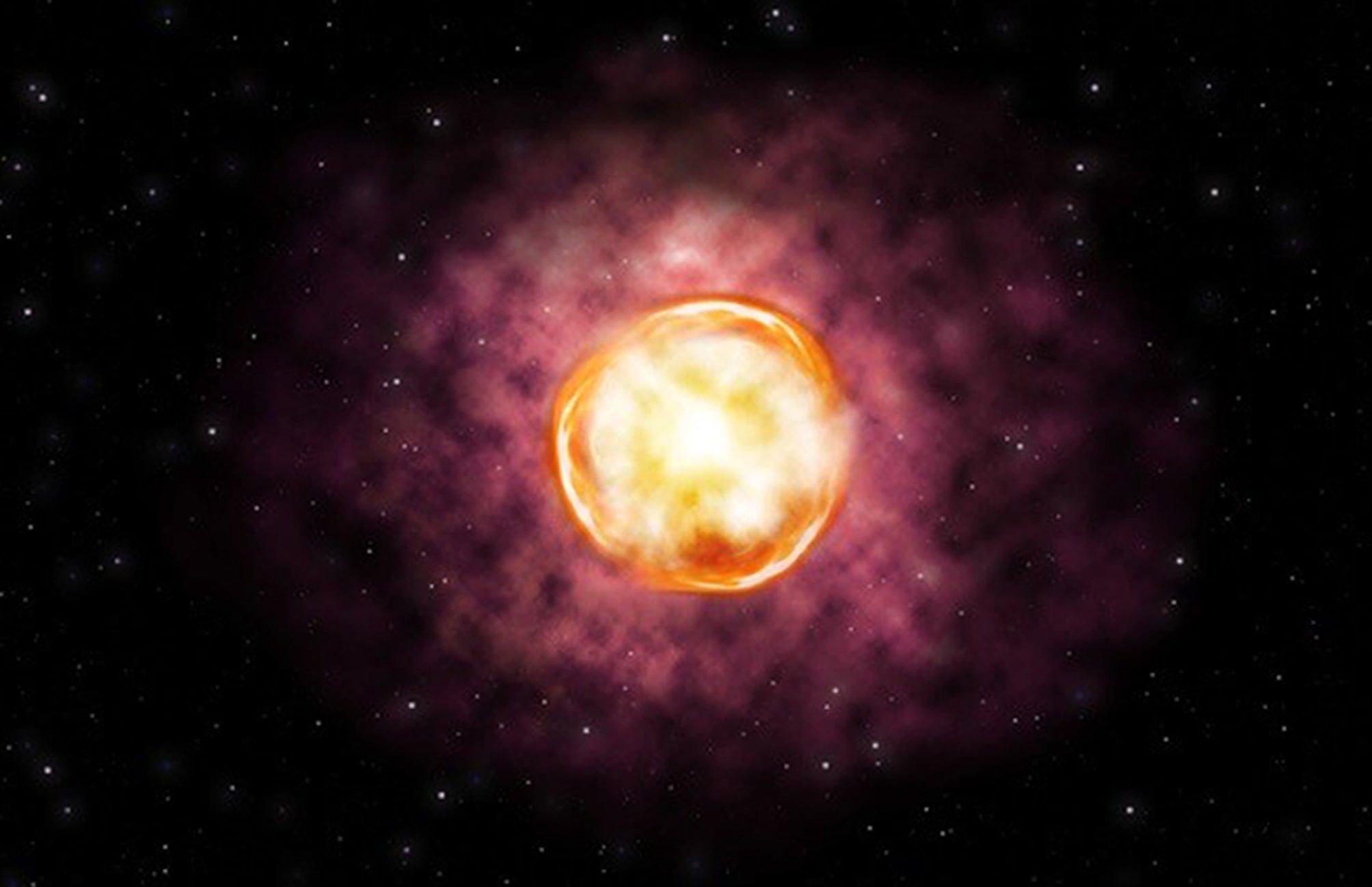
The team used telescopes around the world – in Hawaii, Chile, South Africa and the US – to track the supernova.
They found that the first time it appeared, its light was being produced by slow-moving shells of material colliding near the star.
When it appeared for a second time, it was expanding much faster, suggesting the core of the star had exploded, marking the end of its life.
The astrophysicists then used modelling to confirm that the first flare was an example of PPI.
They said the star was around 150 times the mass of the sun and underwent a series of extreme pulses in the final 50 days before it exploded.
Dr Angus said: “This is the first time that we have ever obtained observations of a PPI candidate during the shell collisions, allowing us to confirm for the first time that this is really happening.
“That the data matches the modelling predictions is incredibly exciting.”
Also involved in the project were astronomers from the University of California Santa Cruz and from three recent surveys – the Young Supernova Experiment, the ATLAS survey and the PanSTARRS survey.