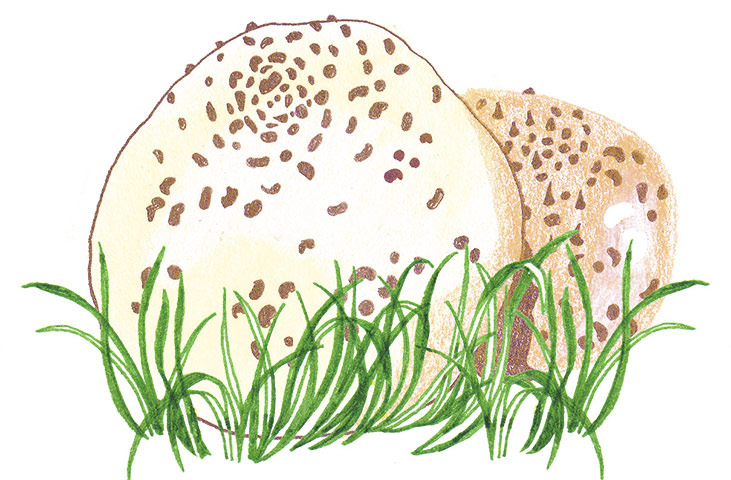
The giant puffball, which can grow as large as a football, is one of Britain’s most distinctive mushrooms. It can be found in fields, meadows and broad-leaved woods throughout lowland areas, from September to November. When puffballs first appear, they are white, with a firm and solid texture. But after a few weeks the flesh begins to turn yellow and soft, as trillions of spores develop; these are released into the air as the puffball decays
Illustration: Hennie Haworth
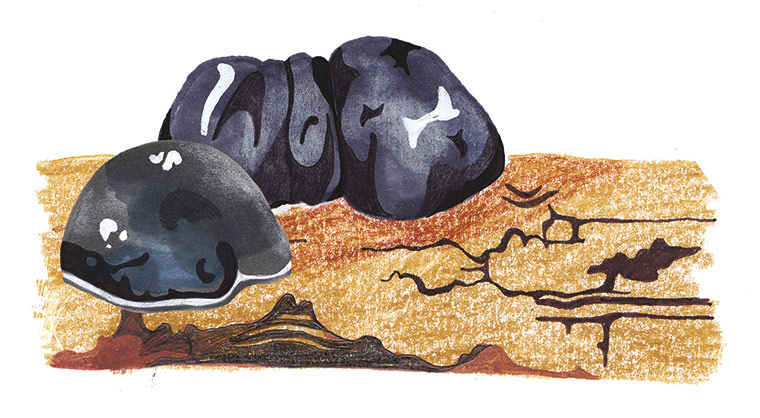
A small, hard, purplish-black fungus, clumps of which can be found on the bark of dead deciduous trees, especially ash. When cut with a knife the interior appears brittle, as if it has been burned – hence the association with the Saxon monarch’s famous culinary accident. May be found at any time of year. Not edible – it is also known as cramp balls
Illustration: Hennie Haworth
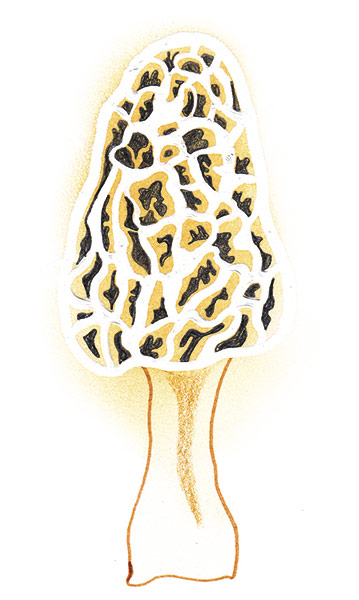
Morels are edible mushrooms, often appearing in spring, highly prized by chefs for their distinctive flavour. The thick, cream-coloured stem is topped with a brownish-yellow cap, pitted rather like a honeycomb. Novice mushroom hunters should beware the similar-looking false morel, which can be highly poisonous
Illustration: Hennie Haworth
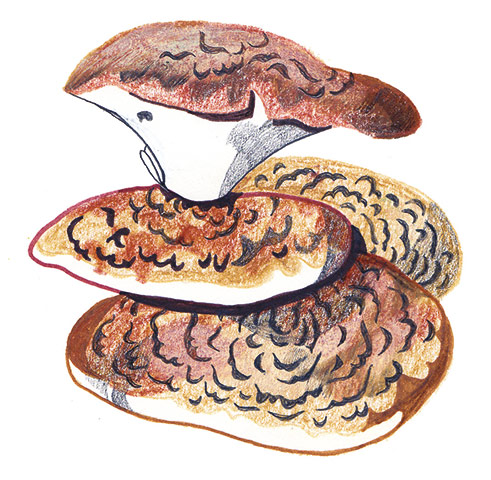
Named after the tiny tree nymphs of Greek mythology, this fungus is also known as “pheasant’s back mushroom” because of the mottled brown pattern on the cap. Dryad’s saddle is a bracket fungus, growing at the base of trees in deciduous woodlands, and helping the process of wood decomposition. Unlike most of our fungi, it often fruits in spring
Illustration: Hennie Haworth
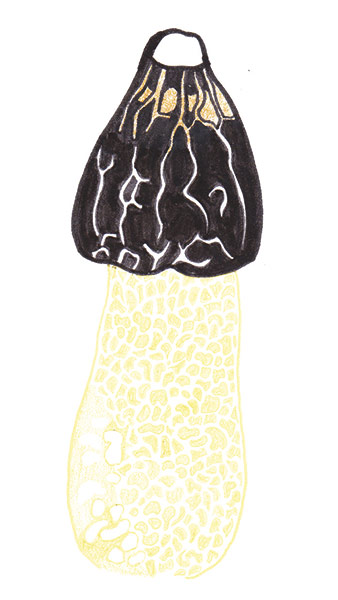
One of our most easily identified fungi, thanks to its very long stem and distinctively phallic appearance. The stinkhorn gets its common name from its foul smell, rather like rotting meat. This attracts a variety of insects, which then transport the spores and enable the fungus to spread
Illustration: Hennie Haworth
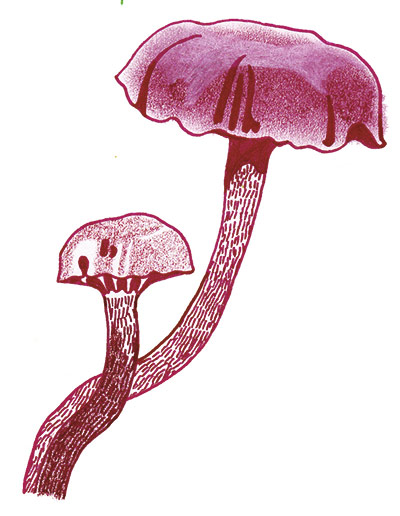
A tiny, delicate fungus with a subtle purple hue, which is commonly found in deciduous woodland, where it grows among the moss or leaf-litter, from June through to October and November. Although the caps are edible the tough stems are not, and as it takes so many of the caps to make a meal they are rarely eaten
Illustration: Hennie Haworth