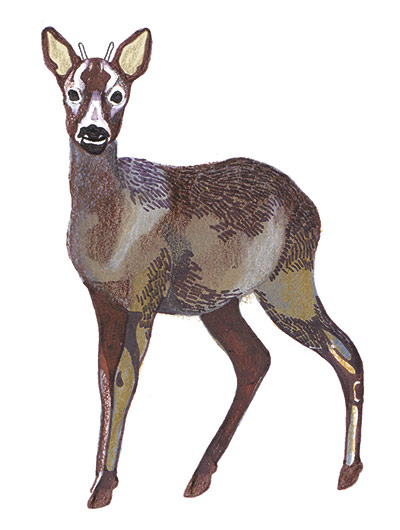
Medium-sized and greyish brown, with characteristically pointed ears, the smaller of Britain’s two native species is a far shyer and less showy creature than the red deer, though a recent increase in numbers means that it is more likely to be encountered nowadays than before. Males have two long, thin, pointed antlers. Found in woods and open countryside throughout Scotland and northern England, with a growing population in the south and west
Illustration: Hennie Haworth
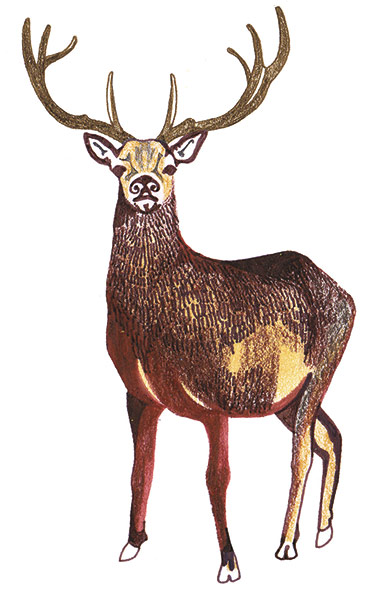
The larger of the two native species, the red deer can easily be identified by its size, and the male’s magnificent antlers. These are put to good use in the annual autumn rut, when stags fight for the right to mate with the harem of females. The stronghold is the highlands and islands but the red deer can also be found on Exmoor and Dartmoor, in the New Forest, and in deer parks including London’s Richmond Park
Illustration: Hennie Haworth
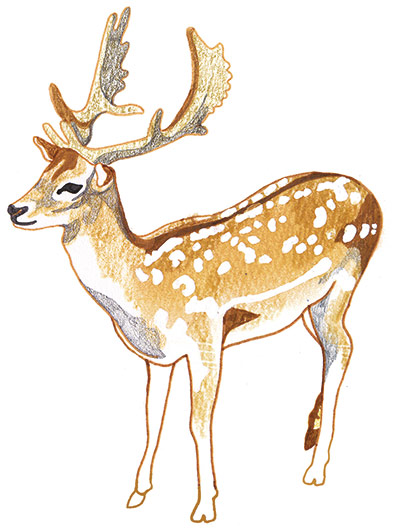
Originally from the Middle East and Mediterranean areas, fallow deer were spread across Europe by the Romans, for food, and introduced to Britain by the Normans for hunting. They are commonly found in the grounds of stately homes and deer parks, mainly in England and Wales. A slim, elegant species, the fallow deer has a dappled coat that may vary considerably in shade. Males (bucks) have broad, flattened antlers that they shed each spring, regrowing a new set for the annual autumn rut. Females (does) are smaller and much lighter in weight
Illustration: Hennie Haworth
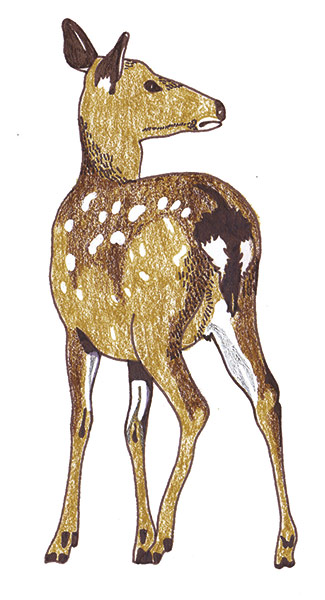
Introduced from eastern Asia, the sika has since spread northwards to Scotland, where its close genetic relationship and habit of interbreeding with the red deer now threatens the native species. Between the red and fallow deer in size, the sika is generally dark greyish brown, though in summer may also appear spotted. Can be hard to see, as it is far more nocturnal in habits than other British deer
Illustration: Hennie Haworth
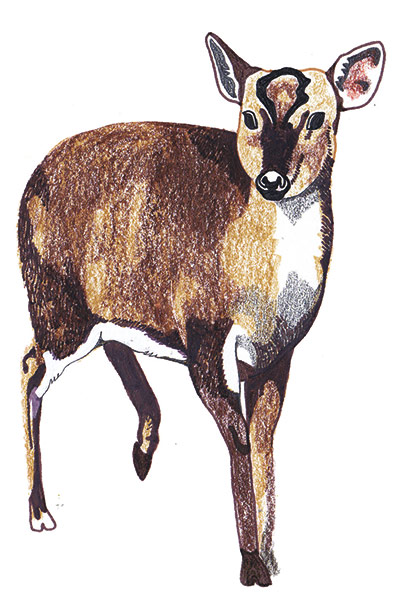
The smallest deer found in Britain, the muntjac’s plump body and short legs can make it look more like a medium-sized dog, and its loud alarm call has led to it being called the barking deer. Introduced from south-east China via Woburn Abbey and Whipsnade Zoo during the early 20th century, the muntjac has since spread northwards and westwards, establishing wild populations across much of England. Its habit of browsing the scrub in woodland has made it a serious pest, and it has been implicated in the decline of the nightingale. Males have short antlers and elongated tusks. Can be confused with the slightly larger and slimmer Chinese water deer, another alien introduction
Illustration: Hennie Haworth