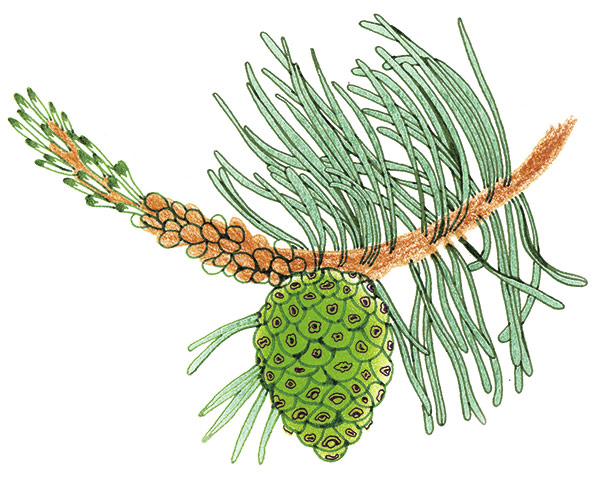
The largest of Britain’s three native conifers (the other two are yew and juniper), this was the dominant tree of the Caledonian forest that once covered much of Scotland but is now confined to the area around the Spey Valley. Growing up to 25 metres (80ft) tall, the Scots pine is home to several key species. These include the only bird found solely in Britain, the Scottish crossbill, which feeds exclusively on its cones
Illustration: Hennie Haworth
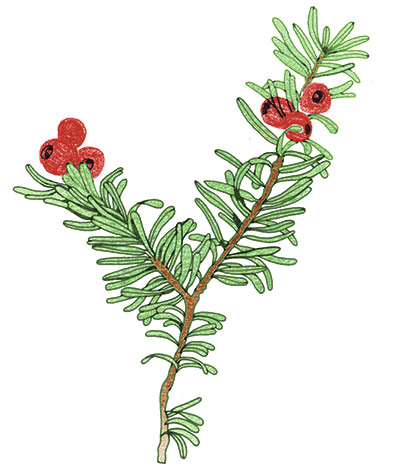
Yews are exceptionally long-lived trees, the oldest living thing in Britain being the Fortingall Yew near Perth, which dates back before the birth of Christ. They are often found in churchyards, partly because of their association with long life, though, ironically, their foliage is poisonous to humans and livestock. The bright red berries, however, are a favourite food for birds such as the mistle thrush and blackbird
Illustration: Hennie Haworth
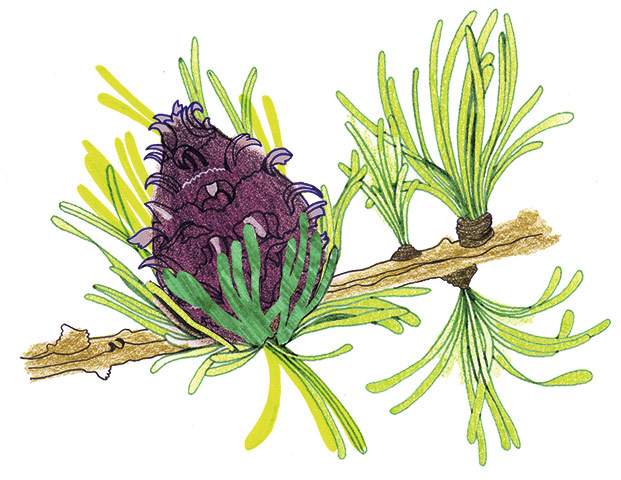
Unusually for a coniferous tree, the larch is not evergreen. Its slender, soft needles turn yellow in autumn before dropping. Originally from northern Europe, the fast-growing larch was introduced to Britain in the 17th century for use in forestry, as its timber is durable and versatile – it is used in boat-building and for the exterior cladding of houses. Larches are often grown in plantations, though, as they need more light than other conifers, they are rarely found in dense stands of trees
Illustration: Hennie Haworth
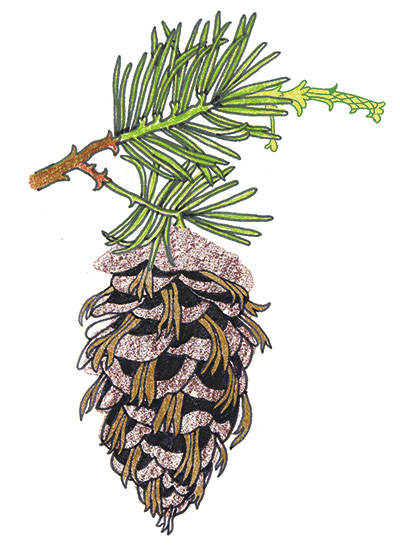
Named after the 19th-century Scottish botanist and explorer David Douglas, this conifer is native to western North America. One of the world’s tallest trees, it can grow to a height of 120 metres (400ft), though those introduced to Britain rarely exceed 50 metres. Unlike true firs, the cones of the Douglas fir hang down rather than point upwards
Illustration: Hennie Haworth
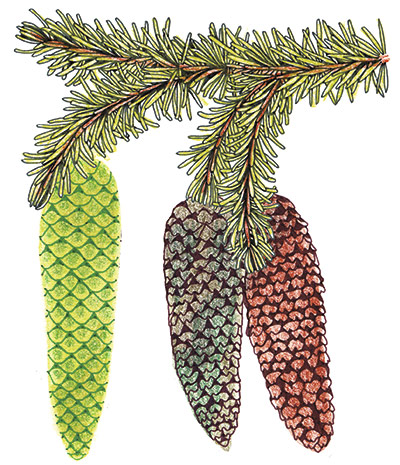
The classic “Christmas tree” is commonly found in commercial forestry plantations but specimens may also be seen in mixed woodlands throughout Britain. Native to northern and central Europe, it was introduced to Britain in the 16th century for timber. The custom of decorating them at Christmas began in Germany and was brought here by the Hanoverian branch of our royal family, in the early 19th century
Illustration: Hennie Haworth
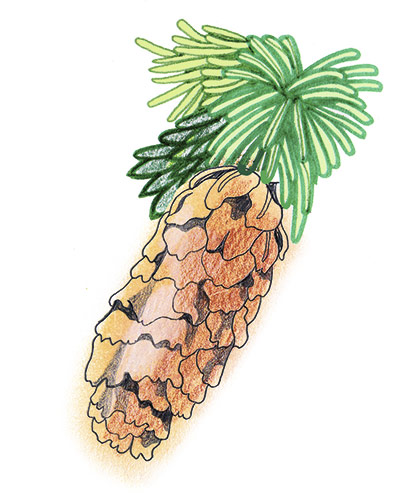
uce The world’s largest species of spruce, with a few specimens growing as tall as 100 metres (325ft), the Sitka spruce is commonly found along the Pacific seaboard of North America. Introduced to Britain in the 19th century, it commonly grows in damp woods and plantations, and its wood is often used for making musical instruments, as it is an excellent conductor of sound. Sitka spruce has blue-green foliage and long, brown, cigar-shaped cones
Illustration: Hennie Haworth