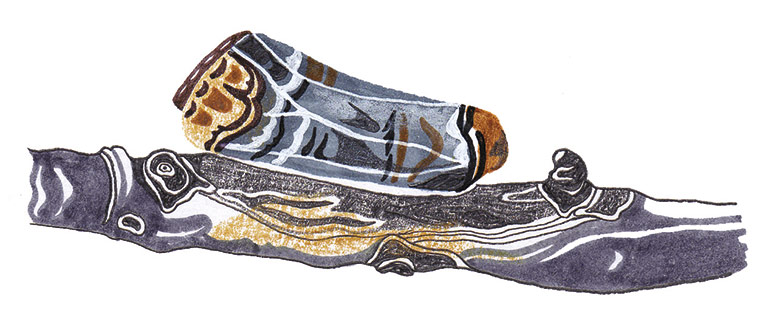
This common moth is a true master of camouflage: when settled, with wings folded, it looks exactly like a birch twig that has been broken off at one end – complete with lichen-like markings. Only when it opens its wings does it reveal that it is a living creature. Found from May to July in woodlands throughout Britain, especially those with birch, oak or hazel trees
Illustration: Hennie Haworth
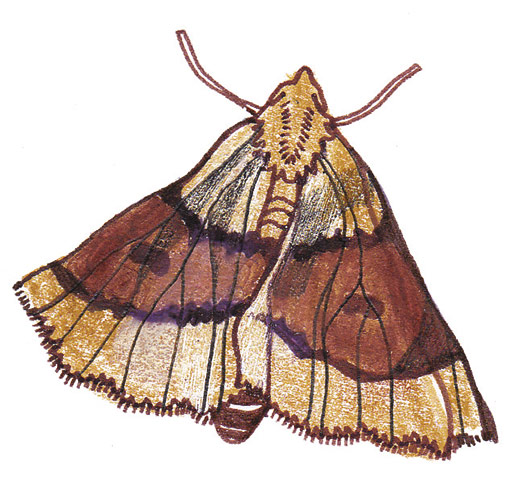
Habitually resting with wings held flat, this triangular-shaped moth resembles a buff piece of wood, complete with markings mimicking lines of grain and a small dark spot on each wing. Varies in colour, from pale straw to orange, brown and even black, with the darkest forms found in northern England and Scotland. Flies by night, usually from July to August
Illustration: Hennie Haworth
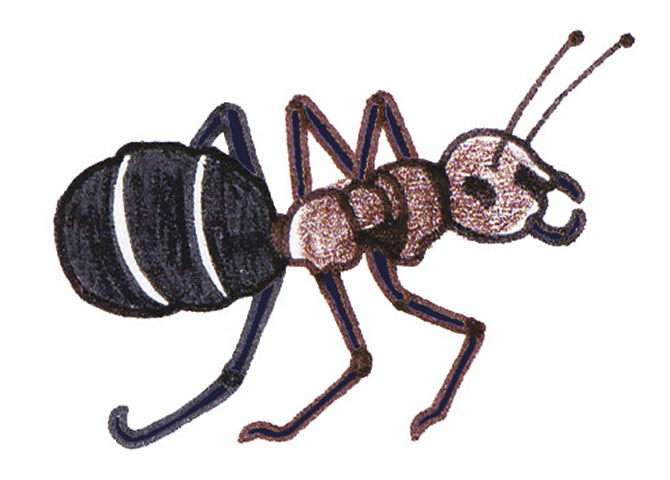
At 1cm long, this is one of our largest ants and forms equally impressive colonies: large mounds of earth thatched with leaves and pine needles, sometimes more than a metre in diameter, and containing up to half a million ants. Stay quiet near a mound and you should hear a rustling as they go about their business. When disturbed, the ants flock to fight off the intruder, spraying formic acid from their rear ends and giving a nasty bite. Found in ancient woodlands in England and Wales, with close relatives in the Caledonian pine forests of Scotland
Illustration: Hennie Haworth
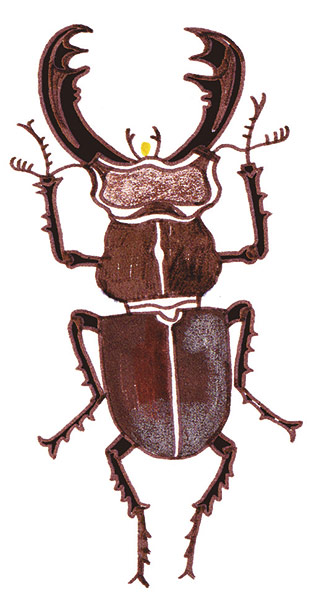
At 7cm long (including the male’s antlers), the stag beetle is one of our largest and most impressive flying insects. After spending up to six years underground as larvae and pupae, adult beetles emerge on warm, muggy evenings from May onwards, males fighting each other for the right to mate, after which the females lay their eggs on rotting wood. Found mainly in the warmer south and east of Britain, and currently declining because of a shortage of suitable habitat
Illustration: Hennie Haworth

Not a worm, but a very peculiar beetle, whose wingless female has evolved a very special way to attract a mate. She emits a bright yellowish-green light from the rear of her abdomen, which the males see as they fly overhead. Once she has mated and laid her eggs she turns off her light and dies. Glow-worms were once found throughout southern Britain, but have drastically declined due to light pollution, and are now mainly confined to rough grassland and woodland rides
Illustration: Hennie Haworth
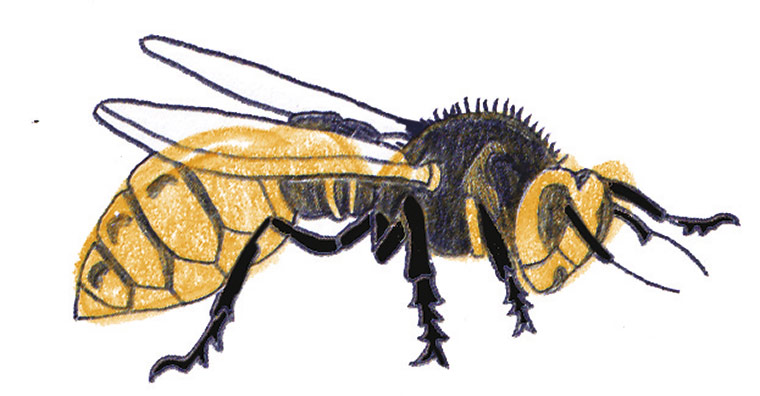
At 3cm long the hornet is the largest British species of wasp, and can easily be identified by its size and coloration. But despite its fearsome appearance it is generally less aggressive than its smaller relatives. In spring hornets build large nests in cavities in hollow trees, especially in broad-leaved woodlands, from southern England north to the Midlands
Illustration: Hennie Haworth