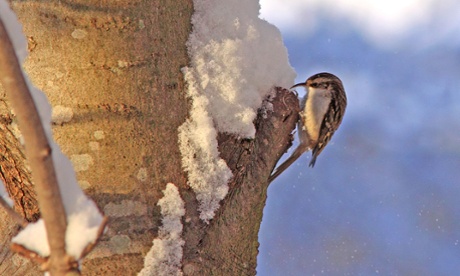
Of all the birds that come to the feeding stations in the garden, for me the most mysterious is the tree creeper. You are not likely to get a long view of this bird, as it is ever on the move and going round and round a tree trunk, almost like a mouse, so it is out of sight for much of the time. Hence the collective noun a “spiral” of tree creepers. The Gaelic word is “snaigear”, meaning “one that creeps”.
The upperparts are mottled and barred brown and a perfect camouflage, while the underparts are a bright white. This does not affect the camouflage, however, as the bird’s body and stiff tail feathers are always pressed tight against the bark as it constantly moves upwards and then flits down to start again.
Tree creepers will mix with other birds, such as titmice, in the winter but I have only ever seen solitary ones in my garden. Their food is mainly insects but in winter they will take the seeds of pine or spruce. In the past few years they have adapted to garden feeders, taking seeds such as nyger and sunflower hearts.
There was a particular mystery about one tree creeper in my garden last week. Every day, this one seemed to spend a great deal of time foraging on the ground. The bird still looked like a mouse as it darted backwards and forwards with its body, and tail, pressed to the ground. It wasn’t underneath a feeder where it could have picked up spilled seed and yet it seemed to be eating something. I cannot find any reference in my books to such behaviour, which seemed out of character with the bird’s normal feeding habits.
I did have one sad experience last month, when a tree creeper flew into my study window, and broke its neck. This was despite the sentinels, transfer silhouettes of falcons, on the glass to stop birds flying into it. In my hand, the tree creeper proved as mysterious as ever.