Were it in Britain, the wildflower meadow by my house would be charged with riotous assembly: self-heal, marjoram, borage, restharrow, oxeye daisies, mallows, clovers, poppies, vetches, astounding in their abundance and colour as hay-harvest approaches. Wind cross-hatched its long grasses to gleaming filigree as I climbed through scattered holm oak and Corsican pine to the ridge. A bird flew from the forest, its compact form and gently undulating flight suggesting one of the wrynecks nesting there. Except it drifted higher – and poured out a song I’d last heard (and that only rarely) in Wales more than 50 years ago: a song of haunting melancholy and declining cadences so lovely it is utterly memorable even after half a century.
I focused the glass: white tail-tip, wing-bars, the exquisitely patterned crown of a woodlark. We think with proper delight of lark song, accepting cultural imperatives rather than judging for ourselves. In truth, the difference between the complex musicality of the woodlark and the dry twitterings of a skylark is as great as between Bach and Eminem. But where can you now hear a woodlark in Britain?
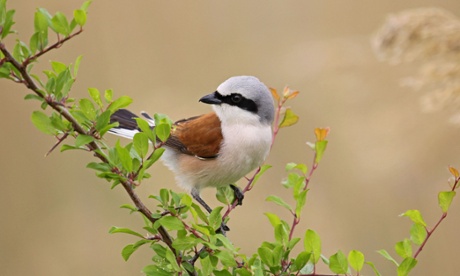
There was another gift in store. I was twice-forewarned as I crashed down through a thicket behind the hamlet’s church: a beetle impaled on a long thorn; nearby, a bee, still buzzing frantically, had suffered the same fate. As elegy for them, a scratchy recording suddenly blossomed into perfect mimicry of the woodlark’s song. On the telegraph wire was culprit and performer, another bird I hadn’t seen in 50 years. What a beauty he was, with pink waistcoat, highwayman’s mask, chestnut wings, dove-grey skull-cap: the butcher bird, the red-backed shrike, guarding his larder.
The harsh winter of 1962/63 decimated the woodlark; saw also the publication of Silent Spring. Now lobbyists seek repeal of the recent ban on neonicotinoids that kill bees and those that eat them. Pity the rare migrants, braving guns of Malta to be brought down by Big Pharma’s toxins. Have we not learnt from DDT? “They changed paradise” back then. Don’t let them do so again…