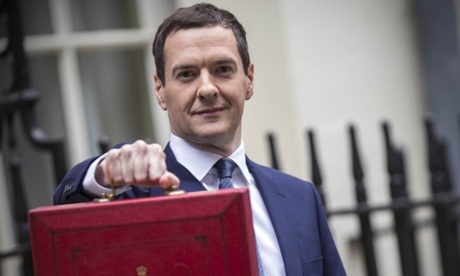
When the Greeks are undergoing the worst economic hardship to affect any industrial nation for decades, it is characteristically tasteless of Chancellor George Osborne to go on about how, thanks to his “long-term plan”, we in Britain have been spared the fate of that unfortunate country.
He was at it again on budget day. The truth is that Britain has been in no way threatened in the way Greece was in 2010. As shadow chancellor, Osborne opposed the recapitalisation of the banking system and the fiscal stimulus that “saved the world”. Luckily, the government at that time was in the hands of a man who, I am told, the present chancellor secretly admires, namely Gordon Brown.
This does not prevent Osborne’s acolytes in the press from informing us with glee that this latest budget, with its full-frontal assault on tax credits, is all part of the unravelling of Brown’s painstaking attempt to alleviate poverty in this country.
Osborne, who is riding high at the moment, knows he has much to thank Brown for, not least the granting of independence to the Bank of England and his predecessor’s statesmanlike opposition to the belief – shared by most of the establishment at the time – that Britain should entered into the eurozone.
He can also thank Brown for the fact that, after a long period of “prudence” with the nation’s finances, he allowed sufficient growth in public spending to give Osborne the chance to conduct a propaganda coup in which he shamelessly encouraged the view that this had caused the banking crisis.
When I saw the new production of The Importance of Being Earnest and again heard that great line “the chapter on the fall of the rupee you may omit – it is somewhat too sensational”, a description from the adventure stories of my youth came to mind: “he is not quite 16 annas to the rupee” was commonly used to describe someone you could not entirely trust.
There was a classic example in the budget speech, when the chancellor gave the impression that, after all the worried lobbying by our defence chiefs and the Obama administration, we were going to honour the official Nato commitment to devoting 2% of our GDP to defence. Later, it appeared that this was only true if the “security budget” – MI5, MI6 etc – was included.
Shiftiness is also there in the claim that the rise in the status of the minimum wage to the level of a “living wage” will offset the damaging impact of the assault on tax credits and other spending on social security.
As many a public organisation or charity at the coalface of the cuts will confirm, this is likely to be far from the case. Indeed, the Institute for Fiscal Studies has already made the point forcibly.
For all the remarkably good press the chancellor initially had, this is not compassionate Conservatism or in the tradition of one-nation Conservatism. To take one example: the chancellor has been congratulated by some for his “Victorian” approach to the nation’s finances, via his obsession with aiming for a budget surplus on both current and capital accounts. But there is also a kind of Victorian viciousness in the removal of tax credits for any beyond the second child.
This is quite out of keeping with the spirit of the history of government help to families, which began with what were then called family allowances. Great Conservative figures such as Harold Macmillan and Ian Gilmour – much admired by our current prime minister – must be turning in their graves at this mean-minded policy.
Budgets are meant to be about running the economy and appropriate fiscal policies. But this chancellor is into “social engineering”. One recalls the time Mrs Thatcher said economics was “the method” but the object was “to change the heart and soul”.
Its early reception suggested that, for all one’s concerns, this had been a clever budget. But it may well turn out in due course to have been too clever by half. I suspect that many of the people who are praising the chancellor now haven’t got an inkling of what is likely to hit public services when we see the full horrors of the public spending review due in the autumn.
On the general macroeconomic front there is much to be apprehensive about. The chancellor boasts about a Britain “back in the black”; in fact, we have a balance of payments deficit of 5.9% of GDP – the largest peacetime deficit since 1830 – the prospects for exports are not good, and the Office for Budget Responsibility’s growth forecasts partly depend on yet another boom in personal credit.
Moreover, people should not be deceived by all this stuff about revisions to his deficit reduction plans and the way he has taken note of OBR chairman Robert Chote’s earlier warning about a “rollercoaster ride” – so that now Chote talks of a “bumpy ride”. The “plan” remains: a guerrilla attack on the public sector, hurting the poor most, and partly based on a gross exaggeration of the degree to which the unemployed are “workshy”.