Who else remembers the COVID briefings on TV given by governments around Europe at the height of the crisis? In the UK, the Prime Minister and top scientists stood behind lecterns, earnestly briefing the nation about the number of deaths, how quickly COVID was spreading and how we should be behaving to protect ourselves.
Amongst my friends and family, our lives revolved around what they told us during those briefings. Group chats were flooded with discussion about what the experts had said and whether it was going to change our strategies on socialising or staying at home.
It was during one of those broadcasts that science communicator Simon Oldridge had an idea: what if there were briefings on national TV about the climate crisis? Experts “getting the facts back on the table” about how climate change is progressing, how it is affecting everything from food supplies to healthcare, and how the population needs to respond. So the National Emergency Briefing (NEB) was born.
‘A secret had finally been shared’
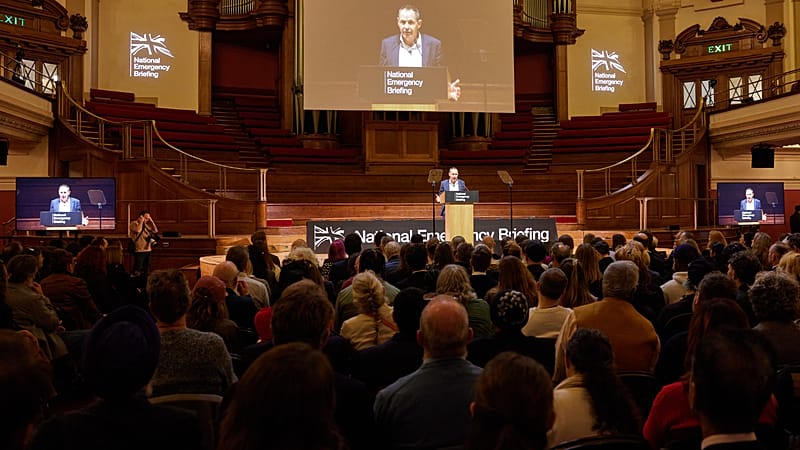
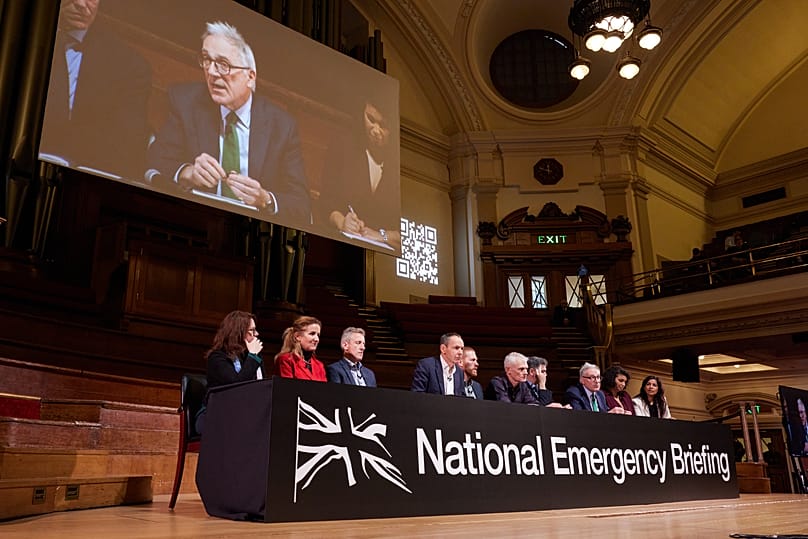
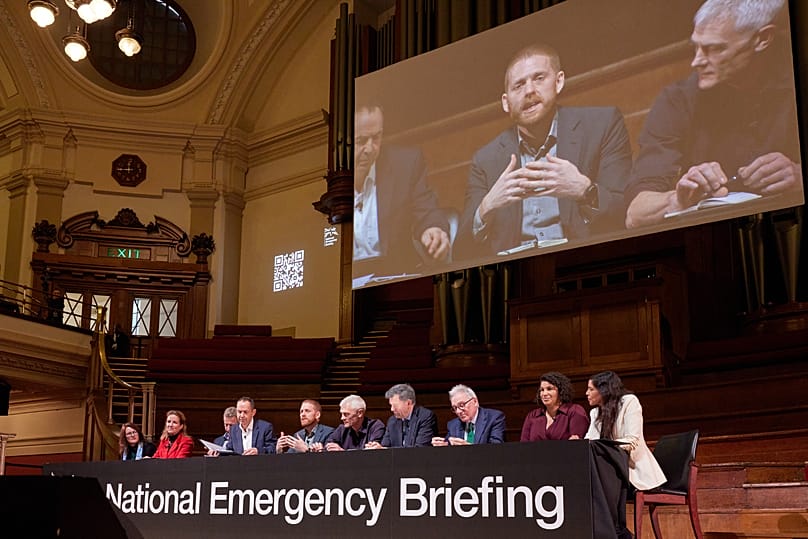
After recruiting his brother to help, the Oldridges decided to kick off the campaign with a briefing of their own: they hatched a plan to put top UK scientists in front of politicians and influential heads of industry and business. The experts would lay out the facts about climate change and its current and future impact on the systems that sustain us: weather, food supply, health and national security. Then the audience would have the opportunity to ask them questions.
The COVID briefings made the nation sit up and, for the most part, follow orders. What if a briefing on the impacts of climate change could lead to the same urgent action on a national scale? “The moment in time when we all sat in front of our TVs and listened to an expert, it was quite a moment, wasn't it? Because you realise that the majority of our fellow country people respect the rule of law, value their communities, and want to act for the benefit of others,” climate science communicator Nick Oldridge shares during a video call.
To strike the same tone as the COVID briefings, they decided the briefing had “to look and feel and sound like we are the government,” Nick explains. This idea came from his collaborators - ex-creative directors in the famously cut throat advertising industry.
“We turned up in sharp suits, which we never wear, and everything was designed to appeal to people in industry, people who are in the world of business as usual and think ‘we're indestructible, nothing can really harm us’.”
Acting like the people they wanted to reach worked. “It was invite only and it got really crazy. We had emails like ‘Hi, I'm the government chief scientist, can I come?’ It was like owning a really famous nightclub.”
They ended up with almost 1,300 people seated in Westminster Central Hall, a historic venue opposite the Houses of Parliament - the UK’s seat of power. The experts had 10 minutes each to address the crowd from the lectern, showing slides and talking through the facts one by one. It was crucial that everyone in the room was hearing directly from these experts, “without the filter of the media”, Nick says.
Despite the high profiles and busy lives of the audience, the room was silent as the experts gave their presentations. “Something happened in that room. Even hardened NGO [non-governmental organisations] people came out and said ‘I was profoundly moved’. Lots of people cried. There was a profound feeling of that pain being inspired and uplifted, as if a secret had finally been shared. As if they're finally watching something get witnessed by everybody together. There was a huge, palpable sense of relief in that room.”
What is the People’s Emergency Briefing?
The scientists’ presentations were filmed and shown to a cross section of the population and a few celebrities, like Jennifer Saunders. Their reactions were also filmed - another idea from the former advertising executives to make the film more engaging. By the end, they had a 50-minute film called the People’s Emergency Briefing. Now, the NEB team wants everyone over 16 from every part of society to see it.
I have seen the film but I’m not going to give away any details. I will say that the scientists deliver the facts in an easy to understand way. They speak clearly and plainly and they don’t sugar coat it. What I loved is that they all end their presentations on an empowering note by explaining what can be done, starting right now, to avoid the disastrous future we’re headed for if we continue on as we are.
After the presentations, the experts were interviewed about how they feel about all the facts they share. There’s a particularly moving moment when one scientist tears up saying he wants to be able to tell his teenage son that he did everything he could to avoid the worst consequences of climate change.
What happens at a People’s Emergency Briefing screening?
In line with spreading the information in the film outside the “bubble” of climate professionals or activists, it is available for anyone in the UK to screen at a venue in their local community, for free.
Mike says: “We've really got to get the multiplier effect going. So the number one ask at a screening is to try and recruit one, two or three groups of people within that audience to do another screening. It could be in their workplace or it could be in another part of the community.”
The team wants it to feel easy for anyone to organise a screening. So screeners are provided with a comprehensive toolkit, which I’ve seen, which walks them through every step of the process, from invites to how to invite local press to technical details for showing the film.
They’re also given guidance on how to run the post-film discussion. This is a vital part of the experience - and the reason the film is not available to watch online. It gives the audience the opportunity to process, in a group, what they’ve just heard. Prestigious climate researcher Mike Berners-Lee, who also presented at the briefing, and Linda Aspey from the Climate Psychology Alliance advised on how the discussion should be facilitated so the audience can “find the agency to act”.
Inviting the area’s Member of Parliament (MP) to the screening is important. Not only so that they are more informed on the wide-ranging and fast moving impacts of the climate and nature crisis. But also because the NEB team is aiming for the film to be shown on national TV. If enough MPs sign a parliamentary call backing the idea, it could happen. 141 out of the UK’s 650 total MPs have signed so far.
1,845 screenings have taken place so far with 1,089 still to come. An interactive dashboard shows where screenings are planned.
An academic survey filled in by people after screenings has positive preliminary results with 58 per cent saying they felt more hopeful (vs 15 per cent less so) after watching, 88 per cent more informed and 87 per cent more motivated to act.
It’s not just local village halls where the film is being shown. Workplaces from a huge range of industries are screening it for their employees, including the BBC. International community group organisers the Women’s Institute are planning screenings. A group of school teachers have used the film to create a suite of teaching materials, with plans to take a shortened version of the film into every staff room in the UK. There’s even been interest from within the British government.
Other nations in Europe are already looking at how they can hold their own emergency briefings with scientists and facts relevant to their country. In Germany, it is called the the Nationaler Risiko Gipfel (National Risk Summit) the organisers have secured internationally renowned climate scientist Johan Rockström as one of the presenters.
What is the aim of the People’s Emergency Briefing?
As for what Nick and the team want ordinary people to do after watching the film, he says that’s not for them to decide. “There isn't one single thing, it really depends on where people are in their process. It isn't for us to prescriptively say what the solutions are and indeed one of the reasons we've got this ridiculously diverse group behind us, like WWF and National Trust and the Church, is because we don't go and list policies, because policies will immediately cause disagreements between NGOs and discussion, and that's not the debate we want to have.”
What they want to do, in this age of politically-driven misinformation, is to “level the playing field, get the facts back on the table, talk very specifically about the UK and the risks, not just the science, and the timescales and the full impacts across the whole of society.”
Empowering people to take action is a key part of the campaign. At screenings, the audience receive flyers with ideas of campaigning organisations they could join or donate to, including the Climate Majority Project, WWF and Friends of the Earth.
“We try and plug people into the fact that change comes from all of us, and because it's a whole society approach we're taking, then they can go and get involved in any element of that across their communities.”