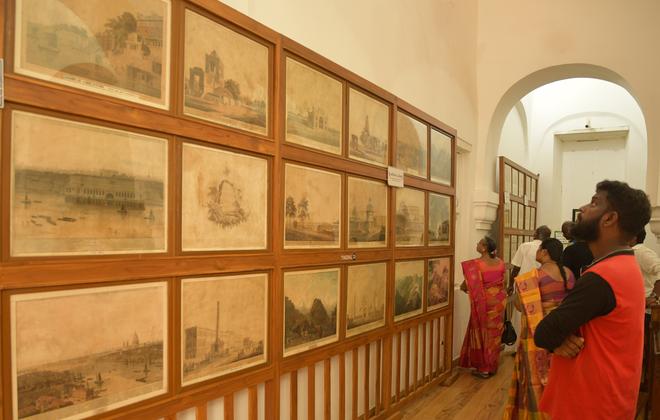
Tucked away inside the historic Thanjavur Palace, the Sarasvati Mahal Library is an enviable repository of palm leaf/ paper manuscripts and books in Tamil, Sanskrit, Marathi, Telugu, Hindi, English, French, German and Italian languages. It is regarded as one of the greatest Oriental manuscript libraries in the world and among the oldest libraries in Asia.
The manuscripts and books cover an array of subjects, including literature, mythology, folklore, philosophy, medicine, astronomy, music and much more.
Ancient palm leaf manuscripts and classics from the rare collections could soon be read on a computer screen as the library’s digitisation project is headed towards completion later this year.
Over the past few years, technicians with the help of language pandits have been busy capturing and preserving thousands of pages of ancient palm leaf/paper manuscripts and more than 100-year-old books from the collections of the library.
The mammoth task began in May 2015, and is set to culminate this year-end. More than 36,000 manuscripts and ancient books, running into a whopping 23,34,519 frames, have been digitised. Another 1.45 lakh frames, comprising mostly Sanskrit manuscripts, remain to be captured digitally and stored in hard disks.
“Except Sanskrit manuscripts, digitisation of all manuscripts, both palm leaf and paper, of other languages such as Tamil, Marathi and Telugu have been completed. The work was scheduled to be completed by October, but may suffer a slight time overrun. But we hope to complete by the end of this year,” says Dinesh Ponraj Oliver, District Collector and Director of the library. Some of the titles are also being stored as microfiche.
The digitisation would add a new facet to the historic library and help it keep up with the changing times. It is believed the collections of the Palace Library began in the 16th Century under the Nayak rulers of Thanjavur (1535–1675 CE) and expanded by the Marathas.
Although successive Maratha kings had maintained the library, Raja Serfoji II (1798-1832), a bibliophile, was chiefly responsible for shaping it. He is credited with having acquired several books and manuscripts. Today, it is a veritable treasure trove, with a collection of over 81,400 books and 47,500 palm leaf and paper manuscripts. The Rajah’s impressive personal collection of 4,530 books also forms part of the library.
The library, thrown open to the public in 1918, houses approximately 39,200 palm leaf and paper manuscripts in Sanskrit, 3,141 paper manuscripts in Marathi, 834 in Telugu, and about 4,300 Tamil palm leaf manuscripts. The scripts used in the palm leaves are Grantha, Devanagari, Nandinagari and a few in Telugu, Malayalam, Kannada and Odiya. The Tamil manuscripts include rare commentaries on the Sangam works, unpublished portions of classics, Saiva, Vaishnavaite and Jain works and medicinal works of exceptional value.
Language pandits continue to pore over the manuscripts to bring them out as printed books too. “The library has about 600 publications to its credit. We intend to bring out more,” says Mr. Oliver.
Efforts are also on to decipher and publish some of the interesting records among the Modi documents, which are old records of the Maratha kings covering over a century of history of Thanjavur. Modi is the shorthand version of Marathi. Found in 1,342 cloth bundles, the Modi documents are mostly court and administrative records. Today, there are just a handful of scholars who can read the text. A set of 27 bundles had been studied and published earlier.
At the preservation section, specially trained staff are busy smearing Citronella oil on the manuscripts to prevent them from breaking. The process is done at regular intervals of two to three years to keep the leaves flexible. The library uses an indigenous insect repellent — a powdered mixture made of sweet flag ( vasambu in Tamil), black cumin, bark of cinnamon, cloves and pepper. The mixture, tied in a cotton cloth with camphor, will act as insect repellents for three to six months. Besides, the well-lit and airy rooms of the palace are naturally conducive for preservation of the books, explains S.Sudarshan, Librarian, Sarasvati Mahal Library.
The museum of the library is a unique treasure trove, with exhibits of palm leaf and paper manuscripts, printed books, drawings, maps, paintings and art collections. Here, you will find one of the oldest manuscript, Phalavati — a glossary on the Purva Mimamsa Sutras of Sage Jaimini, which occupies an important place in the six systems of Indian philosophy.
A bundle of palm leaves containing 24,000 slokas of Valmiki Ramayana brings out the skill of the ancient scribes. Both sides of the leaves bear 30 lines in miniature Grantha letters, impossible to read with the naked eye. A pocket-sized manuscript of the Bhagavad Gita, the Rig Veda with illustrated title sheets and the Mahabharata manuscripts, the Citra Ramayana, the Gaja (elephant) and Asva (horse) sastrams and Charles Le Brun’s Human Physiognomy charts are among the exhibits.
In recent years, the library has added an audio-visual hall where a documentary on Thanjavur is being screened every day. “We screen seven shows a day, but the documentary has become so popular that often we run additional shows,” says Mr. Sudarshan.



.png?w=600)