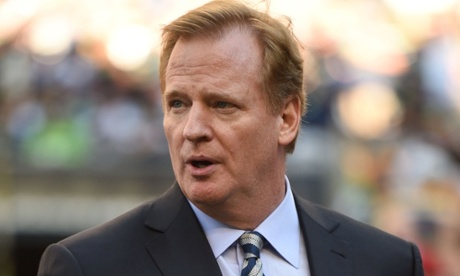
For Roger Goodell and his 32 cronies known as the NFL ownership, Robert Mueller’s report on the league’s response to the Ray Rice domestic violence case is cause for celebration. Mueller found “no evidence” that Goodell or anyone at the league saw in-elevator footage of Ray Rice punching his fiancé before TMZ released it, thereby refuting what ESPN’s Bill Simmons said and many believed – that Goodell was lying. But as Sports Illustrated deftly points out, Mueller’s assertion that the “League investigators did not contact any of the police officers who investigated the incident, the Atlantic County Prosecutor’s Office, or the Revel [casino] to attempt to obtain or view the in-elevator video or to obtain other information” as juxtaposed to Goodell’s September statement that “the league requested from law enforcement any and all information about the incident,” does indeed suggest some untruths.
After the report’s release, New York Giants owner John Mara, who along with Pittsburgh Steelers owner Art Rooney II selected Mueller to lead the investigation, stated, “It certainly wasn’t a case of willful ignorance.”
Therein lies Goodell’s problem both today and in the future. The disparity between what the league accepts as truth versus what many fans believe is only increasing in size and tension.
Mara’s words imply that ignorance will be tolerated by the owners, as long as that ignorance is unintentional (and as long as the ignorant one guides the NFL to nearly $10bn in annual revenue). To the commisioner’s many critics, those words alone can be read as an admission of incompetence, amplifying the widespread belief that Goodell should resign, or at the very least recuse himself from all disciplinary matters.
Even the report, so favorable to Goodell, criticized the league’s failure to gather sufficient evidence regarding the Rice case and its general reliance on law enforcement to frame information used to make important disciplinary decisions. But that’s just a small sliver of the cloud hanging over Goodell’s mountain of mismanagement.
What the report failed to address are the issues that resonate most. Why did Goodell turn a blind eye to domestic violence for so long? In framing the original two-game suspension, how could he claim that Rice was ambiguous with details, as if the commisioner was muzzled and unable to ask pointed questions during their meeting? Most importantly, how can Goodell be trusted to judge any disciplinary matter moving forward?
Those difficult questions were not the ones owners hired Mueller to investigate. But it’s not surprising, as the answers to those questions would have been harder to swallow.
The Count NOW (National Organization of Women) president, Terry O’Neill, is among those dissatisfied with Mueller’s line of questioning.
“Those were always the wrong questions, designed to protect Goodell from accountability for his failure to lead, and deflect the possibility of real and lasting change at the NFL,” she said in a statement.
O’Neill added, “If one of Robert Mueller’s FBI agents had turned in a report as incomplete as the Ray Rice investigation, that agent would have been transferred to Peoria.”
O’Neill has been one of the strongest voices calling on Goodell to resign, something she reiterated today. She’s certainly not alone, and the sentiment is not just a female one.
Goodell’s biggest problem moving forward is how vehemently disliked he was before this situation. The handling of Rice only adds to the view of many fans that Goodell is some combination of a) an obscenely overpaid warlord grossly out touch with the typical NFL fan, b) an imperialist willing to jeopardize player safety in the interest of more games at home and abroad, c) shockingly ambiguous, bordering on unethical, in his role as a disciplinarian, or d) just plain incompetent.
Some fans are happy to be buried in the on-field thrills of the NFL or the competitiveness of their fantasy team, shielded from the disaster that has occurred at the league office. But a growing faction is finding a commissioner that operates with such mixed messages when it comes to social issues, and ambiguity when it comes to discipline, that it takes away from their enjoyment of the game. For those fans who were looking forward to the Divisional playoff round this weekend, having pushed their views on Goodell to the back of their minds, this report couldn’t come at a worse time.
If Goodell cares about his image – and after the money is counted, I truly believe he does – a report rooted in conclusions of plausible deniability won’t cut it. Unfortunately for Goodell, he’s not a player like, say, Johnny Manziel who can alter a shattered image simply by winning football games.
If Goodell really wants to turn around public opinion, he needs to conjure up a bit of humanity, regain credibility with sincere initiatives designed to protect players, not exploit them, and most importantly, he absolutely must step down as the league’s primary disciplinarian.
Even that may not be enough.