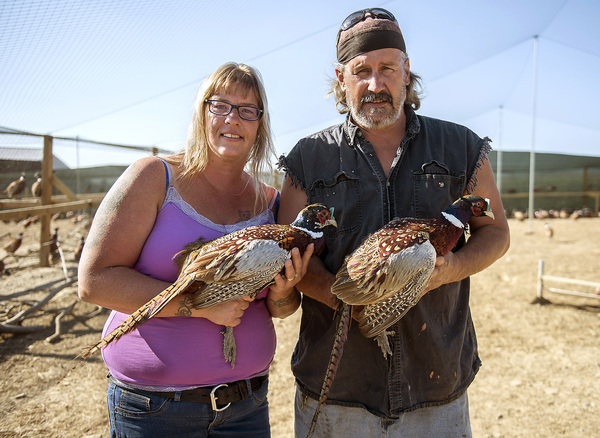
PITTSBURGH _ If you say that you run a cattle farm, people get the picture.
But when Cheryl Fallat says she's converted part of her Westmoreland County (Penn.) property into a ring-necked pheasant farm, "They don't know what to think," she said.
For decades, her father Harold Baker operated a commercial pheasant farm in the nearby village of Claridge, producing up to 5,000 birds per year. In poor health, he closed Baker's Pheasant Farm in 2011.
This year, Fallat and her husband Joe Fallat revived the family business on their rural property in Penn Township, just a few miles from Jeannette.
Fallat expects to sell a few mature pheasants for family dinners, but most of her birds will be purchased by sportsmen's clubs and released for private hunts before they make it to the dinner table.
"I just started this year taking over my father's business," Fallat said. "I worked with him on it when I was a little girl. My dad is my hero. He had a job, but his love and passion were for his pheasants. He took such good care of them, and I helped."
The pheasant is not indigenous to North America. Europeans trading with Black Sea traders learned to recognize the male's distinctive white-ringed neck and iridescent colors. Beautifully plumed, slightly bigger than a chicken and prone to flush, hunters began importing the perfect upland game bird from Southeast Asia to North America in the early 1700s. Pheasants were raised and stocked extensively by American wildlife agencies starting around the turn of the 20th century in programs funded through the sale of hunting licenses and excise taxes on hunting gear.
In many states, including Pennsylvania, the birds reproduced and thrived for decades. But by the 1980s, pheasants were in decline in many states. Despite many attempts, increased stocking could not re-establish naturally reproducing pheasant populations. In Pennsylvania, the stocking of as many as 425,200 birds in 1983 had dwindled to 100,000 in 2005.
The reason? "Habitat loss," said Bob Boyd, wildlife division chief for the state Game Commission. "And not just from (urban) sprawl. Farming techniques are much different now than they were a few decades ago. Land is extensively farmed now with very little edge growth or wasted seed. Look at a corn stubble field. There's nothing there."
"That's how we help," Fallat said. "Clubs are buying our birds so club members can hunt them. My dad sold to (gun clubs in) Trafford, Herminie ... all over. We're hoping to pick up some of the same customers."
To turn their property into a pheasant farm, the Fallats took out a $20,000 loan to pay for posts, electric fencing and ceiling netting for four 50-foot by 100-foot outdoor pens. The loan also was used for a watering system, shelving and heat lamps for 8-foot by 16-foot pens in their four-bay garage for an indoor rearing area, as well as for tons of feed. Some $3,000 paid for about 2,000 1-day-old peeps, purchased from the Game Commission.
The Fallats ordered eggs by February and picked up the peeps May 23.
"You wouldn't think it, they're so small, but they ate two tons of medicated feed in three weeks," Fallat said. "That's $1,600 from Agway."
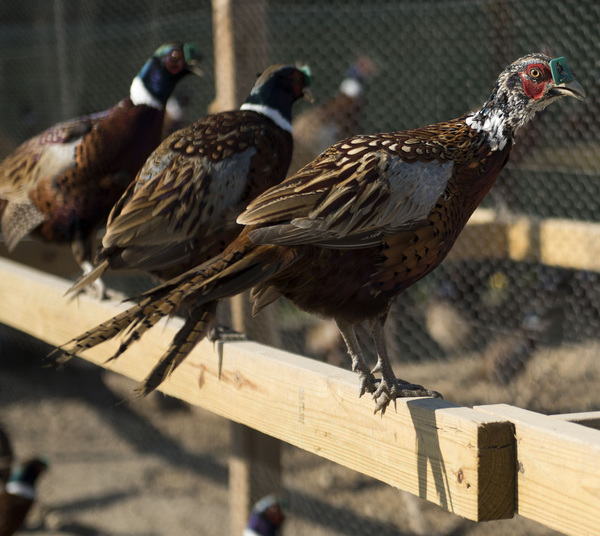
For their five-week birthday, the chicks got "sunglasses."
"People think they're so cute and sweet, but at five weeks, when we're about ready to put them outside, we have to prevent them from pecking," she said.
Like many birds, the ring-necked pheasant's evolutionary nest-survival model is brutal but effective. To provide more food for chicks with the better chance of survival, the stronger, healthier birds peck the weaklings to death.
"If one gets hurt or pecked, that one's a target. If one's bleeding, they'll peck that bird until it's dead. With 400 birds per pen, there are bullies _ ones that will chase the smaller birds," Fallat said.
"We have these little anti-peck things that look like sunglasses that keep them from seeing right in front of them so they won't peck."
Fallat said she knows her birds will not reproduce. They're stocked to be shot in a hunting culture that prefers the colorful roosters, and most pen-raised pheasants are male.
The Game Commission releases about 220,000 pheasants per year on public hunting grounds. Boyd said few people, like the Fallats, are in the pheasant farm business. Those that are must buy a propagator permit, agree to state-mandated standards for the birds' health and safety, and agree to sell the pheasants for use on public hunting grounds.