
Scientists know that Mars spins a little faster each year, but the cause has been a mystery. Now, a new study published Feb. 18 in the Journal of Geophysical Research: Planets suggests the reason may lie deep underground, where a huge plume of buoyant rock could be stirring beneath the Red Planet's crust.
This strange plume could help to explain not just Mars' quicker rotation but also how the planet holds on to geologic heat far longer than expected — forcing scientists to rethink how small, rocky worlds cool and die.
"The Martian surface is so old and shows all these complex but largely not well understood process[es], which I think we can start to unravel by combining interior with surface," Bart Root, an assistant professor of planetary exploration at the Delft University of Technology in the Netherlands and first author of the study, told Live Science in an email. "Understanding Mars will help in understanding our solar system, as its history is laid out on the red soil."
Looking under the surface
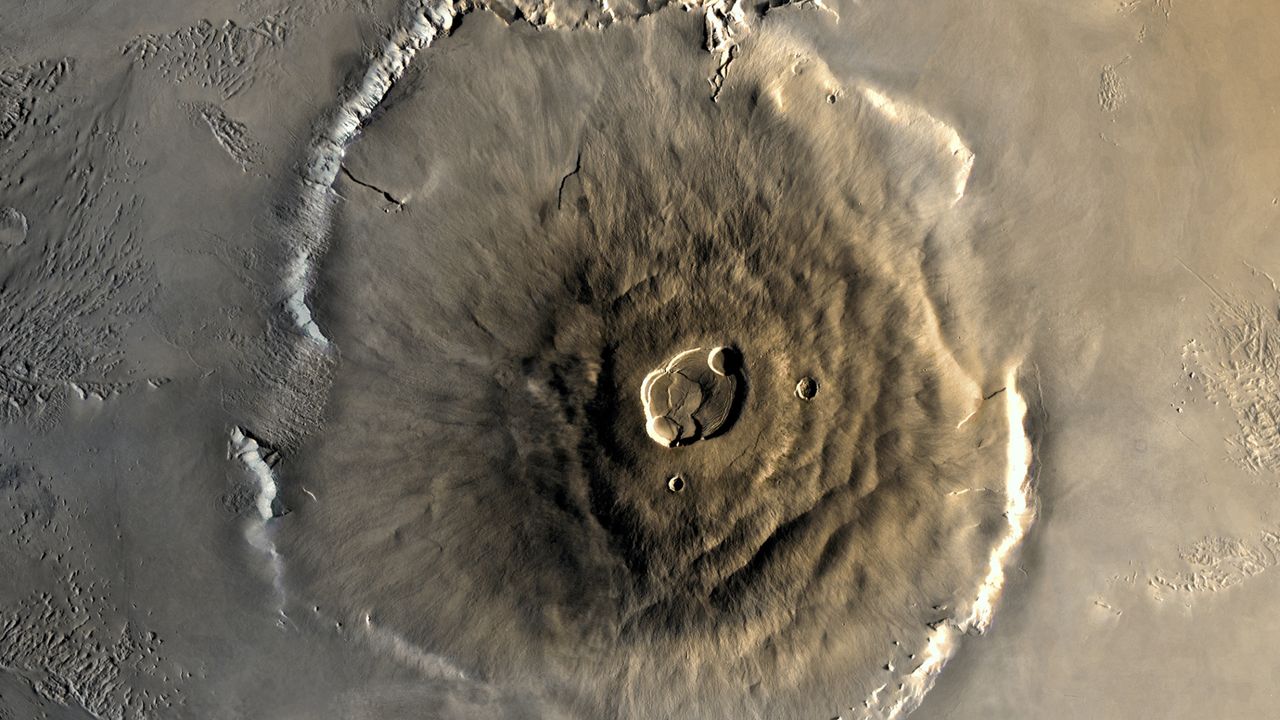
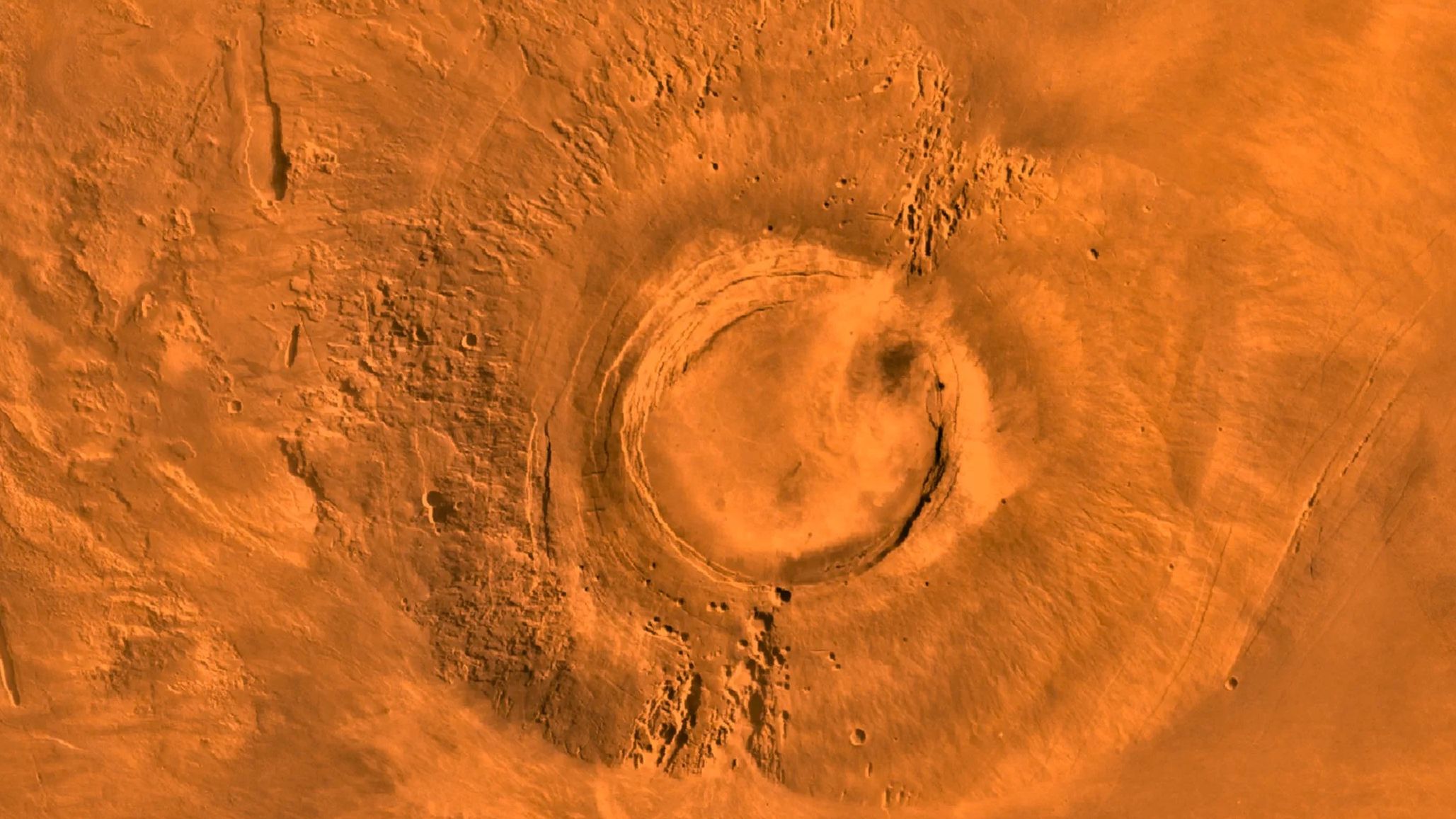
Mars has some of the largest volcanoes and mountains in the solar system. This is because, unlike Earth, Mars does not seem to have plate tectonics, the shifting crustal plates that drive much of our planet's volcanic activity. Instead, the lava from Mars' ancient active volcanoes just sits there, piling up and building far bigger structures over time. This resulted in the formation of the Tharsis volcanic province, a volcano-strewn region that stretches 3,700 miles (6,000 kilometers) across the planet's surface.
In 2018, NASA sent the InSight lander to the Red Planet to better understand the planet's interior, which, in turn, could help reveal more about its volcanoes. For years, the lander studied Mars' interior, giving scientists a direct estimate of the crust's thickness.
Using data from InSight, Root and the team ran computer simulations to test what kinds of structures could explain why the volcanic region has dominated one side of Mars. Those models pointed to a plume of unusually light material — called a "negative mass anomaly," or something less dense than the rock that surrounds it — in the mantle beneath the Tharsis region.
According to the researchers, this anomaly may explain how the Tharsis region became so large and full of volcanoes. It could also signal that fresh volcanic activity on Mars may be possible in the future.
"The negative or light mass anomaly will move upwards and hit the lithosphere of Mars, introducing melt pockets that have the potential to penetrate the crust and erupt as volcanoes," Root said. (The lithosphere is a single rigid outer shell approximately 310 miles (500 km) thick.
A solution to spin?
The researchers then asked whether that same hidden plume of material could also explain Mars' strange spin rate. Earlier measurements comparing data from the Viking landers, which explored Mars in the 1970s, with data from InSight showed that Mars' day is shrinking by roughly 70 microseconds per year. That means the planet is rotating slightly faster over time.
Root and his team used their simulations to calculate whether this less-dense material underneath Tharsis could shift mass inside Mars enough to influence the planet's spin.
"With some simple back-on-the-envelope calculations, we can explain the order of magnitude of the observed speed up," Root said. "Of course more complicated modeling will be needed to actually link this better."
Root compared this process to someone spinning in a desk chair while holding heavy books. If the books are pulled inward, the spin speeds up. Mars may be doing something similar with this less-dense material.
"A negative mass flowing upwards means something heavier needs to go down, and because the mass anomaly is located on the equator of Mars, this means the heavier mass is going closer to [the] rotation axis, hence a speed up," Root said.
Besides being a possible solution to some of Mars' biggest mysteries, these models could help scientists better understand how rocky planets cool and eventually die. Mars is much smaller than Earth, so researchers have long assumed it lost its internal heat relatively quickly. But if the Red Planet still has enough energy to drive deep mantle motion, that suggests smaller worlds may stay active longer than expected.
"I would love to show that Mars is more interesting than was assumed," Root said.
Editor's note: This article was updated on Mar. 25 to make clear there isn't currently an active volcano on Mars, as a previous headline suggested. The new discovery hints that fresh volcanic eruptions may be possible in the future, and that Mars is not volcanically dead after all.