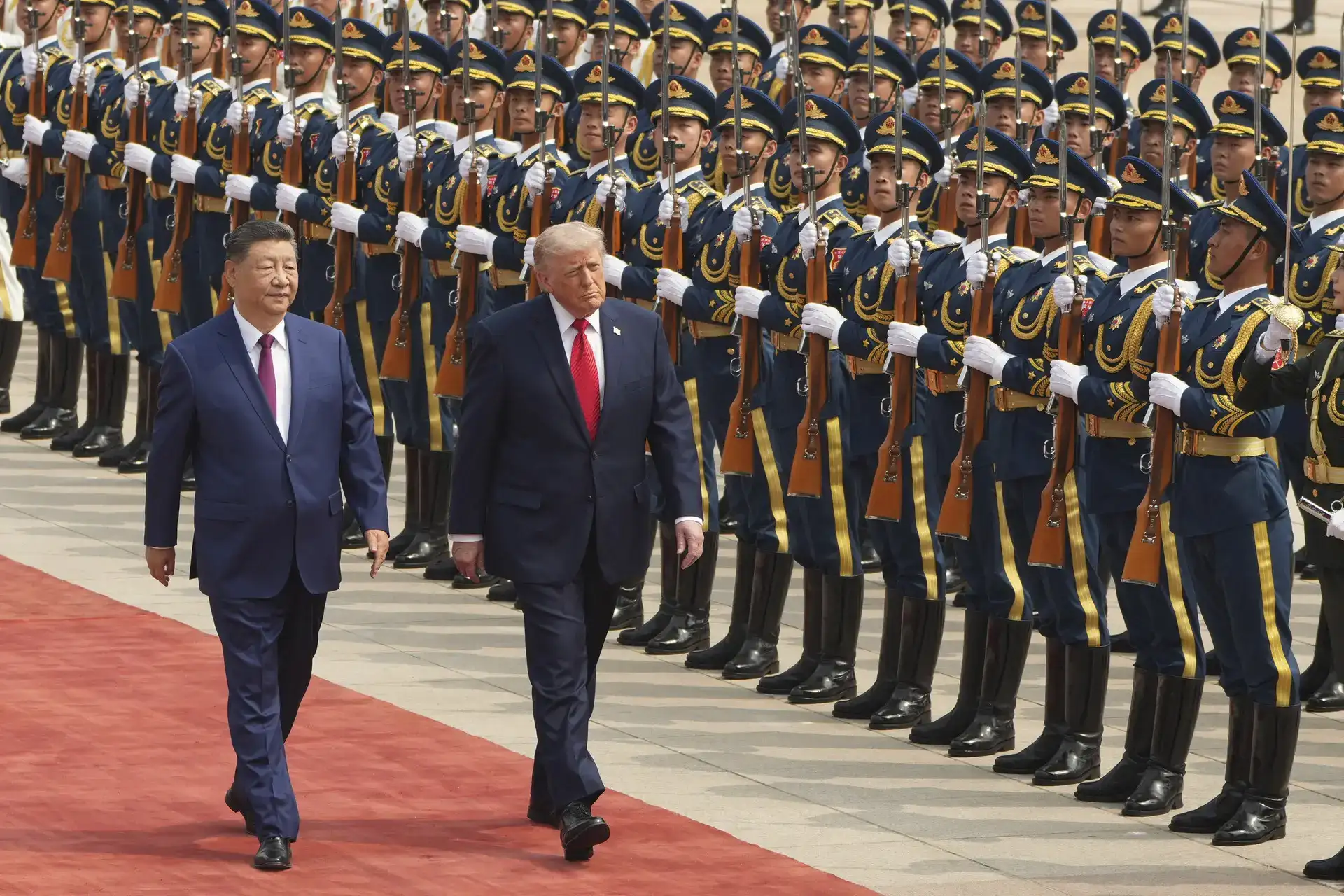
Nuclear weapons as a topic are unlikely to come up at length in this week’s summit between the presidents of the United States and China. Relative to other matters, the subject seems less urgent. And yet it is the most existential, which is why it must get onto the agenda if and when Donald Trump and Xi Jinping meet again later this year, as they intend.
The list of likely talking points includes controversies about microchips going one way and soybeans the other; hype about “boards” of trade and investment; hotspots in Taiwan and Iran; artificial intelligence and of course deals, deals, deals. All important in their own ways, but really no more than icebreakers next to atomic weapons.
ALSO READ | US, China will have 'a fantastic future together', Trump tells Xi at Beijing meeting
Think back to February 6. That was the day after the expiry of New START, the last remaining arms-control treaty between the US and Russia. It was also when Thomas DiNanno, the US Undersecretary for Arms Control and International Security, detonated a diplomatic bomb at a disarmament conference in Geneva.
One of the most frightening perils of our time, DiNanno began, was the rapid growth of China’s nuclear arsenal and its opaque, and fast-changing, doctrines for the use of such weapons. China is estimated to have 600 warheads already and is projected to get 1,000 by 2030 and then to keep building until it reaches parity with the US and Russia. (The United States has about 3,700 warheads in total, of which some 1,770 are “deployed,” meaning ready for immediate use. Russia has more, but about the same number deployed.) China is also innovating with newfangled delivery vehicles that could evade American missile defenses.
DiNanno then made this accusation: “I can reveal that the US Government is aware that China has conducted nuclear explosive tests, including preparing for tests with designated yields in the hundreds of tons.” To hide the blasts from international monitors, he added, China used a method called “decoupling,” in which explosions are shielded by thick steel walls to minimize their seismic waves.
The US has presented no smoking-gun evidence of these tests, and China indignantly denies them. And yet these secret blasts, if they occurred, are the context in which Trump last year stunned the world by announcing that the US might return to nuclear testing “on an equal basis” with China and Russia. That would mark the end of a long moratorium on atomic testing among the great powers, and the de facto collapse of the Comprehensive Nuclear-Test-Ban Treaty (which the US, Russia and China signed but haven’t ratified).
China’s alleged tests, like the overall expansion of its atomic arsenal, show the hypocrisy of Beijing’s official nuclear stance, argues Diya Ashtakala at the Center for Strategic and International Studies.
At fora such as the review conference of the Treaty on the Non-Proliferation of Nuclear Weapons, which is going on right now at the United Nations in New York, China tries to impress the Global South by publicly supporting the moratorium and disarmament, presenting itself as the most responsible of the great nuclear powers. “Its actions tell a different story,” says Ashtakala. They include not only the tests but also the new categories of weapons and China’s refusal to engage in trilateral disarmament talks with the US and Russia, which Trump has repeatedly called for.
The reality is that China under Xi has abandoned its old nuclear posture, which was deliberately non-threatening, and become provocative, as several new books make clear. For several decades after China joined the nuclear club in 1964, Mao Zedong and his successors deliberately maintained only a “minimum deterrent” of warheads. China also adopted a policy of “no first use,” which is officially still on the books.
In recent years, though, both the size and variety of its arsenal have grown, with more low-yield or “tactical” warheads that could be used, for example, against American bases in Asia during an escalating conflict over Taiwan. In effect, China’s new policy resembles America’s during the Cold War, with an emphasis on flexible options during a war against the US or other adversaries, as well as “launch on warning,” meaning retaliation at the first sign of any incoming attack (even if it’s a false alarm). The objective seems to be not only deterrence but also escalation dominance against the US.
That has naturally raised the alarm in Washington, especially since China is a partner of Russia and North Korea, and US strategists must at least contemplate scenarios in which those three nuclear adversaries gang up. Should America, which is modernizing its nuclear triad, also increase the size of its arsenal to match the total of its adversaries? The answer is not obviously yes. But the odds are getting shorter of a new arms race among the great powers even as more countries consider testing and building their own nukes.
For the US, China and the world, this reality means that nuclear instability and the risk of atomic holocaust, which after the Cold War seemed to be remote, are again rising. Trump has often said that he’s aware of the danger and wants to talk about it. Xi, as yet, doesn’t seem ready. As Air Force one lifts off in Beijing this week, judge this first summit of 2026 by the prospects it leaves that the two leaders will broach the biggest topic when they meet again.
(The views expressed in this article are those of the author and do not necessarily reflect the views of the publication.)