When Australia first tried to get to the Women’s World Cup, they finished the qualification campaign with an average winning margin of seven goals. They conceded just once along the way, resulting in their only loss. Thankfully, competition has improved since then.
It was May 1991, and Australia, New Zealand and Papua New Guinea met in Sydney for a round-robin tournament. The first-ever women’s cup was on the horizon, and this six-game competition would determine who Oceania would send to Guangdong, China.
In the opening match, the Kiwis put 16 past the team from PNG, and there was really no catching them from there. PNG improved throughout the tournament, and by the time they faced Australia in the final qualifier, they held the home side to just eight goals. Twice that many were needed, and so it was that New Zealand qualified through superior goal difference.
The same teams reconvened in PNG a few years later to decide Oceania’s representation at Sweden 1995. Australia’s goal difference was sliced almost in half, thanks to PNG’s continued improvements, but it was enough to get them through.
Like New Zealand before them, the Matildas did not pick up a point – though this time, they were the only team not to do so. They were thumped in all three games, starting with a 5-0 defeat at the hands of Denmark. It would, however, be many years before they were held goalless again.
The 1999 tournament, this one held in the US, saw the Matildas pick up Oceania’s first point at the World Cup. It came in a draw against Ghana, which sent the Africans to the bottom of the table and the Matildas up to third. For the first time, the confederation also had a multiple goal scorer, Julie Murray, who netted against both Sweden and Ghana.
The Sars outbreak in host-country China meant the tournament headed back to the US four years later, and it was déjà vu for the Australians. Once again they were up against China and Ghana in Group D (Matildas fact: they have never been in a group other than C or D). And once again, they picked up a point and had a multiple goal scorer – this time, a young Heather Garriock.
They were baby steps, but the Matildas were slowly improving and things really started to get better with Australia’s move to the Asian confederation (just as with the men). The tournament made its return to China, and the Matildas, now playing on “home” soil, secured their first World Cup win.
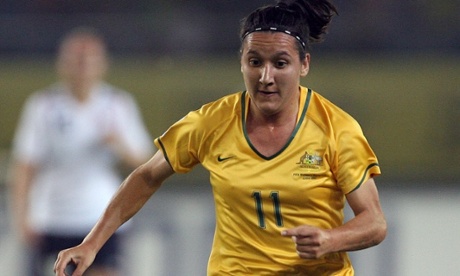
It was a 4-1 thrashing of old enemy Ghana, inspired by a brace from 23-year-old half-time substitute Lisa De Vanna. Draws against Norway and Canada followed, meaning the Matildas were not just undefeated for the first time, but were also through to the knockout stages.
Their opponent in the quarter-finals was a Brazil side featuring Marta – a five-times world player of the year at the peak of her powers. The Matildas chased down a two-goal deficit, through De Vanna and Lauren Colthorpe, but were sunk by a late goal to Cristiane.
De Vanna ended the tournament with four goals to her name. It was a tally only bettered by players in four top teams, and is twice as many as any Australian – male or female – has ever scored at a single World Cup. It has taken Tim Cahill three tournaments to reach a tally of five.
New Zealand, still representing Oceania, finished bottom of their group without scoring a goal. They would manage four goals and a draw against Mexico next time around.
The Matildas took out their first continental title in 2010, but the newly-crowned queens of Asia got off to a shaky start at Germany 2011. Their 1-0 defeat to Brazil was the first time they been held goalless in a World Cup match since that debut outing in 1995. They responded with victories over Equatorial Guinea and then, through a Kyah Simon brace, over Norway.
For the first time, they had two wins at a World Cup. They finished second in the group, putting them through to the knockout stages again. Though outclassed in Augsburg by Sweden, the game did feature the only World Cup goal ever scored by an international cricketer – Ellyse Perry.
The Australian side was the second youngest at the tournament. The team included 16-year-old Caitlin Foord, the winger-cum-full-back who would take out the young player of the tournament award. Elise Kellond-Knight, aged 21, was also named in the team of the tournament, an honour bestowed on De Vanna four years prior.
Perry isn’t in this tournament’s squad, but Foord, Kellond-Knight and De Vanna are. They are joined by 10 World Cup debutants, the youngest being the 19-year-old Larissa Crummer. And the oldest member of the squad? That’s 35-year-old goalkeeper, Melissa Hudson. She is taking part in her fourth World Cup, though no longer wearing number one – or the name Barbieri – on her back. That jersey goes to Lydia Williams, who like De Vanna and Clare Polkinghorne, will be at her third cup.
The story of Australia’s performances is not a grand narrative, but a tale of gradual improvement. Should the trend line continue its trajectory this month in Canada, the Matildas might win their first knock-out match. Or even make the semi-finals.